
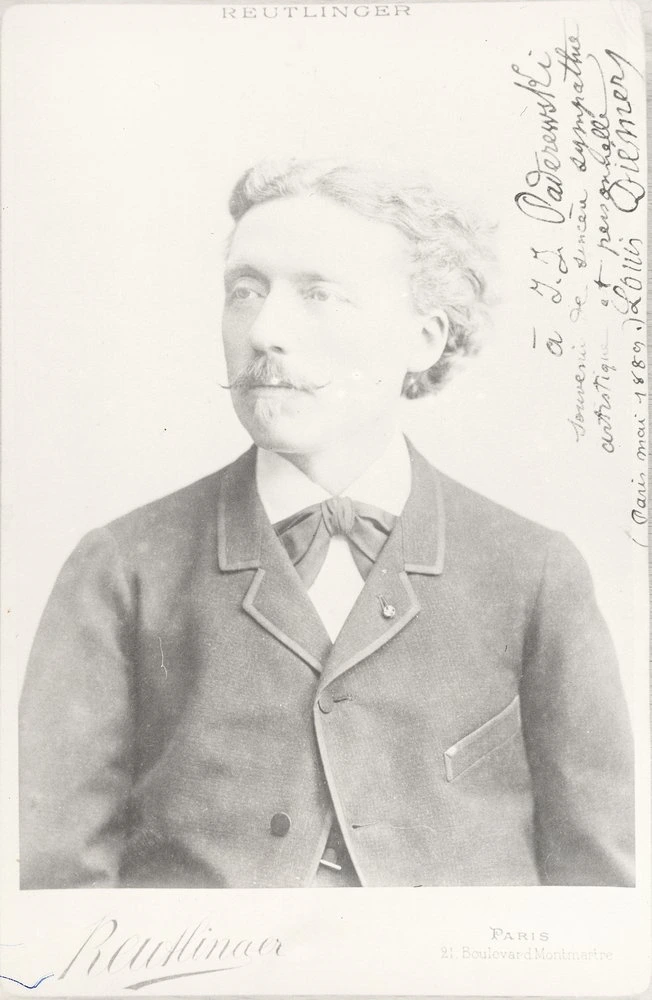
[Portret Louisa-Josepha Diémera z dedykacją]

Diémer Louis-Joseph, *14 February 1843 Paris, †21 December 1919 Paris, French pianist, composer, and teacher. In 1853–61 he studied at the Paris Conservatory under A.F. Marmontel (piano), A. Thomas (composition), F. Benoist (organ), and F. Bazin (harmony), earning several prizes. Plagued by financial difficulties, he abandoned his attempts for the Prix de Rome and for some time gave piano lessons in Paris. In 1863 he began concertizing throughout France, also as a chamber musician, notably with P. Sarasate, gaining great popularity and recognition in musical circles (he enjoyed a close friendship with the aging Rossini). In 1887 he succeeded A.F. Marmontel as professor of piano at the Paris Conservatory. A series of harpsichord recitals he gave for the 1889 Paris World Exhibition became a landmark success in Diémer’s career, prompting him to found the Société des Instruments Anciens that same year and to continue editorial work on publishing French harpsichord works; he also edited numerous compositions by later masters. He remained active in both performance and teaching until the end of his life. In 1902 Diémer established a triennial piano competition for first-prize winners of the Conservatory’s piano classes. He was a Knight of the Legion of Honor (1889).
Both Diémer’s pianistic and editorial activities reflected his characteristic discipline and musical erudition. His playing was noted for precision and scrupulous attention to the musical text, countering the distorted performance practices common at the time and preserving stylistic authenticity in the works presented. His editorial efforts, aimed at reviving French early music and familiarizing pianists with the classical repertoire, also demonstrated his role as a teacher, in which he achieved considerable success as a founder of the French piano school (among his students were A. Cortot, E. Risler, R. Casadesus, and A. Casella). Diémer’s compositions achieved limited success, apart from some songs.
Compositions:
Piano Concerto in C minor Op. 32
Konzertstück for piano and orchestra Op. 31
Konzertstück for violin and orchestra, Op. 33
2 piano trios
Sonata for violin and piano, 1874
Sonata for cello and piano
Légende for oboe and piano
Sonata for piano
7 Orientales for piano
waltzes, preludes, impromptus, nocturnes, caprices for piano
vocal duets
numerous piano transcriptions of symphonic and operatic works by Haydn, Mozart, and Beethoven
publications:
École classique concertante with D. Alard and A. Franchomme, Paris 1868 (contains all piano trios by Haydn, Mozart and Beethoven)
Les clavecinistes français du XVIIIe siècle, Paris 1887–1912 (contains 80 works by Lully, Couperin, Rameau, Daquin and others)
additionally, numerous editions and arrangements of piano sonatas by Mozart, Beethoven, Weber, as well as many works by Chopin
Writings:
Méthode supérieure de piano, with L. Lévy and V. Staub, Paris 1907