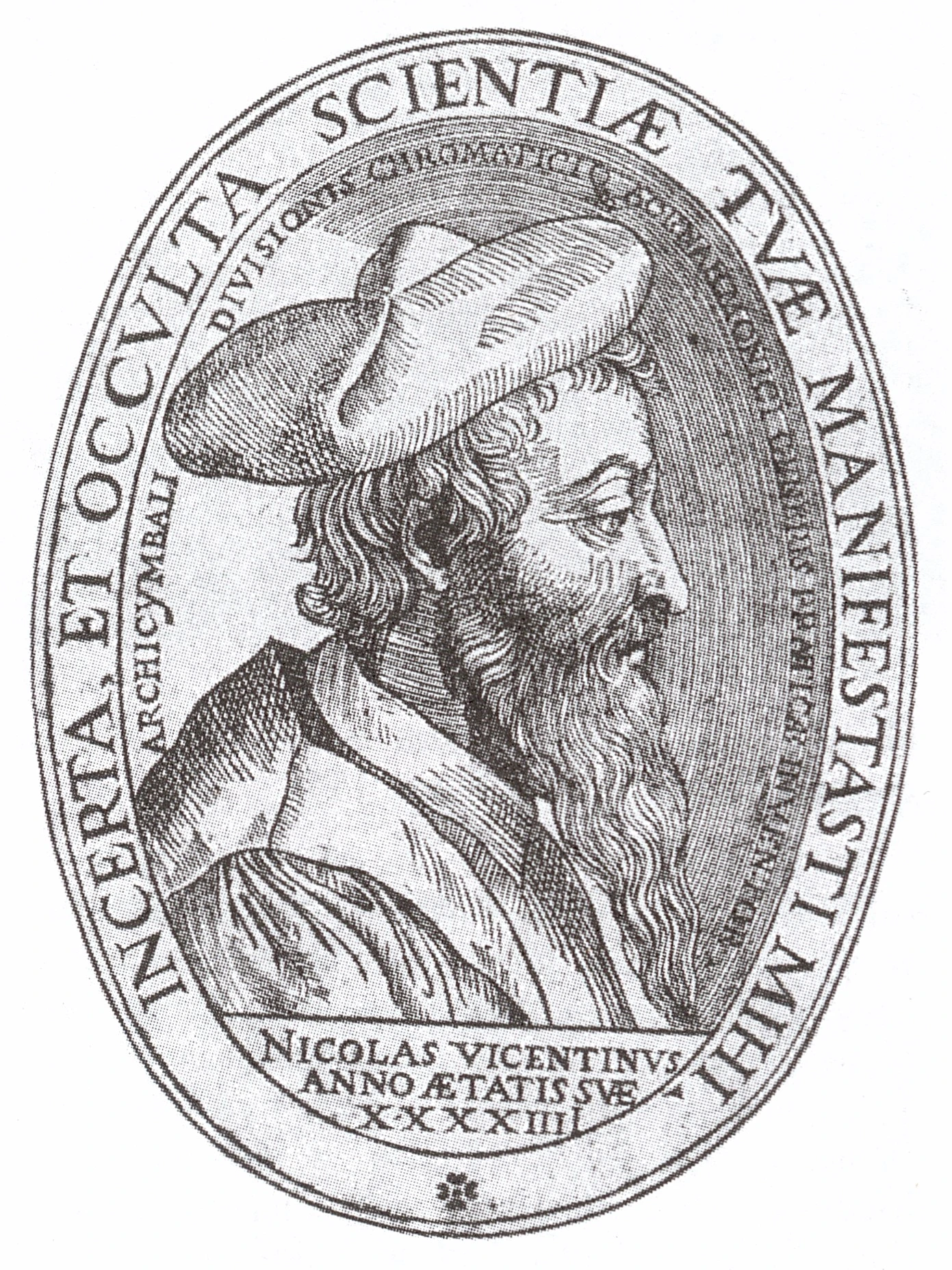
Vicentino, dei Vicentini, Nicola, *1511 Vicenza, †ca. 1576 Milan, Italian theoretician and composer, clergyman. On the title page of a print from 1546, he calls himself a pupil of A. Willaert, who he may have been in the 1530s. Employed by Cardinal Hippolyte d’Este, he stayed with him in Rome in the autumn of 1549. In June 1551, he faced V. Lusitan in a debate on Greek genera, resolved by G. Danckerts and B. Escobedo in his adversary’s favour. In the 1550s, he accompanied his patron during his stay in Siena, several times in Rome, and in 1560 in Ferrara. In 1561–63, he probably travelled with a group of singers throughout the cities of northern Italy, propagating his innovative musical ideas; then, until January 1565, he served as maestro di cappella of the cathedral in Vicenza. From 1565, he lived in Milan, where his music attracted the attention of, among others, C. Borromeo (he planned to commission a chromatic mass from Vicentino) and where he died during one of the epidemics that struck northern Italy in 1575–76.
Vicentino’s goal in writing L’antica musica was to “extract ancient musical practice from its darkest shadows and, as if through a new birth, restore its splendour.” The treatise opens with an introductory book, a synthetic treatment of the foundations of music theory, based primarily on Boethius’s De institutione musica and covering topics such as the study of intervals, tetrachords, the eight modes, and the three genera. The main body of the treatise consists of five books devoted to musical practice. In the first four, Vicentino writes about the basics of composition, counterpoint, various compositional techniques (canon, double counterpoint), musical notation, rules for correctly combining words with music, and methods of musically conveying the emotions contained in the text. In the last book, he describes the structure and two types of tuning of the archicembalo he constructed, enabling playing in the enharmonic genus. The most innovative part of the treatise consists of remarks related to the relationship between words and music. According to Vicentino, the musical arrangement should closely follow the linguistic layer of the work. This applies to phonetic qualities (respecting the duration, tonic accent, and key – which should fall on a strong beat), syntactic qualities (musical elimination of enjambments), and semantic qualities (emphasising the content of the lyrics and the theme of the piece through the metro-rhythmic structure, the direction of the melodic line, and even the choice of intervals, to which Vicentino was one of the first to attribute a specific affective nature). Vicentino also recommended that singers utilise the art of oratory, which was achieved by, among other things, performing pieces from memory.
Vicentino’s attempt to create rules for composing in the three ancient genres was original. According to him, the pure diatonic style was characterised by the absence of minor and major thirds in the melodic line, which he treated as simple intervals, proper to the chromatic and enharmonic genres, respectively. Consequently, Vicentino viewed the music of his contemporaries as an example of the blending of different genera, which, in his opinion, was one of the reasons why it did not possess the same impact as ancient art. The compositional examples included in the treatise are works in both pure and mixed genres. The most interesting of these is the ode Musica prisca caput, whose three sections are successively in the diatonic, chromatic, and enharmonic genres, chosen to illustrate the text (for example, the “hard” diatonic style on the words “musica prisca” – “ancient music”). In works employing the enharmonic genus, dieses appear in the melodic line (quarter tones marked in notation with a dot above the note), while the contrapuntal relationships between voices are conventional. The madrigals and motets from Vicentino’s surviving collections are traditional in style and are characterised by, among other things, a careful musical interpretation of the text, achieved primarily through tonal means. La bella, based on a work by a little-known composer (P. de Villiers), is an interesting example of the changes in the way French chansons are paraphrased.
Literature: H.W. Kaufmann The Life and Works of Niola Vicentino (1511–c. 1576), Rome «Musicological Studies and Documents» XI, 1966; D. Harran Vicentino and his Rules of Text Underlay, “The Musical Quarterly” LIX, 1973; M.R. Maniates Vicentino’s „Incerta et occulta scientia” Reexamined, “Journal of the American Musicological Society” XXVIII, 1975; V. Rippe Nicola Vicentino – sein Tonsystem und seine Instrumente, “Die Musikforschung” XXXIV, 1981; F. Sumner The „Stylized canzone”, in: Essays on the Music of J.S. Bach and Others Divers Subjects, commemorative book of G. Herz, ed. R. Weaver, Louisville (Kentucky) 1981; M.R. Maniates What’s in a Word? Lnterpreting Vicentino’s Text, in: Music and Civilization, commemorative book of P.H. Lang, ed. E. Strainchamps and others, New York 1984; M.R. Maniates Bottrigari versus Sigonio. On Vicentino and His Ancient Music Adapted to Modern Practice, in: Musical Humanism and its Legacy, commemorative book of C.V. Paliski, ed. N.K. Baker and B.R. Hanning, New York 1992; D. Collins Fugue, Canon, and Double Counterpoint in Nicola Vicentino’s „L’antica musica”, in: Music and the Church, ed. G. Gillen and H. White, «Irish Musical Studies» II, Dublin 1993; R.J. Wieczorek „Ut cantus consonet verbis”. Związki muzyki ze słowem we włoskiej refleksji muzycznej XVI wieku, Poznań 1995; M.R. Maniates Nicola Vicentino and the Ancient Greek Genera, commemorative book of W. Wióra, ed. Ch.-H. Mahling and R. Seiberts, Tutzing 1997; P. Niedermüller La musica cromatica ridotta alla pratica vicentiniana. Genus, Kontrapunkt und musikalische Temperatur bei Nicola Vicentino, “Neues Musikwissenschaftliches Jahrbuch” VI, 1997; D. Daolmi Don Nicola Vicentino Arcimusico in Milano. Il beneficio ecclesiastico quale risorsa economica prima e dopo il Concilio di Trento: Un caso emblematico, Lucca 1999; Muzyka we Włoszech, cz. 2: Technika polichóralna, «Historia Muzyki XVII w.», ed. Z.M. Szweykowski, Kraków 2000; T.R. McKinney Point/Counterpoint. Vicentino’s Musical Rebuttal to Lusitano, “Early Music” XXXIII, 2005; T. McKinney A Rule Made to Be Broken: on Zarlino, Vicentino, Willaert and Parallel Congruent Imperfect Consonances, “Early Music” XLII, 2, 2014; T. McKinney Adrian Willaert and the Theory of Interval Affect: The Musica nova Madrigals and the Novel Theories of Zarlino and Vicentino, Farnham 2010; M. Kirnbauer “Vieltönigkeit” instead of Microtonality: The Theory and Practice of Sixteenth- and Seventeenth-Century “Microtonal” Music, in: Experimental Affinities in Music, ed. P. de Assis, Leuven 2015; M. Privitera, E. Sciarra Nicola Vicentino: L’antica musica ridotta alla moderna prattica, in: Musico perfetto. Gioseffo Zarlino (1517–1590). La teoria musicale a stampa nel cincquecento, ed. L. Zanoncelli, Udine [2018]; M. Kirnbauer „Sonare & cantare le pronuntie delle passioni delle parole”: Annäherungen an Nicola Vicentinos arciorgano, in: „Basler Beiträge zur historischen Musikpraxis” XLI, 2021.
Editions:
Nicola Vicentino Opera omnia, H.W. Kaufmann, «Corpus Mensurabilis Musicae» XXVI, 1963
L’antica musica, facsimile ed. E.E. Lowinsky, «Documenta Musicologica» series I Kassel, «Druckschriften-Facsimiles» XVII, Kassel 1959, English transl. M.R. Maniates Ancient Music Adapted to Modern Practice, C.V. Palisca, New Haven 1996
Descrizione, H.W. Kaufmann in: Vicentino’s Arciorgano. An Annotated Translation, “Journal of Music Theory” V, 1961
Compositions:
with Latin text:
Moteta (…) liber quartus, 15 pieces for five voices (only the 5th vox preserved and cantus, alto and bass of two pieces in a manuscript from Modena), Milan 1571
two pieces for six voices, manuscript: one in Regensburg (incomplete) and one (Heu mihi Domine) added in print Magnificat octo tonorum Orlanda di Lasso, Nuremberg 1567) in Wrocław, University Library
with Italian text:
Madrigali a cinąue voci…, book 1, 19 pieces, including eight in two or three parts and one dialogo for seven voices, Venice 1546; book 5, 12 pieces, including five in two parts, Milan 1572
one incomplete piece, manuscript Venice
one piece for six voices, published in a collective print from 1572
instrumental:
La bella. Canzone da sonare in the book of five madrigals
Works:
L’antica musica ridotta alla moderna prattica, Rome 1555, 2nd ed. 1557 (includes two motets for four voices and one motet for five voices, fragments of three madrigals for four voices and a piece without text for four voices)
Descrizione dell’arciorgano, Venice 1561