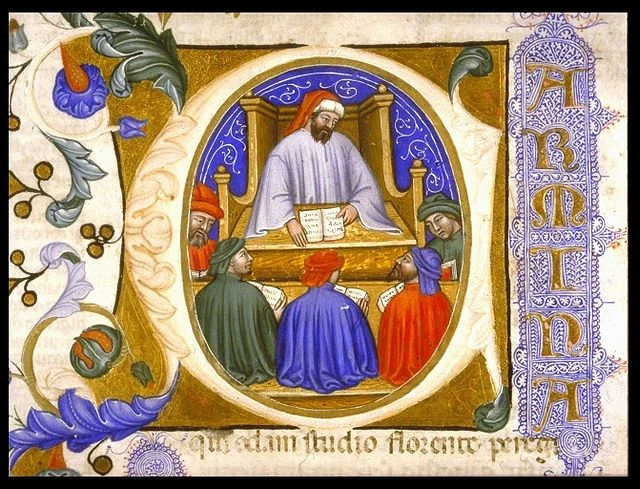
Boecjusz, Boetius Anicius Manlius Severinus, *ok. 480 Rzym, †23 X 524 Calvenzano (?) k. Mediolanu, rzymski polityk, filozof, matematyk i teoretyk muzyki. Spokrewniony był ze szlacheckim rodem Anicjuszów, z którego pochodziło dwóch cesarzy (Petroniusz Maksimus i Olibriusz) i dwóch papieży (Feliks III i Grzegorz Wielki). Ojciec Boecjusza był konsulem w 487. Po śmierci ojca wychowywał się i pobierał nauki w domu patrycjusza rzymskiego, Kwintusa Aureliusa Memmiusa Symmachusa. Poślubił jego córkę.
Za wzorem ojca Boecjusz poświęcił się karierze politycznej i działał na dworze cesarza Teodoryka, gdzie zyskał uznanie również jako muzyk; w 510 został konsulem, w 522 objął urząd magistra officiorum. Pod koniec 522 lub na początku 523 Boecjusz był zamieszany w proces senatora Albinusa. Oskarżony o współudział w spisku przeciw Teodorykowi, został skazany na wygnanie i śmierć. Razem z nim zginął Symmachus. Przebywał prawdopodobnie w więzieniu w Ticinum (obecnie Pawia), a następnie w Calvenzano k. Mediolanu. Z tego okresu pochodzi jego najsłynniejsze dzieło, De consolatione philosophiae (‘o pocieszeniu, jakie niesie filozofia’).
Boecjusz jest autorem pism z zakresu arytmetyki, geometrii, astronomii, logiki, teologii i filozofii. Muzyce poświęcił traktat De institutione musica libri V (‘o podstawach muzyki pięć ksiąg’). Traktat ten, podobnie jak De institutione arithmetica libri II (‘o podstawach arytmetyki dwie księgi’) należy do cyklu jego dzieł z zakresu quadrivium (pojęcie stworzone przez Boecjusza), z których dwa pozostałe, dotyczące astronomii (oparte na poglądach Ptolemeusza) i geometrii (oparte na poglądach Euklidesa), zaginęły (autorstwo zachowanych fragmentów traktatu geometrycznego budzi wątpliwości). Czas powstania tych dzieł określa się na lata 500–507.
W traktacie De institutione musica Boecjusz omówił problemy harmoniczno-akustyczne. Dyspozycja traktatu prawdopodobnie została podyktowana względami dydaktycznymi: księga 1 zawiera uwagi na temat etycznej i terapeutycznej funkcji muzyki, rozważania na temat klasyfikacji muzyki i pojęcia „musicus” oraz elementarne problemy akustyki oraz teorii konsonansu; w księdze 2 i 3 znajdują się obliczenia arytmetyczne dotyczące proporcji interwałów, a także omówienie poglądów dwóch głównych greckich szkół teoretycznych, pitagorejczyków i zwolenników Arystoksenosa; księga 4 traktuje o podziale monochordu, ważniejszych konsonansach i notacji; księga 5 (niezachowana w całości) przedstawia problemy harmoniki w ujęciu Ptolemeusza. Kwestia źródeł, z których czerpał Boecjusz, nie została ostatecznie zbadana, aczkolwiek przypuszcza się, że opierał się na zaginionym podręczniku Nikomachosa z Gerazy. Sam autor wymienia Platona, Arystotelesa, Albinusa, cytuje Nikomachosa z Gerazy, Archytasa, Filolaosa i Ptolemeusza. W swych poglądach Boecjusz nawiązywał głównie do koncepcji pitagorejskich, krytycznie natomiast odnosił się do szkoły Arystoksenosa. Był zwolennikiem wyższości poznania intelektualnego nad empirycznym; doświadczenie słuchowe traktował jako pierwszy etap poznania, którego wyniki muszą być weryfikowane przez umysł. Muzykiem, jego zdaniem, był tylko ten, kto wiedzę muzyczną opierał na przesłankach racjonalnych; nie był nim ani kompozytor, kierujący się według Boecjusza tylko instynktem, ani instrumentalista, który spełniał jedynie rolę narzędzia. Muzyka w ujęciu Boecjusza była wiedzą matematyczną, związaną jednak nie tylko ze spekulacją, ale i z moralnością. Twierdził za Platonem, że muzyka wiąże się ściśle z duszą świata (anima mundi), oddziałuje na charakter człowieka i obyczaje w państwie. Uważał, podobnie jak Platon, że należy uprawiać jedynie muzykę prostą: różnorodność, złożoność i przemieszanie gatunków pozbawiają muzykę powagi, a tym samym mają negatywny wpływ na charakter człowieka. Z koncepcji neopitagorejskich i neoplatońskich wywodzi się sformułowany przez Boecjusza podział muzyki na musica mundana, humana i musica in quibusdam instrumentis. Harmonię sfer uważał Boecjusz za zjawisko realnie brzmiące, jednak nieuchwytne zmysłowo.
W duchu pitagorejskim utrzymane są również poglądy Boecjusza dotyczące akustyki. Dźwięk pojmował on, podobnie jak Nikomachos z Gerazy, jako zjawisko powstałe w wyniku wielokrotnych uderzeń powietrza, które dociera do słuchu jako jednolita całość. Dostrzegał zależność pomiędzy częstotliwością owych uderzeń (drgań) a wysokością dźwięku. Rozróżniał dźwięki o wysokości określonej (sonus incontinuus) i nieokreślonej (sonus continuus). Interwał definiował jako różnicę pomiędzy dźwiękiem wysokim a niskim. Konsonans pojmował w aspekcie empirycznym jako połączenie dźwięku wysokiego i niskiego, które dociera do ucha w sposób miły i jednorodny. Za ostateczne kryterium konsonansu Boecjusz uważał proporcję liczbową: konsonans tworzą proporcje multiplices “xn : n” i superparticulares “(n+1) : n”. Idąc za przykładem pitagorejczyków, do konsonansów zaliczał oktawę, duodecymę, podwójną oktawę, kwintę i kwartę. Nie uważał za konsonans undecymy, którą dopuszczał Ptolemeusz, ani potrójnej oktawy. Dalsze interwały (ditonus – tercja wielka, semiditonus – tercja mała, apotome – półton większy, limma – półton mniejszy składający się z 2 diesis określał wzorem pitagorejczyków jako sumy lub różnice już zdefiniowanych interwałów. Dokładne obliczenia związane z podziałem poszczególnych tetrachordów w systema teleion we wszystkich trzech rodzajach (diatonicznym, chromatycznym i enharmonicznym) zawarte są w księdze 4. Pogląd, że w wywodach dotyczących gatunków oktawowych i skal greckich Boecjusz nawiązywał do Ptolemeusza, jest kwestionowany. Boecjusz stosował termin modus do gatunków oktawowych. Wymienił 8 modi, którym nadał nazwy hypodorycki, hypofrygijski, hypolidyjski, dorycki, frygijski, lidyjski, miksolidyjski, hypermiksolidyjski (jest powtórzeniem hypodoryckiego o oktawę wyżej).
Pisma Boecjusza stanowiły dla wczesnego średniowiecza najbardziej wpływowy przekaz nauki platońskiej. Jego poglądy, zwłaszcza sformułowany przez niego podział muzyki i teoria konsonansu, odgrywały zasadniczą rolę w teorii muzyki do XVI w. włącznie. Na jego obliczeniach dotyczących interwałów opierał się m.in. Johannes de Muris (Musica speculativa). Traktat Boecjusza należał do najczęściej kopiowanych dzieł. Teoretycy średniowieczni powszechnie zaliczali Boecjusza w poczet „wynalazców muzyki”. W okresie renesansu De institutione musica stanowiło główne źródło wiedzy o muzyce starożytnej Grecji. Korzystali z niego m.in. Gafurius i Glareanus, a w Polsce Jerzy Liban z Legnicy (De musicae laudibus oratio). W historii muzyki europejskiej znaczną rolę odegrał również traktat De consolatione philosophiae. Zawarte w nim utwory poetyckie zaopatrywano w melodie już w epoce karolińskiej; w XVI w. opracowywano je niekiedy na wzór tzw. ody horacjańskiej (m.in. w Polsce).
Literatura: F.A. Gevaert Histoire et théorie de la musique de l’Antiquité, t. 1, Gandawa 1875; F.A. Gevaert La mélopée antique dans le chant de l’Église latine, Gandawa 1895; K. Schmidt Quaestiones de musicis scriptoribus Romanis, Darmstadt 1899; H. Abert Die Musikanschauung des Mittelalters, Halle 1905; M. Emmanuel Histoire de la langue musicale, t. 1, Paryż 1911; Th. Kreyer Die Musica speculativa des Magister Erasmus Heritius, w: ks. pamiątkowa A. Sandbergera, Monachium 1918; G. Pietzsch Die Klassifikation der Musik von Boethius bis Ugolino von Orvieto, Halle 1929; R. Bragard L’harmonie des sphères selon Boèce, „Speculum” IV, 1929; L. Schrade Das propädeutische Ethos in der Musikanschauung des Boethius, „Zeitschrift für Geschichte der Erziehung und des Unterrichts” XX, 1930, przedr. w: De scientia musicae studia atque orationes, Berno 1967; L. Schrade Die Stellung der Musik in der Philosophie des Boethius, „Archiv für Geschichte der Philosophie” XLI, 1932, przedr. w: De scientia musicae studia atque orationes, Berno 1967; G.Ph. Krapp The Paris Psalter and the Meters of Boethius, Nowy Jork 1932; H.R. Patsch The Tradition of Boethius, Londyn 1935; L. Kunz Die Tonartenlehre des Boethius, „Kirchenmusikalisches Jahrbuch” XXXI–XXXIII, 1936–38; C.-A. Moberg Sfärernas harmonie, „Svensk Tidskrift för Musikforskning” XIX, 1937; O.J. Gombosi Studien zur Tonartenlehre des frühen Mittelalters, „Acta Musicologica” X, 1938; O.J. Gombosi Tonarten und Stimmungen der antiken Musik, Kopenhaga 1939, przedr. 1950; M. Galdi Saggi boeziani, Piza 1938; G. Reese Musik in the Middle Ages, Nowy Jork 1940; O. Ursprung Die antiken Transpositionsskalen und die Kirchentöne, „Archiv für Musikforschung” 1940; R. Bragand Boethiana, Études sur le „De institutione musica” de Boèce, w: Hommages à Charles van den Borren, Antwerpia 1945; D. De Bruyne Études d’esthétique médiévale, de Boèce à Jean Scot Erigène, Brugia 1946; L. Schrade Music in the Philosophy of Boethius, „The Musical Quarterly” XXXIII, 1947; F. von Lepel Das Leben des Boethius, Berlin 1958; F. von Lepel Die antike Musiktheorie im Lichte des Boethius, Berlin 1958; G.B. Chambers Boethius’ De musica, w: Studia Patristica III, Berlin 1961; H. Potiron Boèce, théoricien de la musique grecque, Paryż 1961; M. Vogel Boethius und die Herkunft der modernen Tonbuchstaben, „Kirchenmusikalisches Jahrbuch” XLVI, 1962; M. Vogel Die Entstehung der Kirchentonarten, w: ks. kongr. Kassel 1962; A. Machabey De Ptolémée aux Carolingiens, „Quadrivium” VI, 1964; U. Pizzani Studi sulle fonti del „De institutione musica” di Boezio, „Sacris erudiri” XVI, 1965; K.V. Sinclair Eine alte Abschrift zweier Musiktraktate, „Archiv für Musikwissenschaft” XXII 1965; G. Wille Musica Romana, Amsterdam 1967; M. Masi Manuscripts Containing the „De musica” of Boethius, «Manuscripta» XV, 1971; G. Massera Severino Boetius e la scienza armonica tra l’antichità e il medioevo, Parma 1976; M. Bernhard Wortkonkordanz zu Anicius Manlius Severinus Boetius „De institutione musica”, Monachium 1979; J. Caldwell The „De institutione arithmetica” and the „De institutione musica” oraz A. White Boethius in the Medieval Quadrivium, w: Boethius, His Life, Thought and Influence, red. M. Gibson, Oksford 1981; M. Masi The Influence of Boethius’ „De arithmetica” on Late Medieval Mathematics, U. Pizzani The Influence of „De institutione musica” of Boethius up to Gerbert d’Aurillac. A Tentative Contribution oraz C.M. Bower The Role of Boethius’ „De institutione musica” in the Speculative Tradition of Western Musical Thought, w: Boethius and the Liberal Arts, red. M. Masi, «Utah Studies in Literature and Linguistics» XVIII, Berno 1981; H. Chadwick Boethius. The Consolation of Music, Logic, Theology, and Philosophy, Oksford 1983; C.M. Bower The Modes of Boethius, “The Journal of Musicology” III, nr 3, 1984; W. Domański Humanistyczny i racjonalny sens nauki o muzyce Boecjusza, Musica Antiqua Europae Orientalis, festiwal w Bydgoszczy. Acta scientifica VII, Bydgoszcz 1985; B. Sudak Matematyczny aspekt boecjańskiej koncepcji muzyki, „Muzyka” 1986 nr 1; A. Karpati Translation or Compilation? Contribution to the Analysis of Sources of Boethius’ „De institutione musica”, „Studia Musicologica Academiae Scientiarum Hungaricae” XXIX, 1987; C.M. Bower Boethius’ „De institutione musica”. A Handlist of Manuscripts, «Scriptorium» XLII, 1988; M. Bernhard Glossen zur Arithmetik des Boetius, w: Scire litteras, ks. pamiątkowa B. Bischoffa, «Abhandlungen Akademie München», Monachium 1988; M. Bernhard Glosses on Boethius’ „De institutione musica” oraz C.V. Palisca Boethius in the Renaissance, w: Music Theory and Its Sources, red. A. Barbera, Notre Dame Conferences in Medieval Studies 1, Paryż 1990; M. Bernhard Überlieferung und Fortleben der antiken lateinischen Musiktheorie im Mittelalter, w: Geschichte der Musiktheorie, t. 3, red. F. Zaminer, Darmstadt 1990; M. Bernhard Die musikalische Fachschrifttum im Lateinischen Mittelalter, w: Geschichte der Musiktheorie, t. 3, red. F. Zaminer, Darmstadt, 1990; D. Illmer Die Zahlenlehre des Boetius, w: Geschichte der Musiktheorie, t. 3, red. F. Zaminer, Darmstadt 1990; R. Erickson Eriugena, Boethius and the Neoplatonism of „Musica” and „Scolia enchiriadis”, w: Musical Humanism and Its Legacy, ks. pamiątkowa C.V. Paliski, red. N.K. Baker, B.R. Hanning, Stuyvesant (Nowy Jork) 1992; B. Sudak Matematyczna koncepcja muzyki, Opole 1992; E. Witkowska-Zaremba „Musica Muris” i nurt spekulatywny w muzykografii średniowiecznej, «Studia Copernicana» XXXII, Warszawa 1992. M. Bernhard, C.M.Bower Glossa maior in institutionem musica Boethii, t. 1–4, Monachium 1993–2011; M. Hochadel Commentum Oxoniense in musicam Boetii, Monachium 2002; A. Rausch Der Boethius-Kommentar in der Handschrift St. Florian XI 282, „Studien zur Musikwissenschaft: Beihefte der Denkmäler der Tonkunst in Österreich”, 2002; Ch.A. Atkinson The Critical Nexus, Oksford 2009.
edycje krytyczne i przekłady De instututione musica i De institutione arithmetica:
De institutione arithmetica i De institutione musica, w: G. Friedlein Anicii M.T.S. Boetii de institutione arithmetica, de institutione musica; accedit geometria quae fertur Boetii, Lipsk 1867, przedr. Frankfurt n. Menem 1966;
O. Paul, Boethius und die griechische Harmonik, przekł. niem., Lipsk 1872
Boetian Number Theory. A Translation of the „De institutione arithmetica”, przekł. ang. M. Masi, «Studies in Classical Antiquity» VI, Amsterdam 1983
Anicius Manlius Severinus Boetius. Fundamentals of Music, przekł. ang. C.M. Bower, New Haven 1989
Boethius. De institutione arithmetica, lib. 1, cap. 1; lib. 2, cap. 54, przekł. niem. T. Krischer, w: Geschichte der Musiktheorie, t. 3, red. F. Zaminer, Darmstadt 1990
G. Marzi, An. M. T. Severini Boethii de institutione musica, tekst łac. i przekł. włoski, Rzym 1990
Chr. Meyer, Traité de la musique de Boèce, introduction, traduction et notes, Brepols 2004