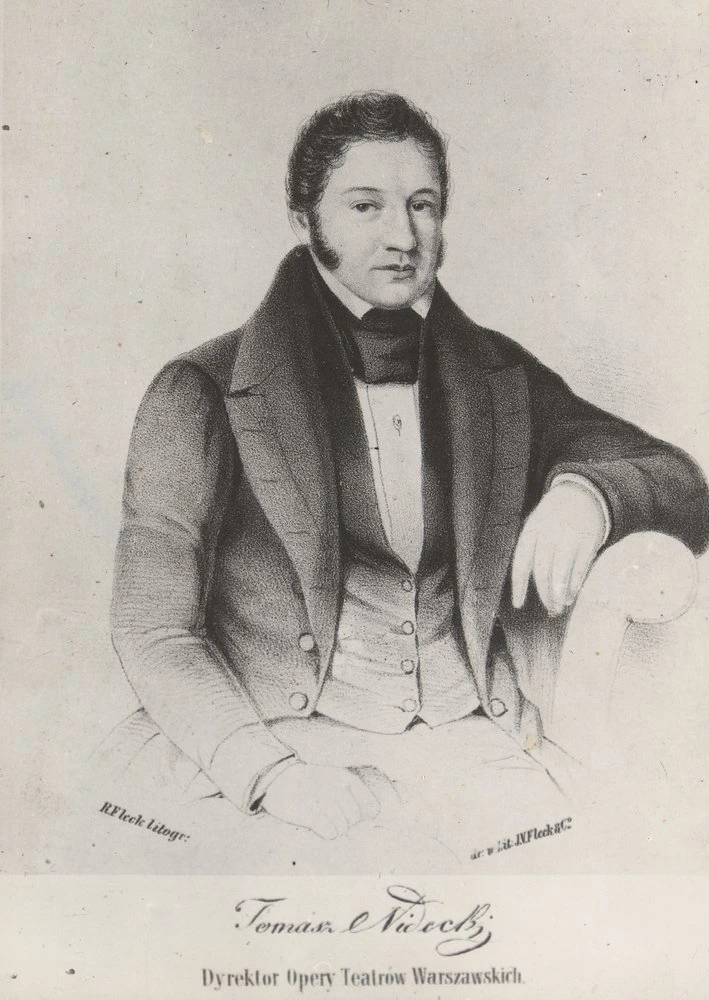
Nidecki Tomasz Napoleon, *2 January 1807 Studzianka (near Radom), †5 June 1852 Warsaw, Polish composer, conductor and pianist. He was the son of a peasant, and according to Elsner (Sumariusz moich utworów muzycznych), he had a patron in the person of Count H. Zabiełło. Nidecki’s brother, Ludwik, fought in the National Guard as an officer in the November Uprising (1830–31, Sumariusz…).
From 1822, Nidecki studied at the conservatory in Warsaw under A. Stolpe (piano), J. Bielawski (violin), W.W. Würfel (organ), and from 1824 to 1827 with J. Elsner (composition), who in 1827 gave him a grade of “special ability.” He also taught in J. Javůrek’s clavichord class, and after graduating (he conducted his Msza for four voices and orchestra at the time), he became a violinist in the orchestra of National Theatre [in Warsaw]. Between 1828 and 1831, he studied in Vienna, probably at the conservatoire, on a scholarship from the Polish government; he then supported himself financially by accompanying and giving piano lessons. He visited Chopin, “reviewed and corrected the orchestral parts” (probably in the Variations in B flat major, Op. 2; cf. Chopin’s letter to his family dated 12 August 1829), and in 1830–31 he practised at Chopin’s flat at Kohlmarkt, preparing for the premiere of the Concerto in E minor, but this plan did not come to fruition. With Nidecki in mind as his co-performer, Chopin sketched a concerto for two pianos in the spring of 1831. In 1831, Nidecki became associated with the theatre in Leopoldstadt; he made his debut there on 11 March as the author of musical interludes for K. Meisl’s Die Kathi von Hollabrunn (a parody of H. Kleist’s drama Das Kätchen von Heilbronn), and in 1833/34, following the success of his operetta Der Waldbrand oder Jupiters Strafe, he was hired permanently as a Kapellmeister. In April 1838, he returned to Warsaw, where on 1 June 1839 he staged D. Auber’s opera Le cheval de bronze at the Grand Theatre and was appointed opera director, sharing the position with K. Kurpiński until 1840 and with J. Quattrini from 1845 onwards. On this stage, he staged, for the first time in Poland, Norma by V. Bellini and Lucia di Lammermoor by G. Donizetti (both in 1845), Loteria by Moniuszko, Don Pasquale and La fille du régiment by Donizetti (all in 1846), Marta by F. von Flotow (1850), Macbeth and Ernani by Verdi (1851). On 25 March 1842, he conducted J. Haydn’s oratorio Die Sieben letzten Worte unseres Erlösers am Kreuze at the Capuchin church in Warsaw, and on 23 December 1847, W.A. Mozart’s Requiem at the Franciscan church. In 1847, he conducted at the theatre in Vilnius. Until 1850, he taught singing at the school attached to the Grand Theatre and the real gymnasium in Warsaw, where he also founded and conducted church choirs, for which he created the repertoire. He was married twice: to Emilia Elsner (daughter of J. Elsner, †15 April 1864) and Julia (Józefa?) Bieńkowska (from 28 August 1838). He died during a cholera epidemic.
Today, Nidecki’s name is mainly mentioned in the context of Chopin’s biography; his music, known and appreciated during his lifetime, was quickly forgotten. In the history of Viennese operetta, Nidecki was a notable figure, and his works were performed dozens of times, including in provincial theatres. Viennese critics praised the melodic inventiveness of his operettas, their “delightful choruses and ariettas” and good instrumentation; his overtures were noted for their originality and “nobility of style,” which were seen as striving for a deeper artistic form (Der Sammler, 1831, Nos. 35 and 96); these qualities meant that they functioned as independent symphonic works (Nidecki was called “the composer of overtures”). Due to the loss of the librettos by J.E. Gulden, with whom Nidecki collaborated regularly (only the libretto of the operetta Der Waldbrand oder Jupiters Strafe has survived), it is impossible to precisely define the genre of his stage works. As director of the Warsaw opera, he was considered by his contemporary Polish critics to be an efficient and reliable conductor, but he was unable to maintain the high standard set by K. Kurpiński.
Literature: theatre posters from Leopoldstadt from 1831, Stadtbibliothek Wiedeń, signature C 64525; reviews: The Veritable (pseudonym), “Der Sammler” 1831 Nos. 35 and 96, G. Arnold, “Allgemeine Theaterzeitung” 1832 Nos. 4 and 35, “Allgemeiner musikalischer Anzeiger” 1833 No. 43; F. Starczewski Spis numerowy utworów znajdujących się w Bibliotece Warszawskiego Towarzystwa Muzycznego, Warsaw ca. 1932; Z. Jachimecki Sukcesy kompozytora polskiego w wiedeńskim teatrze muzycznym przed stoma laty. Napoleon Tomasz Nidecki (1807–1852), “Kurier Literacko-Naukowy,” supplemented with “Ilustrowany Kuriery Codzienny” 1934 No. 50; “Kurier Warszawski” 1852 No. 149 (obituary); J. Elsner Sumariusz moich utworów muzycznych, revised by A. Nowak-Romanowicz, Krakow 1957.
Instrumental:
Polonaise sur des thèmes favoris de l’opéra Le Postillon de Longjumeau for piano, dedicated to H. Iliński, Warsaw after 1836 I. Klukowski (National Library of Poland)
Mazur z tematów opery Koń spiżowy for piano, Warsaw 1839 I. Klukowski (Jagiellonian Library)
Marsz uroczysty wykonany podczas przeniesienia Obrazu Śtej Weroniki… for orchestra, Warsaw, 31 July 1841, transcription for piano Nideckiego, Warsaw 1841, I. Klukowski (Jagiellonian Library)
Polonaise sur des Motifs de l’Opéra Le Brasseur de Preston for orchestra, dedicated to A.S. Golicyn, transcription for piano by Nidecki, Warsaw 1841 G. Sennewald (Jagiellonian Library and National Library of Poland)
Polonaise à Grand Orchestre exécutée le 27 Maj/8Juin 1846 au Théâtre de L’Orangerie à Łazienki… for orchestra, transcription for piano, Warsaw 1846, I. Klukowski (National Library of Poland)
Marsz żałobny for wind orchestra and choir, in memory of J.I. Kraszewski, transcription for piano J. Sosnkowskiego, Warsaw 1887 lithography J. Mękarskiego (National Library of Poland)
Polonez i hymn Lwowa „Boże Cesarza chroń” for orchestra, do 1939 in Library of Warsaw Music Society
Uwertura after A. Schumacher’s melodrama Das Mädchen von Gomez Arias
Romance, Rondo Op. 7 for piano
Vocal:
Hulanka. Mazur do śpiewania lub na pianoforte, song dedicated to J. Krogulski, Warsaw before 1842 I. Klukowski (version for piano in National Library of Poland)
Das Grab, song, text by Salis (Johann Gaudenz Salis-Seewis), Vienna, no date, A. Penauer
Vocal-instrumental:
Msza, performed in Warsaw, 26 September 1824
Msza Nro Pszy na cztery głosy ułożona dla Uczniów Gimnazjum Realnego for soprano, alto, tenor and bass with orchestral accompaniment, performed in Warsaw 1828, score with organ accompaniment, published in Warsaw, 1845, I. Klukowski (Jagiellonian Library)
Veni Creator, cantata, dedicated Grand Duchess Olga Nikolaevna of Russia, 1847
Salve Regina, at the funeral of J. Rautenstrauch
Ave Maria
cantata
Stage:
Die Kathi von Hollabrunn, 3 acts, libretto K. Meisl, staged in Vienna, 11 March 1831
Schneider, Schlosser und Tischler, 3 acts, libretto J.A. Gleich after K. Weisflog, staged in Vienna, 30 July 1831
Der Waldbrand oder Jupiters Strafe, 2 acts, libretto J.E. Gulden, staged in Vienna, 19 December 1833, manuscript of the score, Nationalbibliothek Vienna (in 3 sources), 4 pieces for voice and piano, Vienna 1835 A. Diabelli (Stadtbibliothek Vienna), 3 pieces for voice and piano, published in: Favorit-Gesänge, Vienna ca. 1835 A. Penauer (Bibliothek der Gesellschaft der Musikfreunde Vienna)
Der Schwur bei den Elementen oder Das Weib als Mann, 3 acts, libretto J.E. Gulden, staged in Vienna, 11 October 1834, Polish translation Nidecki, titled Przysięga na żywioły, czyli kobieta mężczyzną, Warsaw 1845
Versöhnung, Wohltätigkeit und Liebe, 1 act, libretto K. Meisl, staged in Vienna, 11 February 1834
Der Traum am Tannenbühl oder Drei Jahre in einer Nacht, 2 acts, libretto J.E. Gulden, staged in Vienna, 28 March 1835, manuscript Nationalbibliothek Vienna
Die Jungge-sellen-Wirtschaft im Monde, 2 acts, libretto J.E. Gulden, staged in Vienna 13 August 1835 (Nidecki’s benefit concert)
Der Temperamentenwechsel, 3 acts, libretto W. Born, staged in Vienna, 16 April 1836
Der Geist der düstern Inseln oder Der Spiegel der Zukunft, 2 acts, libretto J.E. Gulden, staged in Warsaw, 16 February 1837, manuscript of the overture score (?) from ca. 1837 Nationalbibliothek Vienna
Der vierte October, manuscript (?), Bibliothèque Nationale
Arrangements:
Ulubione śpiewy z opery Koń spiżowy (F. Aubera) for voice and piano, Warsaw 1839 G. Sennewald (Jagiellonian Library)
Ulubione śpiewy z opery Piwowar z Preston (A. Adama) for voice and piano, Warsaw ca. 1841 I. Klukowski and G. Sennewald (Jagiellonian Library)
Wybór śpiewów z opery Alessandro Stradella (F. von Flotowa) for voice and piano, 3 books, Warsaw after 20 June 1846, I. Klukowski (5 fragments in National Library of Poland)