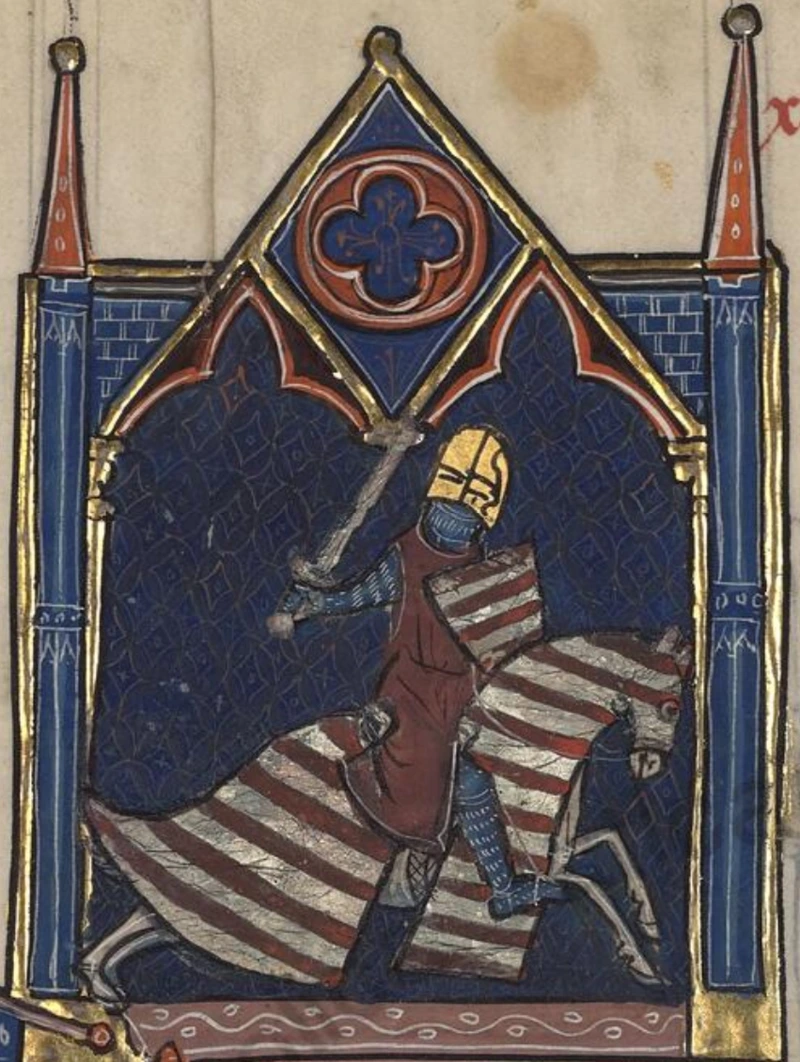
Gace Brulé *ca. 1160 probably Nanteuil-lès-Meaux (Seine-et-Marne, Champagne), †after 1213, French trouvère.
The little information available about his life comes from: an initial miniature and a section from manuscript Reg. 1490 from Rome, held at the Biblioteca Apostolica Vaticana (fol. 17r); two archival documents; and, above all, the poetic works of Gace Brulé himself. The miniature in the Vatican manuscript, depicting a troubadour on horseback with a sword and a coat of arms “burelé de gueules et d’argent de huit pieces”, helps to explain the origin of the poet’s surname; the heading “Ce sont les cançons monseigneur Gasson” (similar to inscriptions found in other sources) further confirms his noble birth.
His name also appears in a lease agreement dated 1212, according to which “Gatho Bruslé” leased land in Groslière to the Knights Templar, and in a payment order from 1213 addressed to the administrators of the court of the future Louis VIII.
Gace Brulé himself, in the poem Les oiselés de mon päis identified “douce Champagne’” as his homeland, and in Pour mal tens ne pour gelee described Nanteuil as his place of residence; it was there, too, that he was probably born and spent his youth. The texts of Gace Brulé’s poetry (Li plusour ont d’amours chanté and Gace, par droit me respondés) contain suggestions that he was a member of the court of Geoffrey II, Count of Brittany (to whom several other songs composed between 1181 and 1186 are dedicated), and subsequently – following the death of Count Geoffrey (†1186) – to Marie de France, Countess of Brie and Champagne (to whom he dedicated the song Bien cuidai toute ma vie, composed in 1189).
Gace Brulé was presumably friends with many trouvères: Bertrand de Born, Huon d’Oisi, Conon de Béthune, Gilles de Vies Maisons, Pierre de Molins, Bouchart de Marli, Amauri de Craon and others; he maintained close relations with members of the aristocracy of the time, including, around 1180–85, with Guillaume V de Garlande, and around 1191–1202 with Count Louis de Blois and Count Thibaut I de Bar.
References in Les consirers de mon päis, Tres grant amours me traveille et confont and Bien cuidai toute ma vie also suggest that Gace Brulé took part in the Third or Fourth Crusade, or perhaps even in both of these crusades.
Gace Brulé, one of the most outstanding troubadours of the first generation, was a poet and composer known and esteemed by his contemporaries, and even by artists of subsequent generations. The popularity of Gace Brulé and the wide influence of his work are evidenced not only by the number of surviving works preserved in numerous manuscripts, but also by the many compositions of other trouvères (Blondel de Nesle, Gautier de Dargies, Gontier de Soignies, Gilles de Vies Maisons and Guillaume li Vinier), sometimes dedicated to the poet or containing allusions to him; numerous songs by Gace Brulé were quoted by French authors (Jehan Renart, Gerbert de Montreuil, Gontier de Soignies, Guillaume le Vinier, Gilles le Vies Maisons and others), as well as by Dante (De vulgari eloquentia), served as the basis for Latin contrafacts (by Philippe de Grève, Adam de la Bassée, Walther Châtillon and anonymous composers), and provided models for later imitators (including Thibaut IV de Champagne, Oede de la Couroierie and the minnesinger Rudolf von Fenis-Neuenberg).
This recognition of Gace Brulé seems to stem from the conventional nature of his works; these are chiefly love poems, and thus deal with the most typical themes of Old French poetry, as introduced by Provençal song, employing the standard forms of artistic expression established by the troubadours.
Gace Brulé’s compositions are characterised by the uniformity and regularity of their formal, poetic and musical structures. These are hymn-like strophic works in which each of the five or six stanzas (often isometric and decasyllabic) usually comprises 7–8 lines and consists of two identical stanzas (most often with an abab rhyme scheme) and a contrasting coda (with a different rhyme scheme); this textual form is generally matched by the musical form of the bar. The melodies of the songs, mostly in the Dorian mode, often share common motivic features (e.g. a fifth interval opening the phrases) and rhythmic characteristics (an acceleration of movement at the end of the phrases).
Literature: G. Huert Chansons de Gace Brulé, «Société des anciens textes français», Paris 1902; F. Gennrich Sieben Melodien zu mittelhochdeutschen Minneliedern, “Zeitschrift für Musikwissenschaft” VII, 1924; R. Fawtier Thibaut de Champagne et Gace Brulé, “Romania” LIX, 1933; F. Gennrich Zwei altfranzösische Lais, “Studi Medievali”, new series XV, 1942; H. P. Dyggve Gace Brulé. Trouvère champenois, «Mémoires de la Société néophilologique de Helsinki» XVI, Helsinki 1951; A. Varvaro A proposito della canzone cortese come lirica formale. Gace Brulé stravagante, in: Festschrift for F. Piccolo, Naples 1962; P. Falk Zwei Lieder Philipps des Kanzlers und ihre Vorbilder, “Archiv für Musikwissenschaft” XXIV, 1967; H. Van der Werf The Chansons of the Troubadours and Trouvères. A Study of Melodies and their Relation to the Poems, Utrecht 1972.
Compositions:
of the 62 songs considered to be authentic, 54 have been preserved with their melodies (in some cases in 8–10 versions)
in addition, 23 songs (including 16 with melodies), the authorship of which is disputed
Gace Brulé’s works, creates between 1179 and 1212, have been preserved in 25 sources, including the following manuscripts: fr. 765, fr. 844, fr. 845, fr. 846, fr. 847, n.a.fr. 1050, fr. 1591, fr. 24406 at the Bibliothèque Nationale in Paris, 5198 at the Bibliothèque de l’Arsenal in Paris as well as Reg. 1490 at the Biblioteca Apostolica Vaticana in Rome
Editions:
Le Chansonnier de Saint-Germain-des-Pres, ed. P. Meyer, G. Raynaud, «Société des anciens textes français», Paris 1892
Le Chansonnier de l’Arsenal, ed. P. Aubry, Paris 1910
Le Chansonnier Cangé, ed. J. Beck, «Corpus Cantilenarum Medii Aevi», series 1 «Les Chansonniers des Troubadours et des Trouvères» I, Paris 1927, II, Oxford 1938
Le Manuscrit du Roi, ed. J. Beck, «Corpus Cantilenarum Medii Aevi», Series 1 «Les Chansonniers des Troubadours et des Trouvères» I, Paris 1927, II, Oxford 1938
Troubadours, Trouvères, Minnesang und Meistergesang, ed. F. Gennrich, «Das Musikwerk» II, Cologne 1951
Trouvères – Melodien, vol. 1, ed. H. Van der Werf, «Monumenta Monodica Medii Aevi» XI, Kassel 1977