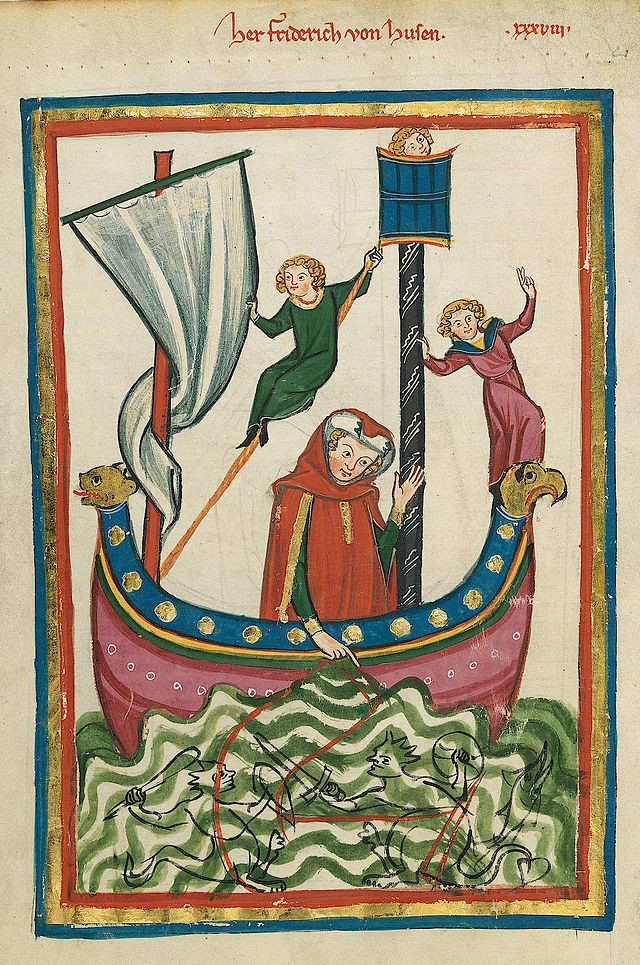
Friedrich von Hausen, Husen, Husa, †6 May 1190 Philomelium (Asia Minor), German minnesänger. His name is mentioned in 1171 in the records of the Archbishop of Mainz, and later in documents of King Henry VI, the future emperor. Friedrich von Hausen resided at the court of Emperor Frederick I Barbarossa as iudicator and secretarius. In 1189, he set out on the Third Crusade and was killed during a skirmish near Philomelium. Fifteen texts of his songs have survived, some modeled on the works of troubadours and trouvères, such as Bernart de Ventadorn, Folquet de Marseille, Conon de Béthune, and Guiot de Provins. It is believed that Friedrich von Hausen transferred the achievements of this lyrical song tradition to the German context and, as the first major composer of German minnesang, created his own style, later imitated by Ulrich von Gutenburg, Bligger von Steinach, Heinrich von Rugge, Berngêr von Hornheim, and Emperor Henry. The original melodies of his songs have not survived.
Literature: F. Gennrich Formenlehre des mittelalterlichen Liedes, Halle 1932; H. Husmann Das Prinzip der Silbenzählung im Lied des zentralen Mittelalters, “Die Musikforschung” VI, 1953; H. Husmann Friedrich von Hausen. Nachbildungen französischer und provenzalischer Minnelieder, «Euphorion» XLIX, 1955; H.J. Rickenberg Leben und Stand des Minnesängers Friedrich von Hausen, “Archiv für Kulturgeschichte” XLIII, 1961; R.J. Taylor The Art of the Minnesinger, 2 vols., Cardiff 1968.