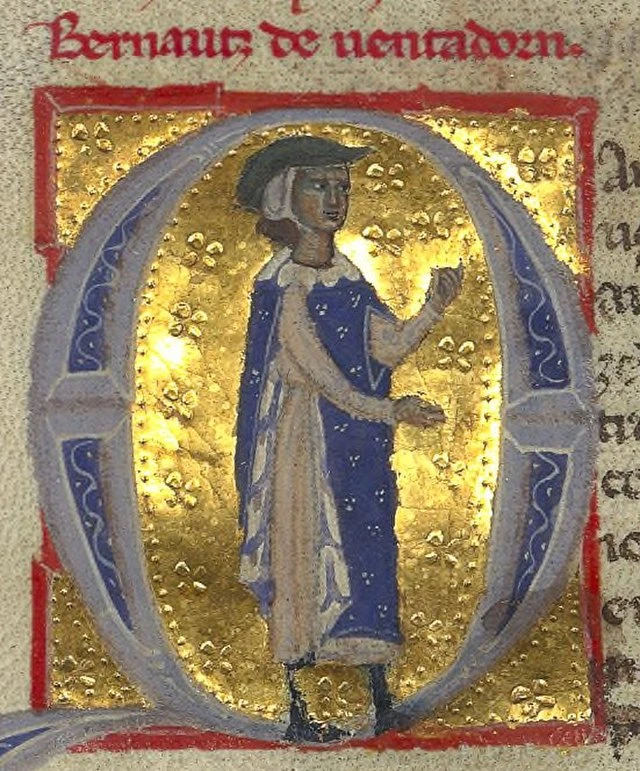
Bernart de Ventadorn, Bernard de Ventadour, *ca. 1130 Château de Ventadorn (department Corrèze), †ca. 1195, Dalon Abbey (?) (near Périgueux), trubadour. According to medieval biographies (vidas), whose reliability is difficult to verify, he was the son of a palace servant and learned the art of songwriting at the court of the Viscount of Ventadorn (identified with Eble II, †1147), who was himself a poet and musician. He may have stayed at the court of Eleanor of Aquitaine in Normandy until her departure for England (1154) and at the courts of Vienne (near Grenoble), Narbonne and Toulouse. After the death of his last patron, Raymond V, Count of Toulouse (†1192), he is said to have entered the Cistercian monastery in Dalon Abbey. It cannot, however, be excluded that this account refers not to the poet but to Bernart, son of Viscount Eble III, who was abbot at Tulle, near Ventadorn, between 1212 and 1234. If this identification is correct, de Ventadorn’s poetic activity would have to be dated some two decades later.
Bernart de Ventadorn was a typical representative of courtly love poetry and its conventions. The musical qualities of his poetry have been emphasised many times. It displays many stylistic features typical of the work of older generations of troubadours, which is evident, among other things, in the small size of the stanzas and the simplicity of the versification. He composed works exclusively in the form of canzonas, usually consisting of 6 or 7 stanzas with a tornada (a shorter final stanza), using the same rhyming syllables in all stanzas (coblas unissonans) or changing the rhymes every two stanzas (coblas doblas). Forty-one of his works have survived (39 cansos and 2 dialogued tensons) have survived. The musical arrangement of the stanzas is usually in AAB form (pedes/cauda) or recomposed (oda continua), sometimes with occasional returns of variably transformed phrases. The style of the arrangements is mostly syllabic, but sparse ornaments appear at the end of the stanzas.
The reception of Bernart’s songs is indicated by the unusually large number of melodies that have survived for a composer of the twelfth century. Some of them were used to create contrafacta. The most popular was the so-called Song of the Lark Can vei la lauzeta mover [“When I see the lark beat his wings”], fragments of which were quoted in many works, including Roman de la Rose ou Guillaume de Dole (ca. 1200), Roman de la Violette by Gerbert de Montreuil (1225) and in the Provençal mystery play featuring the life of St. Agnes (ca. mid–14th century); its melody was adapted to Latin, Occitan, French and German texts. Bernart de Ventadorn is considered one of the most outstanding poets of the second generation of Provençal troubadours.
Literature: N. Zingarelli Ricerche sulla vita e le rime di Bernart de Ventadorn, «Studi Medievali» I, 1904/5; P. Bec La douleur et son univers poétiques chez Bernart de Ventadorn, “Cahiers de civilisation médiévale” XII, 1969; N. Gossen Musik und Text in Liedern des Trobadors Bernart de Ventadorn, “Schweizer Jahrbuch für Musikwissenschaft,” IV–V, 1984–85; W. Paden Bernart de Ventadour le troubadour devint-il abbé de Tulle?, in: Mélanges de langue et de littérature occitanes en hommage à Pierre Bec, Poitiers 1991; E. Aubrey The Music of the Troubadours, Bloomington 1996; J. Haines Vers une distinction leu/clus dans l’art musico-poétique des troubadours, “Neophilologus” LXXXI, 1997; David Murray The Clerical Reception of Bernart De Ventadorn’s ‘Can Vei la Lauzeta Mover’ (Pc 70, 34), “Medium Aevum,” LXXXV, 2016, No. 2; E. Aubrey The progeny of Bernart de Ventadorn’s Can vei la lauzeta mover, in commemorative book of Christopher Page, Woodbridge 2020.
C. Appel Bernart von Ventadorn. Seine Lieder mit Einleitung und Glossar, facsimile of melody transcription, Halle 1915
C. Appel Die Singweisen Bernarts von Ventadorn, facsimile of melody transcription, Halle 1934
Der musikalische Nachlass der Troubadours, ed. F. Gennrich, 3 vols., Darmstadt 1958–65
Bernart de Ventador – Chansons d’amour, Paris 1966 (critical edition of text alone)
J. Maillard Anthologie de chants de troubadours, Nice 1967; The Extant Troubadour Melodies, pub. H. van der Werf, Rochester (New York) 1984