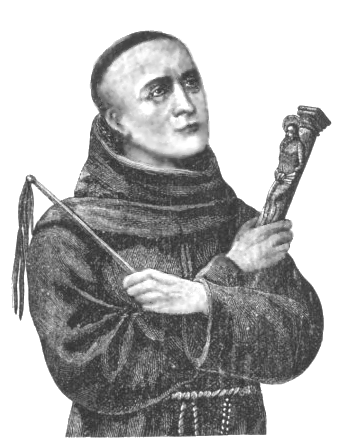
Ladislas of Gielniów, Władysław z Gielniowa (Ładysław, monastic name), actually Jan (or Marcin), son of Piotr z Gielniowa, beatified, *ca. 1440 Gielniów (near Opoczno), †4 May 1505 Warsaw, Polish poet and priest, Bernardine. He studied for some time in Kraków, perhaps at the University. Around 1461, he entered a Bernardine monastery, in Kraków or Warsaw, and in 1462, he took monastic vows. After completing his monastic studies, around 1463 (1465?), he was ordained a priest. He held various positions in many Bernardine monasteries throughout Poland, e.g. in 1486, he was the custodian of the Kraków convent, and in 1487–90 and 1496–99, the vicar of the Polish province. In 1490, he lived in Urbino, and in 1498 in Milan. He participated in the founding of Bernardine convents in Skępe and Połock. From 1504 until the end of his life, he was the guardian of the monastery of St. Anne in Warsaw.
Ladislas of Gielniów is one of the first poets known by name to write in Polish. His work, according to the first biographers extremely abundant and popular, has survived only in part and includes various literary genres and forms cultivated at the time. Songs with religious themes, often Marian, come to the fore, mainly in Polish, less often in Latin. In addition, he created Latin poems in the form of abecedaries, catalogues and others of an occasional, autobiographical or important historical event nature. Three of Władysław’s works have survived with music. The most famous and widespread of them (his text is quoted by, among others, Jan Kochanowski) was Żołtarz Jezusów czyli piętnaście rozmyślań o Bożym Umęczeniu, beginning with the words “Jezusa Judasz przedał.” It is probably an inventive adaptation of an older Czech song, unknown today, which appears in a slightly different form (including two additional stanzas at the beginning) in Czech and Polish hymnals of other denominations with the incipits Umučení našeho Pána milostneho or Umęczenie naszego Pana miłosnego and similar ones. The melody from the Protestant hymnals is probably original and also appears in the tenor of the four-voice arrangement of the slightly extended text by Gielniowczyk published in Kraków in 1558 entitled Pieśń o Bożym umęczeniu (without giving the author of the text or musical arrangement). A Marian stanza hymn for the time of the immediate, Imperatrix angelorum consolatrix afflictorum combined in two 16th-century manuscripts with the melody of Notker Balbulus’s sequence Congaudent angelorum chori. The original work of Ladislas of Gielniów, on the other hand, is probably the melody for his votive antiphon “contra Turcos” Iesus Nazarenus Rex Iudaeorum. It has been preserved, among others, in the acts of the beatification process and in Bernardine liturgical manuscripts, but also in several sources from the 16th–18th centuries from Hungary and Germany (Augsburg, Havelberg), which attest to its considerable popularity.
Literature: K. Kantak Z poezji bernardyńskiej w. XV i XVI, “Pamiętnik Literacki” XXVIII, 1931; K. Kantak Bernardyni polscy, vol. 1, Lviv 1933; Cz. Bogdalski Bernardyni w Polsce 1453–1530, 2 volumes, Kraków 1933; H.E. Wyczawski O właściwe imię błogosławionego Władysława z Gielniowa, “Ruch Biblijny i Liturgiczny” XIV, 1961; W.F. Murawiec Bernardyni warszawscy. Dzieje klasztoru św. Anny w Warszawie 1454–1864, Kraków 1973; H. Kowalewicz Nieznana pieśń Ładysława z Gielniowa „contra pestem”, in: Ars historica. Prace z dziejów powszechnych i Polski, ed. M. Biskup et al., Poznań 1976; B. Brzezińska O melodii pieśni „Jezusa Judasz przedał”, “Roczniki Biblioteczne” XXIX/1–2, 1985; K. Grudziński Błogosławiony Władysław z Gielniowa, in: Polscy święci, vol. 6, ed. J.R. Bar, Warsaw 1986; W. Wydra Władysław z Gielniowa, Poznań 1992 (includes a publication of all works by Ladislas of Gielniów); T. Michałowska Średniowiecze, «Wielka Historia Literatury Polskiej», Warsaw1995, 8th ed. 2002; K. Morawska Średniowiecze. 1320–1500, «Historia Muzyki Polskiej» 1/2, ed. S. Sutkowski, Warsaw 1998; „Cantando cum citharista”. W pięćsetlecie śmierci Władysława z Gielniowa, ed. R. Mazurkiewicz, «Studia Staropolskie. Series Nova» XII (LXVIII), Warsaw 2006; J. Kubieniec O antyfonie „Iesus Nazarenus Rex Iudaeorum” bł. Władysława z Gielniowa, “Muzyka” 2021, no. 1
Texts:
songs in Polish:
Jezusa Judasz przedał
Augustus kiedy królował
Już się anjeli wiesielą
Anna niewiasta niepłodna
Jasne Krystowo oblicze
Jezu, Zbawicielu ludzski
Kto chce Pannie Maryi służyć, song (Latin transl. entitled Qui Mariae cupit servire)
in Latin:
Ad Cantica Canticorum verto me (commentary to Pieśń nad pieśniami in a form of an abecedarius)
Anno Christi milleno quadrin sexin secundo (autobiographical poem from 1462)
Taxate penitencie metrice “Annum decet peniteat” (an abecedarius, mnemotechnic handbook for confessors from the 15th/16th c.)
Iesus Nazarenus Rex Iudaeorum (antiphon called “contra paganos,” connected with the Turkish invasion of Podolia in 1498–99, 17th-century Polish translation entitled O Jezu Nazareński, can be included in the canto Jezusa Judasz przedał)
Imperatrix angelorum (supplication “contra pestem” related to the outbreak of plague at the end of the 15th century, acrostic: “Iezus Cristus Maria Ladislaus”)
Inde lupus surgens cum Turcis tot rapit agnos (also entitled Wiersz o spustoszeniu Sambora, connected with the Turkish invasion of Sambor 1498)
Metra de nativitate Domini: Iam puer est natus
Metra de sanctis (probably fragments of a poetic cycle De sanctis per totum annum):
Beatissima Birgitta (De s. Birgitta)
In cruce Franciscus (De stigmatibus s. Francisci)
Indorum doctor est Thomas (De s. Thoma Apostoo)
Iam, iam clericuli” (De s. Gallo)
Iam pueri videant loca (In Die Animarum)
Serve Dei Simon (epitaph of praise for the ceremony of translation of the relics of Blessed Szymon of Lipnica from ca. 1488)
of uncertain authorship, including:
O nova lux Poloniae (antiphon in honour of Blessed Simon of Lipnica)
Słuchaj tego wszelika głowo (decalogue)
songs:
Anieli słodko śpiewali
Anna matrona święta
Anna święta i nabożna
Jezu Chryste krzyżowany
O Maryja kwiatku panieński
Świebodność Boga żywego
verse catalogues of popes, Polish kings and Roman emperors:
Antistes primus Romanus
Auctor Polonorum regni
Augustus Octavianus
Editions:
texts:
Średniowieczna pieśń religijna polska, ed. M. Korolko, «Biblioteka Narodowa» series 1 no. 65, altered Wrocław 2nd ed. 1980, 3rd ed. 2005
Chrestomatia staropolska, ed. W. Wydra, W.R. Rzepka, Wrocław 1984, revised 3rd ed. 2005
musical arrangements:
Imperatrix gloriosa, ed. J. Pikulik in: Sekwencje polskie, «Musica Medii Aevi» V, ed. J. Morawski, Kraków 1976
Żołtarz Jezusów, ed. J. Surzyński, in: Polskie pieśni kościoła katolickiego od najdawniejszych czasów do końca XVI stulecia, ed. J. Surzyński, Poznań 1891; ed. H. Feicht in: Muzyka staropolska, ed. H. Feicht, Kraków 1966 and in: Średniowiecze, «Musica Antiqua Polonica» I, ed. J. Morawski, Kraków 1972; Polskie pieśni pasyjne. Średniowiecze i wiek XVI, 2 volumes, ed. J. Nowak-Dłużewski, Warsaw 1977; multi-voice version 1558: ed. P. Poźniak and W. Walecki in: Śpiewnik staropolski, book 2: Pieśni na rok liturgiczny, Kraków 1996 and in: Polska pieśń wielogłosowa XVI i początku XVII wieku, «Monumenta Musicae in Polonia», Kraków 2004.