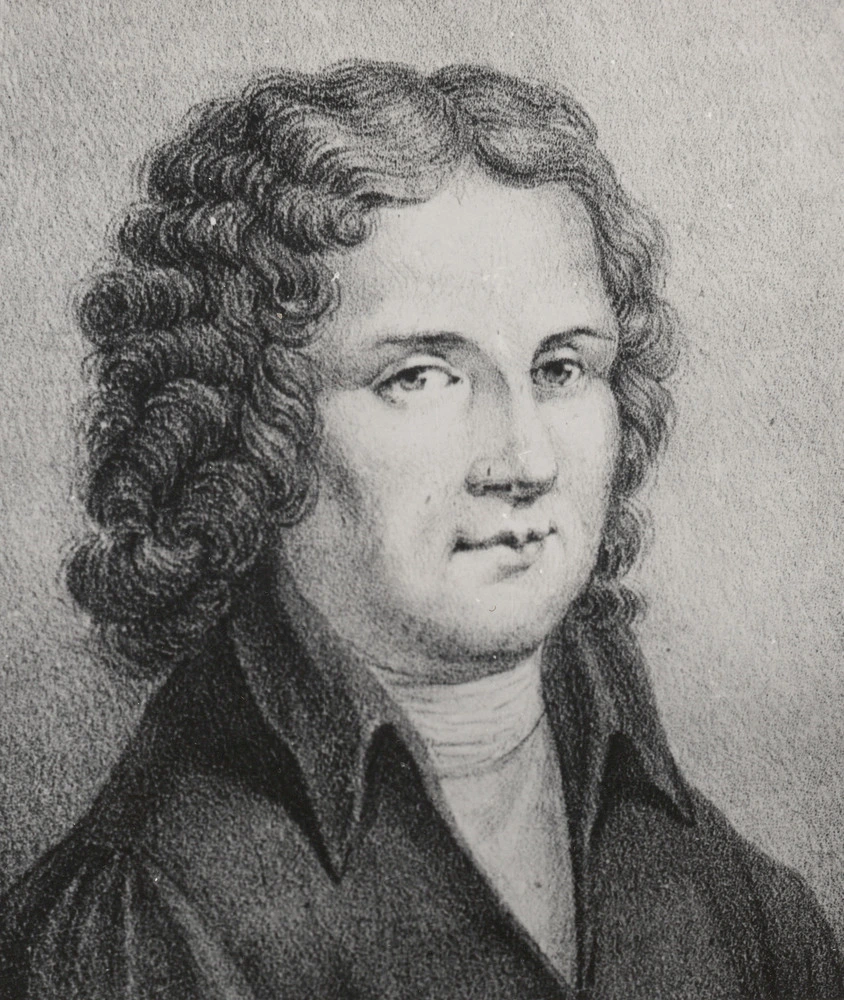
Scarlatti Pietro Alessandro Gaspare, *2 May 1660 Palermo, †22 October 1725 Naples, Italian composer. Son of Pietro Scarlata and Eleonora d’Amato; he began his musical education in Palermo and continued it in Rome from 1672, where he arrived with his mother and sisters. On 12 April 1678, he married Antonia Anzalone; they had 10 children. On 16 December 1678, he was appointed maestro di cappella at the church of S. Giacomo degli Incurabili; he wrote oratorios for Lent period for the Oratorio del Santissimo Crocifisso at the church of S. Marcello. He soon found himself in the circle of young composers patronised by the former Queen of Sweden, Christina; in 1679, she appointed him her bandmaster. In November 1682, Scarlatti became Kapellmeister at the church of S. Girolamo della Carità. The operas he composed at that time were staged in private theatres, including those of Cardinal Pietro Ottoboni, architect Giambattista Contini and Prince Maddaloni. In 1684, he took over the position of Kapellmeister at the court of the viceroy in Naples from M.A. Ziani; thanks to Scarlatti, the city soon gained fame as an opera centre rivalling Venice. Scarlatti’s operas were usually at first performed at the royal palace and then at the public theatre of S. Bartolomeo, where Scarlatti was also the Kapellmeister. At that time, he also wrote serenatas for courtly occasions, sacred music, and chamber cantatas. The need to support his large family forced Scarlatti to take up other forms of activity, including teaching at the Conservatorio di S. Maria di Loreto for a period of time. In April 1689, he left for Rome. When P. Ottoboni (Alexander VIII, 1689–91) became pope in November of that year, interest in opera grew, and the pope’s nephew, Cardinal Pietro Ottoboni, Vice-Chancellor of the Church, became one of Scarlatti’s greatest enthusiasts. The staging of the operas La Statira and Gli equivoci in amore in 1690, on the occasion of the marriage of the pope’s nephews to members of the Barberini and Colonna families, brought Scarlatti fame and the prospect of leaving Naples permanently (initially he had hoped to move to Rome, then Florence, and finally Venice). In 1698, and then in 1702–06, the Grand Duke of Tuscany, Ferdinando de’ Medici, patronised the staging of several of Scarlatti’s operas in Tuscany (at the Villa Pratolino near Florence, in Siena and Florence). In 1702, the arrival in Naples of the young Philip V, king of Spain was celebrated with a performance of Scarlatti’s serenade Clori, Dorino e Amore and the opera Tiberio imperatore d’Oriente; in the same year, Scarlatti travelled to Florence for several months for the staging of the opera Il Flavio Cuniberto. Although he did not obtain a position at the court of Ferdinando de’ Medici, he maintained contact with the Florentine court in the following years by sending oratorios, religious music, and operas. Around 1702, he left his position in Naples and became involved in the musical life of Rome (during those years, Queen Marie Casimire, widow of John III Sobieski, was an influential patron). However, Pope Clement XI (1700–21) declared a period of collective penance due to the armed conflict between Austria and Spain, as a result of which no operas were staged in Rome. Scarlatti then turned his attention to writing religious music and cantatas. On 9 January 1703, he became assistant to G. Bicilli at the Congregazione dell’Oratorio di S. Filippo Neri, and on 31 December 1703, he was appointed deputy choirmaster at the Cappella Liberiana at the Basilica of Santa Maria Maggiore. He received an increasing number of compositional commissions and was held in ever higher esteem as a composer. In April 1706, he became a member of the Accademia dell’Arcadia.
In 1707, Scarlatti travelled to Venice; however, the two operas he composed for the occasion did not arouse the enthusiasm of the Venetian public, with Il Mitridate Eupatore being particularly criticised. He was also not supported by Venetian composers, who felt threatened by the presence of the newcomer from Naples. In April 1707, Scarlatti visited his eldest son Pietro, the bandmaster at the local cathedral in Urbino, and a few months later he returned to Rome, where, after the death of A. Foggi, he took up the position of bandmaster at the Basilica of Santa Maria Maggiore, limiting his compositional activity to church music. Scarlatti’s situation improved when he found a new patron in Cardinal V. Grimani, the Austrian agent to the Holy See. Competing with Marie Casimire, Ottoboni, Pamphili and others, Grimani organised evenings of religious music, and when he became viceroy and settled in Naples, Scarlatti decided to return to that city in 1708; thanks to the protection of the new ruler, he regained his former position and high salary. In the following years, he returned to writing operas (he composed 11 for Naples at that time), serenades, and also created many cantatas and religious works. In 1716 he was granted a title of nobility by Pope Clement XI. In 1719, he composed the opera Il Cambise, though he did not attend its premiere, as he was once again in Rome at that time, where Marco Attilio Regolo was being performed. In the last years of his life, after staging the opera La Griselda (1721), Scarlatti devoted himself to composing solely instrumental music (including 12 Sinfonias di concerto grosso), conducting, and teaching. His students included D. Zipoli, F. Geminiani and J.A. Hasse. In 1725, Scarlatti composed seven sonatas for flute and string ensemble for J.J. Quantz, whom he met at the turn of 1724 and 1725.
Throughout his life, Scarlatti composed mainly operas and achieved considerable success in this field. For example, Il Pirro e Demetrio was staged outside Naples during the composer’s lifetime in Rome, Siena, Florence, Milan, Mantua, Brunswick, Leipzig, and London. The style and concept of Scarlatti’s stage work derive from Venetian opera, whose influence extended to Rome around the middle of the century. His works are also characterised by exceptional consistency. Most of Scarlatti’s operas were described by him as ‘dramma per musica,’ sometimes (after 1690) as ‘melodramma.’ and also as opera ‘drammatica’; these are works with serious themes, usually with comic (parodic and caricatural) scenes and a happy ending. Unlike Venetian opera, Scarlatti’s operas do not feature mythological themes in their librettos. The protagonists are rulers, usually with briefly described personalities, accompanied by their supporters and servants; the librettos are merely a plot framework for the music, with the action revolving mainly around love affairs, jealousy, betrayal, misunderstanding, and deception. One exception is the opera Il Mitridate Eupatore, described by the composer as a ‘tragedia per musica.’ Scarlatti left few works in the comedy genre, but he contributed to the popularisation of opera buffa with librettos in the local dialect. The opera Il trionfo dell’onore belongs to this small group, with a libretto in the Neapolitan dialect.
The basis of Scarlatti’s opera concept was the distinctly different dramatic function of recitatives and arias. Recitatives, most often secco, served to highlight the dramatic element and contributed to the development of the plot, while in arias the action was suspended, giving priority to musical values and creating an opportunity for vocal display. Recitatives and arias were not always juxtaposed according to the R-A-R-A template. In the final sections of the recitatives, Scarlatti used short, melodic ariosos, which served as a transition to the arias. Secco recitatives were usually accompanied only by the harpsichord, less often by an orchestra without the harpsichord. Scarlatti also introduced recitative accompagnato (for the first time in 1685 as ‘recitativo stromentato’ in Olimpia vendicata), entrusting it with special dramatic tasks, such as emphasising the mood of scenes taking place at night, the fantasy of dreams, the power of supernatural phenomena, etc., and sometimes (e.g. in La Statira) emphasising emotional tension.
Scarlatti’s operas, generally lasting just over three hours, are dominated by short arias (30 or more in a single opera); the composer reserved grand arias mainly for the protagonists. His early works still feature arias based on basso ostinato, strophic arias (usually with a short orchestral ‘ritornello’ between verses or a refrain), as well as those with an AB or ABB’ structure. After 1695, however, the da capo form predominates, in which the first part is repeated in its entirety or in abbreviated form, while the middle part, shorter than the first, is related to it thematically and tonally, but differs in orchestration and greater modal mobility; sometimes Scarlatti extended the da capo aria by adding a short scene between parts B and A’.
Scarlatti was gifted with extraordinary melodic inventiveness, but he always considered the capabilities of the human voice, which is why the range of his arias rarely exceeds a tenth; larger leaps occur only in the opening or closing sections, where they introduce the cadence. As a rule, the beginning of a periodic melody is repeated in the vocal or orchestral part and then developed using the technique of motivic development in asymmetrical phrases. In his late operas, he also introduced the so-called ‘motto,’ a phrase preceding the aria, not always thematically related to it. Scarlatti’s style is also characterised by chromaticism (lowering the 3rd or 6th degree in major keys and the 2nd in minor keys), contrapuntal relationships between the melody and bass line, and coloratura melismas, usually placed before the cadence in small arias, while in large arias they also fulfil a specific dramaturgical function (to express emotions such as anger or warlike fervour). Ensemble parts play a secondary role in Scarlatti’s operas; in his later works, their number increased slightly, but they do not play a significant role in the dramaturgy of the work. Scarlatti, on the other hand, appreciated the role of the orchestra. Its relationship to the vocal line is analogous to that of the ripieno to the solo instrument in a Baroque concerto (a reduction in the ensemble whenever the singer performs). String quartet is the core of the orchestra, to which Scarlatti occasionally added other instruments, such as concert trumpets (Alessandro’s aria in La Statira), horn obbligato (Il Tigrane, Telemaco, Marco Attilio Regolo), and, less frequently, flute (Cambise, La Griselda). In his later operas, oboes also appeared. The role of instrumental introductions increased, and Scarlatti usually gave them the form of a three-part sinfonia with a sequence of fast-slow-fast movements; this arrangement soon became the norm for Italian-style opera overtures, as well as a model for the form of the concerto and even the symphony. Scarlatti’s oratorios, mostly based on mythological themes, the lives of saints and allegorical plots, are constructed on similar principles to operas, but due to the lack of stage action, there is a tendency to treat all voices equally.
Scarlatti is particularly recognized for his contributions to the development of the chamber cantata. He is considered the leading representative of this genre in the 18th century and the heir to over a century of Italian cantata tradition, following in the footsteps of A. Cesti, G. Carissimi, and L. Rossi. Throughout his life, Scarlatti composed over 600 cantatas, which, due to their quantity and artistic value, perfectly illustrate the development of Italian chamber cantatas in the 18th century and are considered a model of this type of composition. Most of them were written for solo voice (usually soprano, but also alto or bass), with a few for two solo voices (two sopranos, soprano and alto, or soprano and bass). The vocal parts are usually accompanied only by basso continuo, although Scarlatti sometimes introduced a string ensemble, following the contemporary trend, sometimes with the addition of recorders or trumpets. The compositions are usually based on lyrical texts on the themes of love, narrative or descriptive. Scarlatti’s cantatas vary in structure, from those with 3 or 4 sections (A-R-A, R-A-R-A) to multi-sectional (with ritornellos, arias with varying instrumental accompaniment).Scarlatti made creative use of existing compositional techniques (strophic variations, basso ostinato), and in particular the principle of verbal-musical refrain, which he applied to the entire work as well as to the structure of the aria; sometimes the bass line is repeated in the second verse. He developed the individual parts as recitatives, arias or ariosi, incorporating the text’s structure into the work’s structure. In his later cantatas, he developed the melodic part of the basso continuo and sought to give the recitatives the character of arias. After 1705, works consisting of up to three da capo arias separated by recitative, became the dominant. Scarlatti used chromaticism more boldly than his predecessors, especially in ‘rapid recitatives’ (e.g. in the cantata Con idea inhumana, ma in regolato Cromatico), which was sometimes considered extravagant, and he was accused of lacking naturalness.
Among his contemporaries, Scarlatti was regarded as an eccentric composer. Consequently, his creative innovations were considered too unusual to be continued by others (with the notable exception of E. d’Astorga who followed in Scarlatti’s footsteps). For this reason, it was wrong to portray him in the second half of the 18th century as the founder of the Neapolitan school, or, in the 19th century, to attribute to him a role in the decline of the Neapolitan centre. A modern evaluation of Scarlatti’s accomplishments, taking his historical position into account, was initiated in 1905 by E.J. Dent in his book Alessandro Scarlatti, and continued by A. Lorenz.
Literature: E.J. Dent A. Scarlatti. His Life and Works, London 1905, extended and revised version published by F. Walker, 2. edition. 1960, reprint 2018; Ch. Van den Borren A. Scarlatti, Brussels 1921; P. Strüver Die Cantata da camera Alessandro Scarlatis, Munich 1922; U. Prota-Giurleo A. Scarlatti ,”il Palermitano,” Naples 1926; A. Lorenz A. Scarlattis Jugendoper, vol. 2, Augsburg 1927; Accademia musicale chiggiana Gli Scarlatti: Alessandro, Francesco, Pietro, Domenico, Giuseppe; note e documenti sulla vita e sulle opere, Siena 1940; M. Fabbri A. Scarlatti e il principe Ferdinando de’ Medici, Florence 1961; D. Poultney The oratorios of Alessandro Scarlatti, their lineage, milieu and style, Ann Abor (Michigen) 1968; L. Bianchi Carissimi, Stradella, Scarlatti e l’oratorio musicale, Rome 1969; R. Pagano, L. Bianchi A. Scarlatti, Turin 1972 (including Catalogo generale delle opere, ed. G. Rostirolla); J. Jürgens Die Madrigale A. Scarlattis und ihre Quellen, in the commemorative book of L. Rongi, Milan 1973; D. Poultney Alessandro Scarlatti and the Transformation of Oratorio, “The Musical Quarterly” LIX/4 (1973); C.R. Morey The late operas of Alessandro Scarlatti, Bloomington 1974; R. Strohm Italienische Opernarien des frühen Settecento (1720–1730), «Analecta Musicologica» XVI, 1976; Colloquium A. Scarlatti Würzburg 1975, eds. W. Osthoff and J. Ruile-Dronke, Tutzing 1979 (includes, among othes: L. Bianconi Funktionen des Operntheaters in Neapel bis 1700 und die Rolle A. Scarlattis, H. Hucke A. Scarlatti und die Musikkömedie, R. Strohm A. Scarlatti und das Settecento, H.C. Wolff Die Buffoszenen in den Opern A. Scarlatti, W. Witzenmann Zur Behandlung des stile osservato in A. Scarlattis Kirchenmusik); D.J. Grout A. Scarlatti. An Introduction to His Operas, Berkeley 1979; D.J. Grout Opera seria at the Crossroads. Scarlatti’s “Eraclea,” in: Studia musicologica. Aestetica-theoretica-historica, the commemorative book of Z. Lissa, eds. E. Dziębowska et al., Krakow 1979; C.E. Troy The Comic Intermezzo. A Study in Eighteenth-Century Italian Opera, Ann Arbor 1979; W. Holmes “La Statira” by P. Ottoboni and A. Scarlatti. The Textual Sources with a Documentary Postscript, New York 1983; J.M. Chomiński, K. Wilkowska-Chomińska Kantata neapolitańska, in: Formy muzyczne, vol. 5, Krakow 1984; A. Denis, A. Newcomb, Th. Walker, M. Talbot, D.J. Grout, J. Sheveloff The New Grove Italian baroque masters: Monteverdi, Frescobaldi, Cavalli, Corelli, A. Scarlatti, Vivaldi, D. Scarlatti, New York 1984; F.A. D’Accone The history of a baroque opera. Alessandro Scarlatti’s Gli equivoci nel sembiante New York 1985; R. Pagano Scarlatti, Alessandro e Domenico. Due vite in una, Milan 1985, 2nd edition. Lukka 2005, in English Alessandro and Domenico Scarlatti: Two Lives in One, translated by F. Hammond, New York 2006; F.A. D’Accone The History of a Baroque Opera. A. Scarlatti’s ‘Gli equivoci nel sembiante,’ New York 1985; C.F. Vidali Alessandro and Domenico Scarlatti. A Guide to Research, New York 1993; U. Schacht-Pape Das Messenschaffen von A. Scarlatti, Frankfurt am Main 1993; “Mon respectueux, mon profond silence parle pour moi,” Scarlatti’s correspondence with Ferdinando de’ Medici, translated by P. Hersant and X. Carrère, published by X. Carrère, Toulouse 1995; C. Caruso, M. Lütolf Alessandro Scarlatti und seine Zeit: Beiträge, Bern 1995; E. J. Olszewski The Enlightened Patronage of Cardinal Pietro Ottoboni (1667–1740), , “Artibus et Historiaeˮ, Nr 45 vol. 23 (2002); A. de Place Alessandro et Domenico Scarlatti, Paris 2003; B. Poensgen Die Offiziumskompositionen von Alessandro Scarlatti: Analyse und Werkverzeichnis, VDM Verlag 2008; L. de Frutos, T. Knighton Virtuosos of the Neapolitan Opera in Madrid: Alessandro Scarlatti, Matteo Sassano, Petruccio and Filippo Schor, ‹‹Early Music›› 37, 2009; L. Della Libera Nuovi documenti biografici su Alessandro Scarlatti e la sua famiglia, ,”Acta Musicologicaˮ LXXXIII/2 (2011); J. Byrt Inequality in Alessandro Scarlatti and Händel: a sequel, ‹‹Early Music›› 40, 2012; Devozione e passione: Alessandro Scarlatti nel 350. anniversario della nascita, materials from the 2010 conference in Reggio di Calabria, ed. N. Maccavino, Reggio di Calabria 2013; Devozione e passione: Alessandro Scarlatti nella Napoli e Roma barocca, materials from conferences in Rome and Naples in 2010, eds. L. Della Libera, L. and P. Maione, Naples 2014; I. Bossuvt De oratoria van Alessandro Scarlatti: Meesterwerken uit de Italiaanse barok (1665-1725), Leuven 2015; Aspects of the secular cantata in late Baroque Italy, ed. M. Talbot, London 2016; L. Della Libera La musica sacra romana di Alessandro Scarlatti = La Fortuna di Roma: cantate italiane e aristocratia romana intorno il 1700, Kassel 2018; D. Fabris Alessandro Scarlatti, in: Oxford Bibliographies, 2019; L. Della Libera The Roman sacred music of Alessandro Scarlatti, London 2022; I. Pasqua ‘Il martirio di Santa Teodosia’ di Alessandro Scarlatti. Analisi storico-filologica di un oratorio, Rome 2023; F. Menchelli-Buttini Sui drammi per musica di Alessandro Scarlatti dopo il 1702, Rome 2023.
Compositions
Stage:
operas:
Approximately 115 works; in the preface to La Griselda (Rome 1721), possibly Scarlatti’s last opera, the composer estimated the number of his operas at 114; presumably, this number also included pasticcios and serenatas, and perhaps other short stage works.
Gli equivoci nel sembiante, 3 acts, libretto D.F. Contini, performed in Rome 1679
L’honestà negli amori, 3 acts, libretto D.F. Bernini (?), staged in Rome 1680
Tutto il mal non vien per nuocere, comic opera, 3 acts, libretto G.D. de Totis, staged in Rome 1681
Il Pompeo, 3 acts, libretto N. Minato, staged in Rome 1683
L’Arsate, 3 acts, libretto F. Orsini, staged in Rome 1683
L’Aldimiro overo Favor per favore, 3 acts, libretto G.D. de Totis, staged in Naples 1683
La guerriera costante, 3 acts, libretto F. Orsini, staged in Rome 1683
La Psiche overo Amore innamorato, 3 acts, libretto G.D. de Totis, staged in Naples 1683
Olimpia vendicata, 3 acts, libretto A. Aureli, staged in Naples 1685
Clearco in Negroponte, 3 acts, libretto A. Arcoleo, staged in Naples 1686
La Rosmene overo L’infideltà fedele, 3 acts, libretto G.D. de Totis, staged in Rome 1686
Il Flavio, 3 acts, after libretto M. Noris, staged in Naples 1688
L’Amazzone corsara [or guerriera] overo L’Alvida, 3 acts, libretto G.C. Corradi, staged in Naples 1689
La Statira, 3 acts, libretto P. Ottoboni, staged in Rome 1690
Gli equivoci in amore overo La Rosaura, 3 acts, libretto G.B. Lucini, staged in Rome 1690
L’humanità nelle fiere overo Il Lucullo, 3 acts, staged in Naples 1691
La Teodora augusta, 3 acts, libretto A. Morselli, staged in Naples 1692
Gerone tiranno di Siracusa, 3 acts, libretto A. Aureli, staged in Naples 1692
Il nemico di sé stesso, 3 acts, staged in Rome 1693
L’amante doppio overo Il Ceccobimbi, 3 acts, staged in Naples 1693
Il Pirro e Demetrio, 3 acts, libretto A. Morselli, staged in Naples 1694
Il Bassiano overo Il maggior impossibile, 3 acts, libretto M. Noris, staged in Naples 1694
Nerone fatto Cesare, 3 acts, libretto M. Noris, staged in Naples 1695
Massimo Puppieno, 3 acts, libretto A. Aureli, staged in Naples 1695
Le nozze con l’inimico overo L’Analinda, staged in Naples 1695
Penelope la casta, 3 acts, libretto M. Noris, staged in Naples 1696 or Palermo 1694
La Didone delirante, 3 acts, libretto F.M. Paglia after A. Franceschi, staged in Naples 1696
Comodo Antonino, 3 acts, libretto F.M. Paglia after G.F. Bussani, staged in Naples 1696
L’Emireno overo Il consiglio dell’ombra, 3 acts, libretto F.M. Paglia, staged in Naples 1697
La caduta de’ decemviri, 3 acts, libretto S. Stampiglia, staged in Naples 1697
Il prigioniero fortunato, 3 acts, libretto F.M. Paglia, staged in Naples 1698
Anacreonte, with M. Bitti and F. de Castris, 3 acts, libretto G.F. Bussani, staged in Pratolino 1698
La donna ancora è fedele, 3 acts, libretto after D.F. Contini, staged in Naples 1698
Gl’inganni felici, 3 acts, libretto A. Zeno, staged in Naples 1699
L’Eraclea, 3 acts, libretto S. Stampiglia, staged in Naples 1700
Odoardo, 3 acts, libretto A. Zeno (?), staged in Naples 1700
Dafni, favola 3 acts, libretto F.M. Paglia after E. Manfredi, staged in Naples 1700
Laodicea e Berenice, 3 acts, libretto after M. Norisa, staged in Naples 1701
Il pastore di Corinto, favola 3 acts, libretto F.M. Paglia, staged in Naples 1701
Tito Sempronio Gracco, 3 acts, libretto S. Stampiglia, staged in Naples 1702
Tiberio imperatore d’Oriente, 3 acts, libretto G.D. Pallavicino, staged in Naples 1702
Il Flavio Cuniberto, 3 acts, libretto M. Noris, staged in Pratolino 1702 (?)
Arminio, 3 acts, libretto A. Salvi, staged in Pratolino 1703, revised versions staged in Naples 1714 and Rome 1722
Turno Aricino, 3 acts, libretto S. Stampiglia, staged in Pratolino 1704
Lucio Manlio l’imperioso, 3 acts, libretto S. Stampiglia, staged in Pratolino 1705
Il gran Tamerlano, 3 acts, libretto A. Salvi after J. Pradon, staged in Pratolino 1706
Il Mitridate Eupatore, tragedia in musica, 5 acts, libretto G. Frigimelica Roberti, staged in Venice 1707, fragments preserved
Il trionfo della libertà, tragedia in musica, 5 acts, libretto G. Frigimelica Roberti, staged in Venice 1707
Il Teodosio, 3 acts, libretto V. Grimani (?), staged in Naples 1709
L’amor volubile e tiranno, 3 acts, libretto G.D. Pioli and G. Papis, staged in Naples 1709
La principessa fedele, 3 acts, libretto A. Piovene (revised version D.A. Parrino?), staged in Naples 1710
Le fede riconosciuta, 3 acts, libretto B. Marcello (?), staged in Naples 1710
Il Ciro, 3 acts, libretto P. Pariati, staged in Rome 1712
Scipione nelle Spagne, 3 acts, libretto A. Zeno and N. Serino, staged in Naples 1714
L’amor generoso, 3 acts, libretto G. Papis and S. Stampiglia, staged in Naples 1714
Il Tigrane overo L’eguale impegno d’amore e di fede, 3 acts, libretto D. Lalli, staged in Naples 1715
Carlo, re d’Allemagna, 3 acts, libretto F. Silvani, staged in Naples 1716
La virtù trionfante dell’odio e dell’amore, 3 acts, libretto F. Silvani, staged in Naples 1716
Il trionfo dell’onore, comic opera 3 acts, libretto F.A. Tullio, staged in Naples 1718
Telemaco, 3 acts, libretto C.S. Capece, staged in Rome 1718
Il Cambise, 3 acts, libretto D. Lalli, staged in Naples 1719
Marco Attilio Regolo, 3 acts, libretto M. Noris, revised by B. Robatti (?), staged in Rome 1719
La Griselda, 3 acts, libretto F.M. Ruspoli (?) after A. Zeno, staged in Rome 1721
***
Adolfo e Lesbina, intermezzo for Odoardo, staged in Naples 1700
Bireno e Dorilla, intermezzo for Tito Sempronio Gracco, staged in Naples 1702
Pericca e Varrone, intermezzo for Scipione nelle Spagne, libretto A. Salvi, staged in Naples 1714
Despina e Niso, intermezzo for L’amor generoso, staged in Naples 1714
Palandrana e Zamberlucco, intermezzo for Carlo, re d’Allemagna, staged in Naples 1716
Leonzio e Eurilla, intermezzo for Marco Attilio Regolo, staged in Rome 1719
co-authorship:
La santa Dimna (3rd act), comic opera, with A. Melani (1st act) and B. Pasquinim (2nd act), libretto B. Pamphili, staged in Rome 1687
La Santa Genuinda overo L’onnocenza difesa dall’inganno (2nd act), dramma sacro per musica, with G.L. Lulier (1st act) and C.E Pollarolą (3rd act), libretto P. Ottoboni (?), staged in Rome 1694
Giunio Bruto overo La caduta dei Tarquini (3rd act), opera, with C.E Cesarini (1st act) and A. Caldara (2nd act), libretto G. Sinibaldi (?), without a premiere
operas, among others, with B. Pasquini, G. Legrenzi, G. Varischino, G. Aldrovandini, E Scarlatti, A. Lotti
Vocal-instrumental:
serenata (more than 30), including:
Venere ed Amore for soprano, alto and ensemble, staged in Naples between 1695 and 1700
Clori, Dorino e Amore for 2 sopranos, alto, 5-voice choir and instrumental ensemble, staged in Naples 1702
Venere e Adone. Il giardino d’amore for soprano, alto and instrumental ensemble, staged between 1700 and 1705
Endimione e Cintia for 2 sopranos and instrumental ensemble, staged in Rome 1705
Amore e virtù ossia Il trionfo della virtù for 2 sopranos and instrumental ensemble, staged in Rome 1706
Amore, Pace e Provvidenza for soprano, alto, bass, 4-voice choir and instrumental ensemble, libretto G. Papis, staged in Naples 1711
oratorios (ca. 37), including:
La Giuditta (I) for 2 sopranos, alto, tenor, bass, 2 flutes, trumpet, trombones, string ensemble and basso continuo, text by P. Ottoboni, performed in Rome 1693 or 1694
La Giuditta (II) for soprano, alto, tenor, string ensemble and basso continuo, text by A. Ottoboni, performed in Rome 1697
S. Casimiro, re di Polonia for 3 sopranos, alto, tenor, string ensemble and basso continuo, performed in Rome (?) 1704
S. Filippo Neri for soprano, 2 altos, tenor, trumpet, string ensemble, lute and basso continuo, text by P. Ottoboni, performed in Rome 1705
Il regno di Maria assunta in cielo for 2 sopranos, 2 altos, flute, 2 oboes, trumpet, string ensemble, lute and basso continuo, performed in Rome 1705
Il Sedecia, re di Gerusalemme for 2 sopranos, alto, tenor, bass, choir, 2 oboes, 2 trumpets, timpani, string ensemble, lute and basso continuo, text by F.O. Fabbri, performed in Urbino 1705, revised version, performed in Rome 1706
Cain overo Il primo omicidio for 2 sopranos, 2 altos, tenor, bass, string ensemble and basso continuo, text by A. Ottoboni, performed in Venice 1707
Il giardino di Rose – La Santissima Vergine del Rosario, for 2 sopranos, alto, tenor, bass, recorder, bass flute, 2 oboes, bassoon, 2 trumpets, lute, strings and basso continuo, Naples 1707
Oratorio per la passione di nostro Signore Gesù Cristo for 2 sopranos, alto, 2 trumpets, trombone, timpani, string ensemble and basso continuo, libretto P. Ottoboni, performed in Rome 1708
Oratorio per La Santissima Trinità, for 2 sopranos, alto, tenor, strings and basso continuo, Naples 1715
La vergine addolorata for 2 sopranos, alto, tenor, flute, oboe, trumpet, string ensemble and basso continuo, performed in Rome 1717
cantatas (over 600), some published during Scarlatti’s lifetime, including Cantata a I & II voci col basso continuo Op. 1, Amsterdam 1701 and in the collection by G.B. Bassani Il cigno canoro, cantate amorose… for 1 voice and basso contiuno, book 2, Op. 3, Bologna 1682.
8 madrigals for a cappella choir
ca. 10 masses, among others:
Messa per il Santissimo Natale in A major for 2 choirs: for 4 and 5 voices, 2 violins and basso continuo, 1707
Messa di S. Cecilia in A major for 5 voices, string ensemble and basso continuo, 1720
Missa ad usum cappellae pontificiae in E major for a cappella choir, 1721
115 motets for solo voices or a cappella choir accompanied by basso continuo or instrumental ensemble
Instrumental:
12 Sinfonie di concerto grosso
VI Concertos in Seven Parts for 2 violins, string ensemble and basso continuo, London ca. 1740
sonatas, including: 4 for string quartet, 7 for flute, 2 for violin, cello, and basso continuo, 1725
2 suites for flute and basso continuo, 1699
harpsichord pieces, including toccatas
Editions:
The Operas of A. Scarlatti, «Harvard Publications in Music», in 9 vols., ed. D.J. Grout, Cambridge (Massachusetts) 1974–85, vol. 1: L’Eraclea, ed. D.J. Grout, vol. 2: Marco Attilio Regolo, ed. J. Godwin, vol. 3: La Griselda, ed. D.J. Grout, vol. 4: La principessa fedele, ed. D.J. Grout, vol. 5: Massimo Puppieno, ed. H.C. Slim, vol. 6: La caduta de’ decemviri, ed. H.W. Williams, vol. 7: Gli equivoci nel sembiante, ed. F.A. D’Accone, vol. 8: Il Tigrane, ed. M. Collins, vol. 9: La Statira, ed. W. Holmes
Gli oratori di A. Scarlatti, in 5 vols., ed. L. Bianchi, Rome 1964–69, vol. 1: La Giuditta (I), vol. 2: Agar et Ismaele esiliati, vol. 3: La Giuditta (II), vol. 4: Cain overo Il primo omicidio, vol. 5: Davidis pugna et victoria
A. Scarlatti. Opera omnia per strumento a tastiera, eds. A. Macinanti and F. Tasini, Bologna 2000–, vol. 1: Toccate (Biblioteca del Conservatorio di Napoli ms. 9478) per organo o clavicembalo, vol. 2: Toccate e composizioni varie
Primo e Secondo libro di Toccate, ed. F. Anti, Naples 2021.
Il trionfo dell’onore, ed. V. Mortari, Milan 1945
Il Mitridate Eupatore, ed. G. Piccioli, Milan 1953
Il Gran Tamerlano, reprint, published by Forgotten Books 2019
La Griselda, ed. D. Drechsler, Kassel 1960
Telemaco, fac., «Italian Opera 1640–1770» XXIII, introduction by H.M. Brown, New York 1978
Il Pompeo and Dafni, fac., «Handel Sources» VI and VII, New York 1986
Pericca e Varrone. Scene comiche per «Scipione nelle Spagne», ed. R. Mangiacavalli, ETS Publishing House 2022
serenatas Venere ed Amore and Amore e Virtù ossia Il trionfo della virtù, ed. A. Tirabassi, Brussels 1921, 1923
serenatas Venere e Adone and Endimione e Cintia, ed. O. Drechsler, Frankfurt am Main 1963
serenatas Venere, Amore e Ragione, ed. J.L. Schwartz, introduction Th.E. Griffrin, «Recent Researches in the Music of the Baroque Era» CIV, Madison (Wisconsin) 2000
Il trionfo della libertà, reprint, Nabu Press 2013
Oratorio Per La Santissima Trinità, ed. G. Piccioli, Bologna 1953
Passio Domini nostri Jesu Christi secundum Johannem, ed. E. Hanley, New Haven 1955
S. Filippo Neri, eds. R. Giazotto and G. Piccioli, Milan 1960
Il Sedecia, re di Gerusalemme, ed. G. Guerrini, Milan 1961, reprint Nabu Press 2012
Oratorio per la Passione di Nostro Signore Gesù Cristo, ed. L. Bianchi, Rome, no date, reprint Nabu Press 2012
Il giardino di Rose – La Santissima Vergine del Rosario, eds. N. Maccavino, G. Locatelli, Bologna 2010
La Vergine Addolorata, ed. G. Pitarresi, Bologna 2016
Motetti sacri, eds. D. Calcamo, D. Cannavò, M.R. de Luca, Bologna 2012
A. Scarlatti 4 cantate (inedite), ed. G. Tintori, Milan 1958
collections ed. O. Drechslera, Kassel 1964 and R. Meylanda, Frankfurt am Main 1970
A. Scarlatti. Three Cantatas, eds. P. Foster, T. Roberts and N. Pyron, London 1982
Cantatas by A. Scarlatti, 1660–1725, fac., ed. M. Boyd, «Italian Cantata in the Seventeeth Century» XIII, New York 1986 (selection)
Acht Madrigale, ed. J. Jürgens, Frankfurt am Main 1980
Madrigali a 4 e 5 voci, ed. N. Maccavino, Bologna 2022
Missa ad usum cappellae pontificiae, eds. J. Bas and F. Nekes, Düsseldorf 1907, published also by J.A. Bank, Amsterdam 1951
Messa di S. Cecilia, ed. F. Steffin, Berlin 1957, published also by J. Steele, London 1966
Messa per il Santissimo Natale, ed. E. Simi Bonini, Rome 2003
Masses by A. Scarlatti and F. Gasparini, ed. L. Della Libera, «Recent Researches in the Music of the Baroque Era» CXXXVII, Madison (Wisconsin) 2004 (includes Messa per il Santissimo Natale andMessa breve e concertata a cinque voci)
with 12 Sinfonie di concerto grosso: No. 1 in F major, No. 2 in D major, No. 4 in E minor, No. 5 in D minor and No. 12 in C minor, ed. R. Meylan, «Hortus Musicus» CXXV, CXLVI, XLVIII, CXVI, CLXVIII, Kassel 1954, 1957, 1955, 1954, 1960, No. 3 in D minor, ed. L. Ring, London 1955, No. 6–11 – A minor, G minor, G major, G minor, A minor, C major, ed. R.-J. Koch, Frankfurt am Main ca. 1972
7 sonatas for flute, strings and basso continuo, ed. L. Bettarini, Milan 1969
Toccate per cembalo, ed. J.S. Shedlock, London 1908, reprint titled Harpsichord and Organ Music by A. Scarlatti, Brescia 1981
Works:
Regole per principianti ca. 1715, manuscript