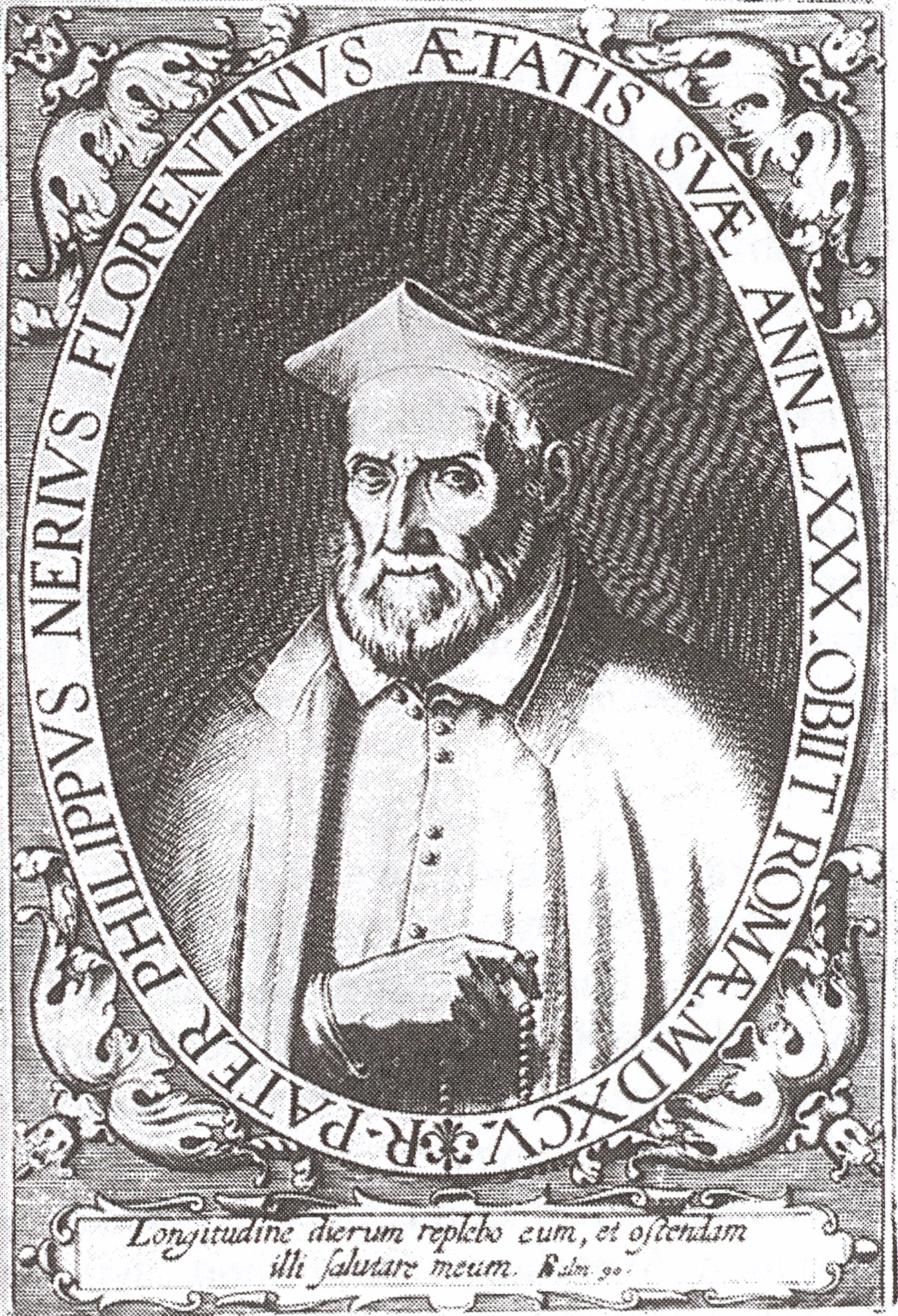
Neri, Nereus, Filippo St, *21st July 1515 Florence, †26th May 1595 Rome, Italian priest and religious activist, canonised in 1622. He spent his youth in his native city, where he maintained contact with the Dominicans from the convent of San Marco, who inspired in him a fascination with their former prior, G.Savonarola. In 1534 he went to Rome with the intention of studying philosophy and theology; however, he did not complete his studies, devoting himself entirely to religious activity. In 1548 he founded the Confraternity of the Most Holy Trinity of Pilgrims and Convalescents, and after his ordination in 1551 he began to lead spiritual exercises for people of various states of life, which included catechesis, prayer, and religious discussion. Following the model of Savonarola’s reforms from 1490, Neri also introduced the practice of singing vernacular laude spirituali. The meetings were initially held in Neri’s own lodgings next to the church of San Girolamo della Carità, but owing to the growing number of participants, they were moved to the church oratory. Neri’s circle of collaborators gave rise to a congregation, approved in 1575 by Pope Gregory XIII’s bull as the Congregazione dei Preti dell’Oratorio, also known as the Oratorians, which was given the church of S. Maria in Vallicella, soon renamed Chiesa Nuova, as its seat. Recognising the role of music in apostolic activity, Neri established contact with many Roman composers. The maestri di cappella of the Oratory included G. Animuccia and F. Soto de Langa, and it is likely that G.P. da Palestrina and T.L. de Victoria also maintained contact with him. It is possible that in the 1550s Neri also met Orlando di Lasso, whose motet compositions are richly represented in the inventories of the Chiesa Nuova. However, the core of the repertoire performed in the Oratory consisted of madrigali spirituali, and especially three- to four-voice laude written by the maestri di cappella of the Chiesa Nuova (nine books were published between 1563 and 1600). The dialogued variant of this genre may have had some influence on the development of the oratorio volgare. A more direct connection with this form – which owed much of its popularity to the Oratorians as well –is found in the works written for the Oratory after Neri’s death, including the dialogued madrigals of G.F. Anerio (Teatro armonico, 1611) and D. Mazzocchi (Madrigali…, 1638), as well as P. della Valle’s Dialogo detto Purificatione (1640).
Literature: P. Bacci Vita di San Filippo Neri, fiorentino, Rome 1622; L. Ponelle, L. Bordet Saint Philippe Néri et la société romaine de son temps, 1515–1595, Paris 1928, 21958, English transl. 1932; Il primo processo per San Filippo Neri nel codice vaticano latino 3798 e in altri esemplari dell’archivio dell’Oratorio di Roma, ed. G. Incisa della Rocchetta and N. Vian, «Studi e Testi» CXCI, CXCVI, CCV, CCXXIV, Rome 1957–63; H.E. Smither A History of the Oratorio, vol. 1: The Oratorio in the Baroque Era. Italy, Vienna, Paris, Chapell Hill 1977; A. Morelli Il teatro spirituale ed altre raccolte di testi per oratorio romani del seicento, “Rivista Italiana di Musicologia” XXI, 1986; A. Morelli Il tempio armonico. Musica nell’Oratorio dei Filippini in Roma (1575–1705), “Analecta Musicologica” XXVII, 1991; N. O’Regan Institutional Patronage in Post-Tridentine Rome. Music at Santissima Trinità dei Pellegrini 1550–1650, «Royal Musical Association Monographs» VII, London 1995; P. Macey Bonfire Songs. Savanarola’s Musical Legacy, Oxford 1998; San Filippo Neri nella realtà romana del XVI secolo, ed. M.T. Bonadonna Russo, N. Del Re, «Collana Miscellanea della Società romana di storia patria» XXXIX, Rome 2000; L. Schmidt Die römische Lauda und die Verchristlichung der Musik im 16. Jahrhundert, «Schweizer Beiträge zur Musikforschung» II, Kassel 2003; J. Bramorski Muzyka jako chrześcijańska ‘paideia’ na przykładzie oratorium św. Filipa Nereusza, in: Muzyka sakralna w wymiarze kulturowo-edukacyjnym: Inspiracje i wyzwania, ed. J. Bramorski, «Musica sacra» IX, Gdańsk 2013; A. Piéjus Musique et dévotion à Rome à la fin de la Renaissance: Les laudes de l’Oratoire, Turnhout 2013; La lauda dell’Oratorio. Aspetti e funzioni, ed. F. Cantone, «Miscellanea Musicologica» X, Rome 2018; I. Fenlon Music and Domestic Devotion in the Age of Reform, in: Domestic Devotions in Early Modern Italy, ed. M. Corry, M. Faini, A. Meneghin, Leiden 2019.
E. Magni Lettere, rime e detti memorabili de San Filippo Neri, Florence 1922