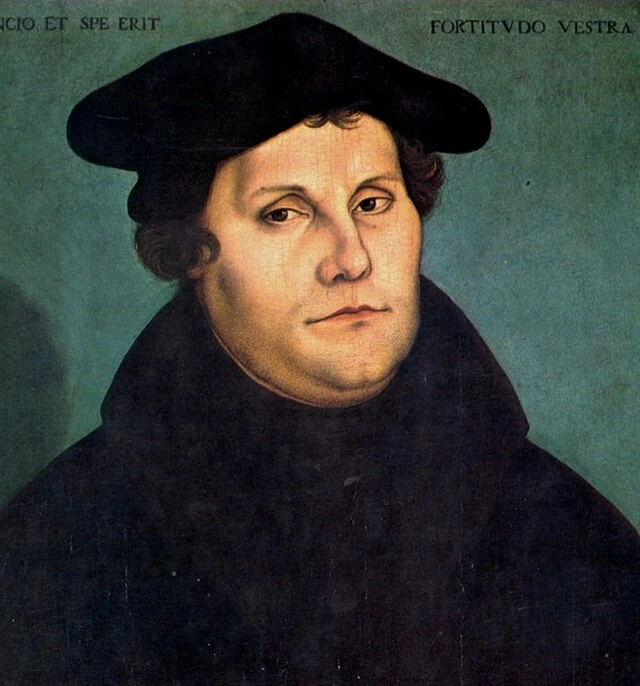
Luther Martin, *10 November 1483 in Eisleben, †18 February 1546 in Eisleben, German theologian and religious reformer. In his youth, he received an education in music practice (he sang tenor, played the lute and flute) and music theory (the principles of choral singing, mensural music, and the basics of counterpoint). The main source of Luther’s views on music is Encomion musices, a preface he wrote to G. Rhau’s collection Symphoniae jucundae (1538). The author, following St. Augustine, emphasizes that music was given to humanity by God and should be used to praise Him. He also draws on J. Tinctoris to highlight music’s diverse effects and educational value. Numerous statements by Luther are contained in the sketch Peri tēs mousikēs (1530), in the preface to the hymnals by J. Walter (1524), H. Weiss (1528), J. Klug (1542), V. Bapst (1545) and to J. Walter’s poem on music (1538), in letters to G. Spalatin (1523), L. Senfl (1530), M. Weller (1534), M. Crodel (1542), scattered throughout Tischreden, as well as contemporary accounts indicate that he did not repeat these traditional views mechanically, but accepted them with full conviction. Luther also admired polyphony as a divine design. Believing that music aids in understanding God’s word and leads people to God, he placed it in the hierarchy of importance just after theology and accepted it regardless of the composer’s denomination. He valued highly the works of Josquin des Prés and L. Senfl. He did not reject instrumental music either; in his mature years, he himself accompanied vocal ensembles on the lute, and allowed the use of organs during church services.
Luther devoted three works to liturgy: Formula missae et communionis pro Ecclesia Wittembergensi (1523), Von Ordnung Gottesdienst in der Gemeine (1523), and Deutsche Messe und Ordnung Gottesdienst (1526). In the first two, while retaining Latin, the reform mainly consisted of limiting the types of services, the variety of mass forms (ceremonies in honor of many saints were omitted), and the number of prayers during mass. Gregorian chant remained almost unchanged, often in local versions; however, Luther envisaged polyphonic performance of certain parts of the mass more often than in the Catholic liturgy; he also recommended the performance of German hymns thematically related to Latin chants as part of the mass. In Deutsche Messe, he included a German translation of the text of the reformed mass. The melodies of Gregorian chant were reworked here; Luther, together with K. Rupsch and J. Walter, adapted them to the new words. The Latin and German versions were treated equally, and Luther took care to provide a repertoire by collaborating with the publisher G. Rhau, who issued collections of appropriate works with Latin texts, and especially with J. Walter, who composed polyphonic German hymns. He also supported the publication of hymnals, intended primarily for clergy and cantors rather than the general congregation, although some German hymns were also meant for domestic performance.
Luther wrote at least 37 hymn texts that became part of the basic repertoire of Protestant chorales (23 of them appear in J. Walter’s collection from 1524). It is assumed that he set these texts to music himself, although his authorship is mostly undocumented. These melodies are adaptations of Catholic liturgical chants, German sacred and secular songs (folk and popular), or were constructed using conventional formulas. The value of these songs lies in the strong connection between the music and the text; it emphasizes both the grammatical and logical accents of the words and the overall mood. Luther’s poetic texts include translations of seven psalms (including Psalm XLVI Ein feste Burg and Psalm CXXX Aus tiefer Not), whose melodies are relatively independent, and translations of six Latin hymns (including Komm Gott Schöpfer – from Veni Creator, Nun komm der Heiden Heiland – from Veni Redemptor, Herr Gott, dich loben wir – from Te Deum) and three other Latin liturgical chants (including Die deutsche Litanei and Christ lag in Todesbanden), whose melodies are very close to their pre-Reformation originals. The melodies show varying degrees of dependence on their models: nine are based on earlier German sacred songs used for the translation of Hus’s hymn Jesus Christus nostra salus, two derive from unidentified model, and nine are based on texts from the Old and New Testaments (e.g. Vater unser or the baptism hymn Christ unser Herr zum Jordan kam). The Old Testament is the basis for, among others, the hymn Jesaja dem Propheten, included in the German mass in place of the Sanctus; Luther’s authorship of this melody, which is an adaptation of the Gregorian Sanctus, is most strongly attested. Luther is also probably the author of the four-part tenor hymn Non moriar sed vivam, while the four-part psalm LXIV attributed to him by J. Klug is presumably the work of J. Walter. Some of Luther’s hymn melodies (sometimes accompanied by translations of his texts) appear in Polish hymnals (e.g., those of Seklucjan, Artomiusz, and others). Luther’s decisions regarding the place and type of music practiced within the Evangelical Church had a significant impact on the history of music in the countries covered by his reform, and the repertoire of hymns, or Evangelical chorales, shaped by him or on his initiative, was also used extensively by the most outstanding German composers of the following centuries.
Literature: J. Rautenstrauch Luther und die Pflege der kirchlichen Musik in Sachsen, Leipzig 1907, repr. 1970; K. Anton Luther und die Musik, Zwickau 1916, 3rd ed. 1928; H. Kretzschmar Luther und die Musik, “Jahrbuch der Musikbibliothek Peters” XXIV, 1917; H. Abert Luther und die Musik, Wittenberg 1924; R. Gerber Zu Luthers Liedweisen, in: Festschrift Max Schneider zum 60. Geburtstag, eds. H.J. Zingel, Halle 1935; H.J. Moser Die Melodien der Luther-Lieder, Leipzig 1935; C. Mahrenholz Luther und die Kirchenmusik, Kassel 1937; F. Messerschmid Die Kirchenlieder Luthers, Würzburg 1937; W.E. Buszin Luther on Music, “The Musical Quarterly” XXXII, 1946; P. Netti Luther and Music, Philadelphia 1948, repr. New York 1967; W. Blankenburg Luther und die Musik, “Luther” XXVIII, 1957; K. Ihlenfeld Die himmlische Kunst Musica: ein Blick in Luthers Brief, “Luther” XXXIV, 1963; M. Jenny The Hymns of Zwingli and Luther. A Comparison, in: Cantors at the Crossroads. Essays on Church Music in Honor of Walter E. Buszin, ed. J. Riedel, St Louis 1967; R. Mazurkiewicz O melodiach kancjonałów Jana Seklucjana z 1547 i 1559 roku. Przyczynek do dziejów chorału protestanckiego w Polsce, Krakow 1967; O. Söhngen Theologie der Musik, Kassel 1967; W. Blankenburg Überlieferung und Textgeschichte von Martin Luthers Encomion musices, “Lutherjahrbuch” XXXIX, 1972; M. Jenny Luthers Gesangbuch, in: Leben und Werk Martin Luthers von 1525 bis 1546, ed. H. Junghans, Berlin 1983; J.D. Kraege Luther théologien de la musique, “Etudes théologiques et religieuses” LVIII, 1983; O. Söhngen Luthers Bedeutung für die Geschichte der Musik, “Musik und Kirche” LIII, 1983; M. Staehelin Luther über Josquin, in: Festschrift Martin Ruhnke zum 65. Geburtstag, Neuhausen 1986; P. Veit Das Kirchenlied in der Reformation Martin Luthers, Wiesbaden 1986; K. Ameln „All Ehr und Lob soll Gottes sein”. Ein deutsches Gloria von Martin Luther?, “Jahrbuch für Liturgik und Hymnologie” XXXI, 1988; C. Schalk Luther on Music. Paradigms of Praise, St. Louis 1988; H. Robinson-Hammerstein The Lutheran Reformation and its Music, in: The Transmission of Ideas in the Lutheran Reformation, ed. H. Robinson-Hammerstein, Dublin 1989; H. Pietsch On Luther’s Understanding of Music, “Lutheran Theological Journal” XXVI, 1992; J.L. Irwin Neither Voice nor Heart Alone: German Lutheran Theology of Music in the Age of the Baroque, New York 1993; H. Guicharrousse Les musiques de Luther, Geneva 1995; R.A. Leaver Theological Consistency, Liturgical Integrity, and Musical Hermeneutic in Luther’s Liturgical Reforms, “Lutheran Quarterly” IX, 1995; R.A. Leaver Luther’s Catechism Hymns, “Lutheran Quarterly” XI/XII, 1997/8; A. Lindner „Non moriar sed vivam”: Luther, Senfl und die Reformation des Hochstifts Naumburg-Zeitz, “Jahrbuch für Liturgik und Hymnologie” XXXVI, 1997; M.L. Hendrickson Musica Christi: A Lutheran Aesthetic, New York – Berlin – Oxford 2005; R.A. Leaver „Concio et Cantio”: kontrapunkt teologii i muzyki w tradycji luterańskiej od Praetoriusa do Bacha, “Muzyka” LII, 2007 no. 4; R.A. Leaver Luther’s Liturgical Music: Principles & Implications, Grand Rapids 2007; R.A. Leaver Luther as Composer, “Lutheran Quarterly” XXII, 2008; R.A. Leaver Luther’s Theological Understanding of Music, in: Music and the Renaissance. Renaissance, Reformation and Counter-Reformation, ed. P. Vendrix, Farnham 2011; M.E. Anttila Luther’s Theology of Music. Spiritual Beauty and Pleasure, Berlin 2013; R. Charteris Newly identified music editions from the private library of Martin Luther, “In Monte Artium” VI, 2013; J.A. Loewe „Musica est optimum”: Martin Luther’s Theory of Music, “Music & Letters” XCIV, 2013; J. A. Loewe Why do Lutherans Sing? Lutherans, Music and Gospel in the First Century of Reformation, “Church History” 82, 2013, no. 1; M.C. Mattes Martin Luther’s Theology of Beauty. A Reappraisal, Grand Rapids 2017; P. Poźniak Miejsca wspólne repertuaru pieśniowego w polskich kancjonałach ewangelickich XVI w., in: Luteranizm w kulturze Pierwszej Rzeczypospolitej, ed. K. Meller, Warsaw 2017; A. Loewe and K. Firth Martin Luther’s „Mighty Fortress”, “Lutheran Quarterly” XXXII, 2018; A. Leszczyńska Piosnka nadobna dla dziatek. Z myślą o młodocianych użytkownikach polskich kancjonałów, “Odrodzenie i Reformacja w Polsce” 62, 2019; Y.E. Kartawidjaja Music in Martin Luther’s Theology, Göttingen 2021; Martin Luther and the Arts. Music, Images, and Drama to Promote the Reformation, eds. A. Loewe and K. Firth, Leiden 2022.
Dr M. Luthers Werke, Weimar 1883–, vols. 12 and 19 (the arrangement of the liturgy), 1891 and 1897, vol. 30, part 2 (Pen tēs mousikēs), 1909, revised ed. 1967, vol. 35 (1- and 4-voice pieces and the preface to the hymnals, eds. W. Lücke, HJ. Moser et al.), 1923, vol. 50 (Encomion), 1914, series Briefwechsel vol. 3, 1933, vol. 5, 1934, vol. 7, 1937, vol. 10, 1947, series Tischreden, vols. 1–6, 1912–1921
Luther’s Works, eds. J. Pelikan and H. Th. Lehmann, St. Louis 1955–, vol. 53 (writings on music and liturgy, as well as musical works)
M. Luther, Sämtliche deutsche geistliche Lieder, ed. F. Klippgen, Halle 1912
Luther, Gedanken über die Musik, aus dessen Werken gesammelt, ed. F.A. Beck, Berlin 1925
Deutsche Messe, ed. G.H. Kawerau, Leipzig 1926 and facs. ed. J. Wolf, Kassel 1934
M. Luther, Liturgische Schriften, ed. O. Dietz, Munich 1940