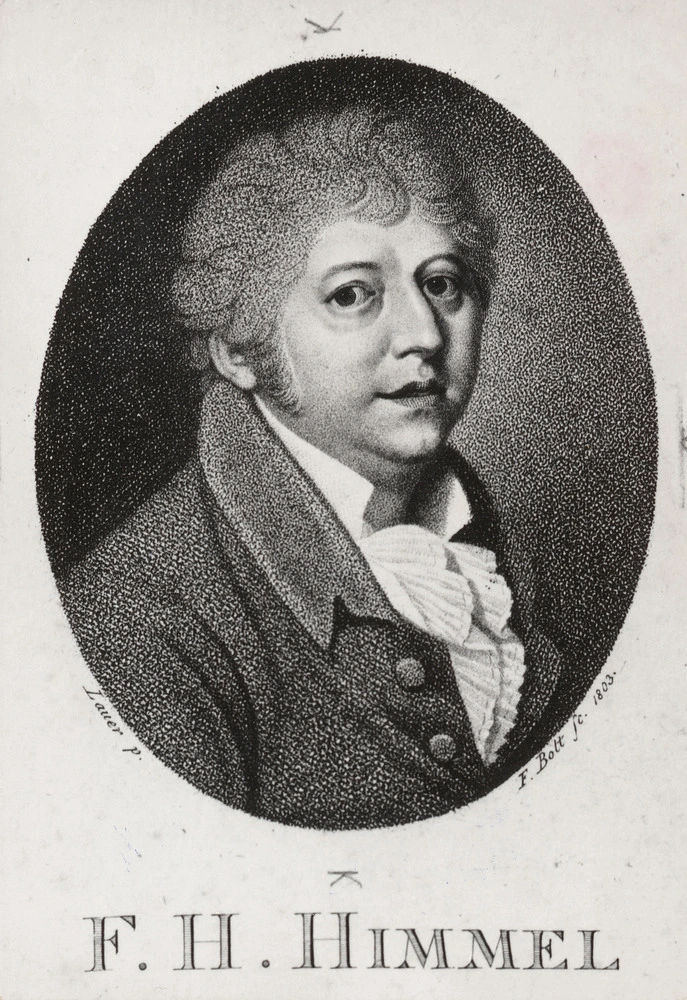
Himmel Friedrich Heinrich, *20 November 1765 Treuenbrietzen, †8 June 1814 Berlin, German composer and pianist. He took his first piano and organ lessons from the organist in Treuenbrietzen. From 1785, he studied theology in Halle. In 1786, he applied for the position of military chaplain in Potsdam; on this occasion, Frederick William II noticed his piano skills and awarded him a scholarship for music studies, which Himmel completed in 1787–92 with J.G. Naumann in Dresden and after, he became the court composer of the King of Prussia. He then traveled to Italy. There he received news of his appointment as royal Kapellmeister and returned to Germany in 1795. Between 1798 and 1800, while on leave, he stayed at the courts of the rulers of Russia, Denmark, and Sweden, enjoying great artistic and financial success. In 1800, he returned to Berlin. The premiere of his opera Vasco di Gama (12 January 1800) and the performance of Rosmonde by J.F. Reichardt (6 February 1801) sparked a debate in Germany about opera style, with Himmel advocating the Neapolitan school of opera and Reichardt favoring the style of Gluck’s opera. Between 1808 and 1810, Himmel stayed with the royal court in Königsberg. Until the end of his life, he traveled extensively throughout Germany and also visited Rome, Vienna, Paris, and Prague, enjoying success as a composer and pianist.
Due to his position at court, Himmel wrote many occasional compositions. His prolific output, almost forgotten by the mid-19th century, was nevertheless popular with his contemporaries and enjoyed many editions. His songs and stage works were particularly popular, including the liederspiel Frohsinn und Schwärmerey and the singspiel Fanchon das Leyermädchen. The simplicity and lightness of their melodies stemmed from Italian arias, while their simple strophic structure corresponded to the ideal of the Berlin school of song. The popularity of Himmel’s melodies also extended to Polish lands in the 19th century, as evidenced by, among others, the publication of the piano piece Polonoise favorite by the I. Klukowski Bookshop in Warsaw in a four-hand arrangement (1823), the song with a Polish text by Fr. F. Kowalski entitled Modlitwa przed bitwą (Prayer before the Battle 1832), as well as collections containing his works. Professional critics, however, did not find any innovative elements in Himmel’s music. Beethoven succinctly characterized him as a composer: “a polite talent, nothing more.” Music historians (H.J. Moser, E. Bücken) attribute a pioneering significance to some of his works – the magical opera Die Sylphen was regarded as a forerunner of Weber’s operas, while the song cycle Alexis und Ida is seen as an anticipation of Schubert’s song cycles.
Literature: M. Steuer Die Erstaufführung von Himmels „Fanchon” 1804, “Signale für die Musikalische Welt” XXXIV, 1904; A. Kohut Friedrich Heinrich Himmel, “Neue Zeitschrift für Musik” LXXXI, 1914; L. Odendahl Friedrich Heinrich Himmel. Bemerkungen zur Geschichte der Berliner Oper um die Wende des 18. und 19. Jahrhunderts, a dissertation at the University of Bonn, 1914, Bonn 1917 (a fragment); L. Gelber Die Liederkomponisten A. Harder, F.H. Himmel, F.F. Hurka, C.G. Hering. Ein Beitrag zur Geschichte des musikalischen Liedes zu Anfang des 19. Jahrhunderts, Berlin 1936; M. Erfurt-Freund Friedrich Heinrich Himmel (1765–1814). Zur Gattungsproblematik deutschsprachiger Bühnenwerke in Berlin um 1800, Saarbrücken 1993.
Compositions:
Instrumental:
orchestral:
Sinfonia in F major (lost?)
Piano concerto in D major Op. 25, Leipzig 1808
two piano concertos with accompaniment by a small orchestra
2 marches pour musique de militaire for orchestra
2 marches militaires en harmonie à 11 parties Op. 34, for orchestra, Leipzig 1810
chamber:
Grand sestetto in F major for piano, two horns, two violas, and cello, Op. 18, Leipzig 1802, Hamburg n.d., as Op. 19, Riga 1799, Paris n.d.
2 quartets for piano, flute, violin, and cello, Berlin 1803
Air des matelots varié for piano, violin, and cello, Op. 15, Leipzig 1803 (?)
14 sonatas for piano, violin, and cello, among others Op. 16, Leipzig 1804, Op. 17, 21., Berlin, Leipzig 1803;
Grande sonate for flute and harpsichord or piano, Op. 14, Berlin 1802 (?), Hanover n.d. (for violin and piano), Leipzig n.d. (for violin or flute and piano)
piano:
Grande sonate for 2 pianos (harpsichords), Leipzig 1801
Sonata for four hands, piano (harpsichord), Op. posth., Berlin, n.d.
several cycles of variations for piano (harpsichord), including 10 published in Leipzig, Berlin, Speyer, and Offenbach, 1790–1814 (?)
ländlers, waltzes, minuets, marches, écossaises, polonaises, and other short pieces for piano (harpsichord), Leipzig, 1808–1811
Vocal-instrumental:
ca. 30 cycles of songs, including:
Sechs Lieder Op. 21, text J.W. Goethe, Leipzig 1807
Zwölf alte deutsche Lieder des Knaben Wunderhorn Op. 27, Leipzig 1808
Bewustseyn (…) und Fünf Gedichte Op. 33, text E. von der Recke and C.A. Tiedge, Leipzig ca. 1810
Alexis und Ida. Ein Schäferroman in 46 Liedern Op. 43, text C.A. Tiedge, Leipzig 1814
individual songs published in Zerbst, Berlin, Leipzig, Dresden, Oranienburg, Bonn, Amsterdam, Wrocław, and Vienna, as well as in manuscript
12 sacred and secular cantatas
Isacco figura del redentore, oratorio, text P. Metastasio, 1792
Das Lob Gottes, hymn for 4 solo voices and orchestra, Berlin 1804
Te Deum 1798
Salve regina and psalms for 4 solo and instrumental voices
Vesper
2 masses
Stage:
Il primo navigatore, libretto S.A. Sografi, staged in Venice 1794 (fragments surviving)
La morte di Semiramide, libretto A. di Benedetto after Voltaire, staged in Naples 1795
Alessandro, libretto F. Moretti, staged in Saint Petersburg 1799
Vasco di Gama, libretto A. de Filistri, staged in Berlin 1801
Frohsinn und Schwärmerey, libretto C.A. Herklots, staged in Berlin 1801
Fanchon das Leyermädchen, libretto A. von Kotzebue after N. Bouilly, staged in Berlin 1804; piano reduction Leipzig 1805 (?)
Die Sylphen, libretto E.L. Robert and M. Levin after La donna serpente by C. Gozzi, staged in Berlin 1806, published in Munich n.d.; piano reduction Berlin 1806 (?); overture as Op. 22 Leipzig 1807
Der Kobold, libretto after F.W. Gotter, staged in Vienna 1813