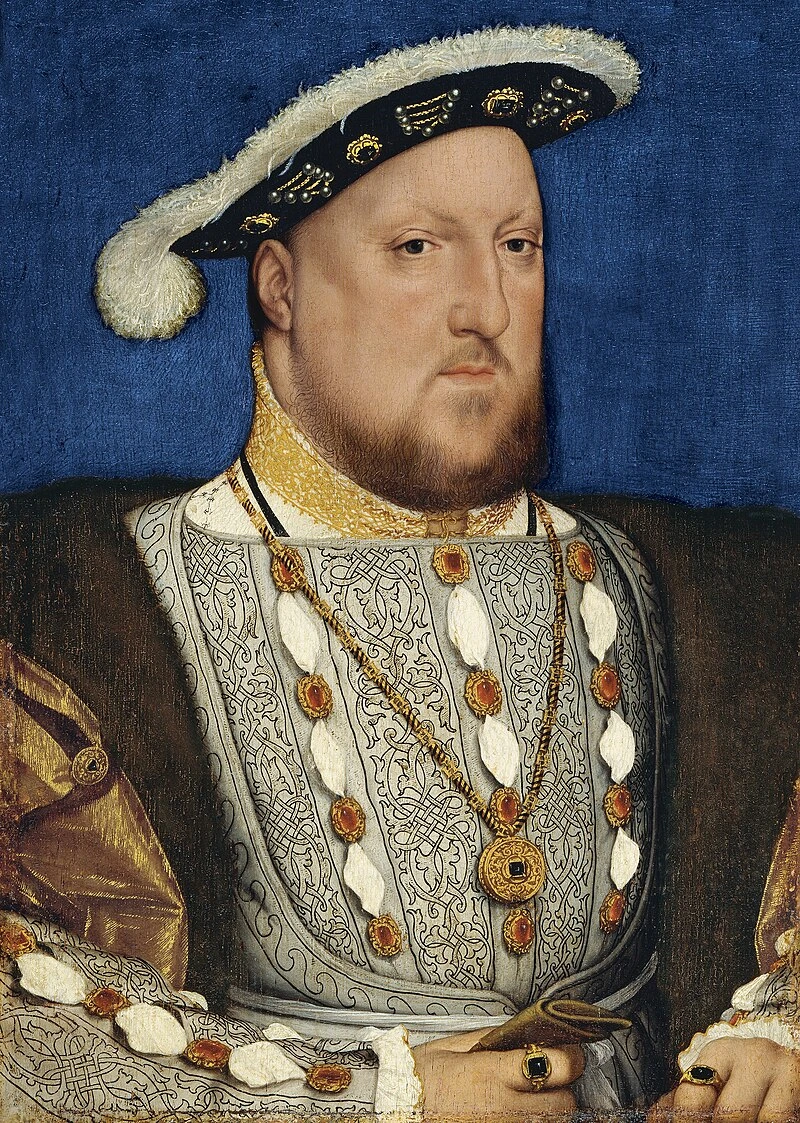
Henry VIII Tudor *28 June 1491 Greenwich, †28 January 1547 Windsor, king of England (from 1509), musician, and amateur composer. During his childhood he received musical education as part of his preparation for the clergy. Numerous references in documents and memoirs indicate that Henry VIII Tudor was particularly fond of music, which played a significant role in enhancing ceremonies and in the everyday life of the court. The king took care to expand and enrich the collection of instruments. In addition to the long-established court ensemble of reed instruments and trombones, a second trombone ensemble was formed in the 1530s, along with a separate ensemble of flutes (which were also previously known at the court). In 1540, six string musicians were brought from Italy, forming the basis of a string orchestra that was developed by subsequent rulers until the 18th century. In the year of Henry VIII Tudor’s death, there were about 60 musicians employed at court, including lutenists and a virginalist. The king himself often played keyboard instruments, the lute, and other instruments, and enjoyed singing with instrumental accompaniment.
Among the works attributed to Henry VIII Tudor, there are 13 songs with English texts, 2 with French texts, 4 pieces with only a textual incipit – either provided alongside the music or incomplete, possibly instrumental – 1 instrumental arrangement of the Dutch melody Taunder naken, and 12 works without any title or incipit. Henry VIII Tudor’s role in the creation of some of the works is unclear; for example, two four-voice songs are also known in anonymous three-voice versions (one of them considerably earlier), so the king likely added only the alto part, which, in terms of melodic style and considerably greater motion, differs markedly from the other voices. Another four-part song, Helas madame bears a striking resemblance Josquin des Prés’ three-part chanson with the same text. Likewise, in the three-voice Pastime with Good Company, the melody is almost identical to the chanson De mon triste deplaisir, first published by P. Attaingnant in 1529. Contrasting voice leading also occurs in the three-voice If Love Now Reigned, but in general, the lines of all voices are constructed similarly. Most songs and untitled pieces are built from two to four clearly defined short sections, which are either repeated immediately or return after some time (e.g., abcdb); the exception is If Love, which consists of as many as nine such sections. The texture is quite varied. Some works, such as Alack, Alack, are entirely chordal, while in other compositions chordal sections are juxtaposed with polyphonic passages; in Departure Is My Chief Pain, the three voices sing a canon in the same register, with the lowest voice repeatedly presenting an ostinato phrase. This clearly illustrates the text: „Departure is my chief pain I trust right well of return again.” Lusty Youth has an extended form with varied texture: the first and second lines are set for three voices, the third and fourth for one voice, and lines five to seven for four voices with developed polyphony in the concluding Amen. In Taunder Naken, successive phrases of the familiar melody are repeated with variation in the middle voice, while the outer voices (especially the top one) provide lively counterpoint. It is unclear to what extent these works represent the independent work of Henry VIII Tudor, but in any case, they testify to his noble ambition and correspond well with accounts of the king’s love of music-making.
Literature: H.C. de Lafontaine The King’s Musick, London 1909, repr. 1973; B. Pattison Music and Poetry of the English Renaissance, London 1948; J. Stevens Music and Poetry in the Early Tudor Court, London 1961; W. Edwards The Instrumental Music of King Henry VIII’s Manuscript, “The Consort” XXXIV, 1978; P. Holman The English Royal Violin Consort in the Sixteenth Century, “Proceedings of the Royal Musical Association” CIX, 1982/83; D.J. Shan A Five-Piece Wind Band in 1518, “Galpin Society Journal” XLIII, 1990; P. Holman Music at the Court of Henry VIII, in: Henry VIII. A European Court in England, ed. D. Starkey, London 1991; D. Rycroft Wind Bands of Henry VII and VIII, “Galpin Society Journal” XLIV, 1991; D. Fallows Henry VIII as a Composer, in: Sundry Sorts of Music Books. Essays on the British Library Collections Presented to O.W. Neighbour on his 70th Birthday, ed. C. Banks, A. Searle and M. Turner, London 1993; D. Helms Heinrich VIII. und die Musik. Überlieferung, musikalische Bildung des Adels und Kompositionstechniken eines Königs, Eisenach 1998; D. Helms Guilielmus Monachus and Henry VIII: Formulaic Compositional Techniques Around 1500, “Tijtschrift voor Muziektheorie” IV, 1999; T. Stemmler A Portrait of the Artist as a Young Man. Henry VIII’s Early Songs, in: Intercultural Encounters: Studies in Literatures. Essays Presented to Rüdiger Ahrens on the Occasion of His 60th Birthday, ed. H. Antor and K.L. Cope, Heidelberg 1999; D. Helms Henry VIII’s Book. Teaching Music to Royal Children, “Musical Quarterly” XCII, 2009.
Compositions:
25 works for 3 voices and 7 works for 4 voices, each bearing the inscription “the Kynge H. VIII” have been preserved among works by other composers in the so-called Henry VIII Manuscript from around 1510–20, British Library, shelfmark Add. 31922
1 motet for 3 voices in MS from ca. 1600, British Library, shelfmark Roy. 24.d.2.
Editions:
All pieces except for the motet in Music at the Court of Henry VIII, ed. J. Stevens, «Musica Britannica» XVIII, London 1962