
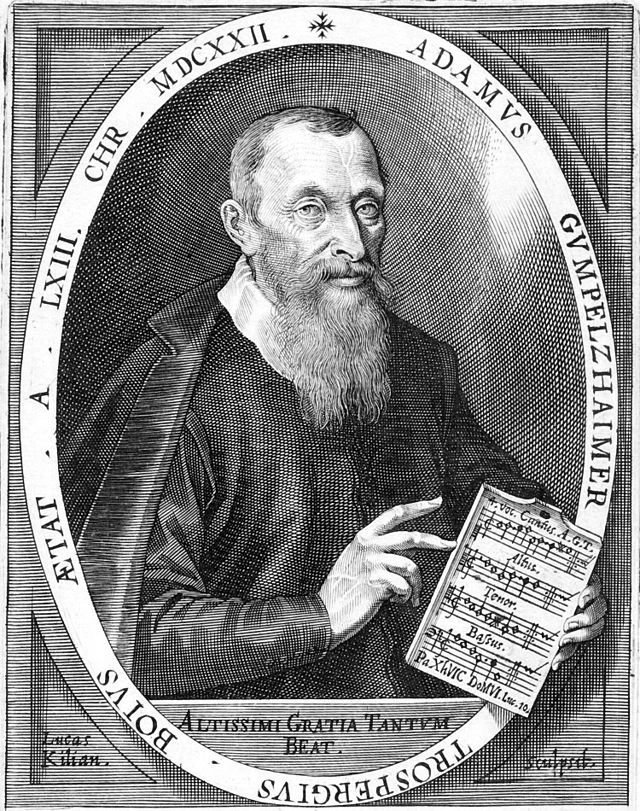
Compendium musicae, pro illius attis tironibus

Gumpelzhaimer, Gumpeltzhaimer, Adam, *1559 Trostberg (Upper Bavaria), †3 November 1625 Augsburg, German music teacher and composer.
As a boy, he spent several years in Oettingen. He then studied music with J. Entzenmüller at the Church of Saints Ulrich and Afra in Augsburg, which at the time was the seat of a Benedictine monastery. He may have received the degree of magister artium at the University of Ingolstadt, where he was certainly matriculated in 1582. For 44 years, from 1581 until his death, he was a tutor and cantor at St Anne’s Gymnasium in Augsburg. He contributed significantly to the development of musical life and the library there, and in 1596 he reorganised the choir. He received numerous salary increases, and in 1611 he was assigned an assistant, Johann Faust, which testifies to Gumpelzhaimer’s high level of activity and the esteem in which he was held. In 1585 he married Barbara Wismüller, with whom he probably had no children. In 1590 he obtained citizenship of Augsburg. He rejected an offer of the position of composer and director of the Württemberg court orchestra in Stuttgart, made to him in 1606. Otto Mayr’s information in «Denkmäler der Tonkunst in Bayern», that Gumpelzhaimer was for a time a member of the Bavarian court orchestra and a pupil of Orlando di Lasso, and then travelled through Italy, has not yet been confirmed by documents.
Gumpelzheimer’s works set to German texts are mostly written – according to the information on the title pages – in the style of Italian villanelles. These simple songs, usually strophic in structure, are predominantly chordal in texture. The tricinia (but not only) are clearly intended for school use. Recitative over repeated chords, often in short rhythmic values, is a characteristic feature of the 53 works on Latin texts preserved in Sacrorum concentuum… (Augsburg, 1601, 1614). These are exclusively motets for two 4-voice choirs, showing a significant influence of the Venetian school, similar to the output of H.L. Hassler and Ch. Erbach, who were active in Augsburg around the same time.
Gumpelzhaimer gained great fame thanks to his treatise Compendium musicae (Augsburg 1591), based largely on H. Faber’s extremely popular textbook Compendiolum musicae… (2nd ed. 1548). He expanded the original work with information on ligatures, and especially on proportions and modes, but his main contribution was the addition of an extensive collection of musical examples, which in the eighth and final edition published during Gumpelzhaimer’s lifetime encompassed nearly 200 vocal and instrumental works. As many as 154 examples come from the author himself, consisting especially of various kinds of canons of considerable didactic value. Between 1591 and 1681, a total of 13 editions of the Compendium were published.
Literature: O. Mayr A. Gumpelzhaimer. Ein Beitrag zur Musikgeschichte der Stadt Augsburg im 16. und 17. Jahrhundert, Augsburg 1908, also as an introduction to «Denkmäler der Tonkunst in Bayern» No. 10/2; K. Köberlin Beiträge zur Geschichte der Kantorei bei St. Anna in Augsburg, “Zeitschrift des Historischen Vereins für Schwaben und Neuburg” No. 49, 1913; K. Köberlin Geschichte des humanistischen Gymnasiums bei St. Anna, Augsburg 1931; O. Wessely Jodoc Entzenmüller, der Lehrer Adam Gumpelzhaimers, “Die Musikforschung” No. 7, 1954; A. Layer Augsburger Musikkultur der Renaissance, w: Musik in der Reichsstadt Augsburg, ed. L. Wegele, Augsburg 1965; R. Schaal Das Inventar der Kantorei St. Anna in Augsburg, Kassel 1965; W. Dekker Ein Karfreitagsrätselkanon aus Adam Gumpelzhaimers “Compendium musicae”, “Die Musikforschung” No. 27, 1974; F. Göthel Gumpelzhaimers “Kreuz-Kanon” im Autograph, “Musik in Bayern” No. 10, 1975; W. Braun Kompositionen von Adam Gumpelzhaimer im Florilegium Portense, “Die Musikforschung” No. 33, 1980; R. Charteris Newly Discovered Works by Giovanni Gabrieli, “Music & Letters” No. 68, 1987; R. Charteris and G. Haberkamp Regensburg, Bischöfliche Zentralbibliothek, Butsch 205–210: a Little-Known Source of the Music of Giovanni Gabrieli and his Contemporaries, “Musica Disciplina” No. 43, 1989; R. Charteris Adam Gumpelzhaimer’s Little-Known Score-Books in Berlin and Kraków, Neuhausen 1996; R. Charteris New Motets by Hans Leo Hassler: Indications of Second Thoughts, in: Musica franca. Essays in Honor of Frank A. D’Accone, ed. I. Alm, A. McLamore and C. Reardon, Stuyvesant 1996; R. Charteris A Rediscovered Collection of Music Purchased for St Anna, Augsburg, in June 1618, “Music & Letters” No. 78, 1997; R. Charteris An Early-Seventeenth-Century Collection of Sacred Vocal Music and Its Augsburg Connections, “Notes” No. 58, 2002; R. Charteris A late renaissance music manuscript unmasked, “Electronic British Library Journal”, 2006; R. Charteris A Neglected Anthology of Sacred Vocal Music Dating from the Sixteenth Century, “Music & Letters” No. 90, 2009; R. Charteris, New light on two canons by Adam Gumpelzhaimer, “Musik in Bayern” No. 82/83, 2017–2018; R. Charteris A Survey of the Art Works Connected to Adam Gumpelzhaimer with Revelations about his Compendium musicae, “Electronic British Library Journal”, 2021.
Compositions:
Neue teutsche geistliche Lieder… for 3 voices, Augsburg 1591, 2nd edition 1602 (lost?), 2 further editions (expanded to include part 2) titled Lustgärtlins teutsch und lateinischer geistlicher Lieder…, Augsburg 1611, 1619
Neue teutsche geistliche Lieder… for 4 voices, Augsburg 1594, 2nd edition 1602 (lost?), edition (expanded to include part 2) titled Wirtzgärtlins teutsch und lateinischer geistlicher Lieder…, Augsburg 1619
Contrapunctus… for 4–5 voices, Augsburg 1595, 2nd edition 1625
Sacrorum concentuum (…) liber primus for 8 voices, Augsburg 1601, …liber secundus for 8 voices, Augsburg 1614
Psalmus LI for 8 voices, Augsburg 1604, 2nd edition 1619
Crux Christi cum titulo for 6 voices, and 2 canons for 6 and 8 voices, Augsburg 1611
3 collections of sacred songs for 4 voices (10, 5 and 2 works), Augsburg 1617
Zwai Schöne Weihenächt Lieder… for 4 voices, Augsburg 1618
Christliches Weihenacht Gesang… for 4 voices, Augsburg 1620
some of these works have been preserved in collective prints and in manuscript copies
compositions in Compendium musicae…
Work:
Compendium musicae, an edition of H. Faber’s treatise and its German translation by Ch. Rid, Augsburg 1591, 2nd expanded edition 1595, 6th edition 1616 and Jena 1636, Augsburg 7th edition 1618 and Erfurt 1665, Augsburg 8th edition. 1625, Ingolstadt 10th edition 1646, Erfurt 11th edition 1655, 13th edition 1681
Editions:
Ausgewählte Werke, ed. O. Mayr, «Denkmäler der Tonkunst in Bayern» X/2, Lepizig 1909 (contains 10 songs for 3 voices and 15 songs for 4–5 voices, 2 carols, 3 works from Contrapunctus… and 8 from Compendium musicae…)
34 works from Compendium musicae…, in: Der Kanon, 3 vols., ed. F. Jöde, Wolfenbüttel 1926
7 songs for 3 voices and 4 songs for 4–5 voices in: Chorbuch, vols. 1, 5 and 6, ed. F. Jöde, Wolfenbüttel 1927–31
Neue deutsche geistliche Lieder (1591), ed. W. Back, Weiblingen 1947
Compendium musicae…, facsimile edition 9–12, Ann Arbor (Michigan) 1965
Neue deutsche geistliche Lieder, ed. M. Rössler, «Das Chorwerk» No. 19, 1973
several works in various anthologies