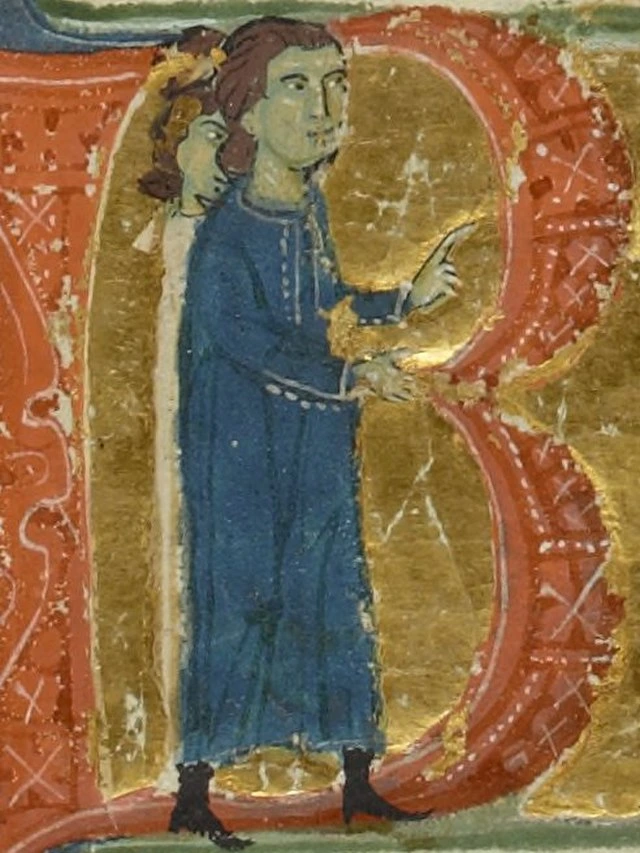
Guiraut de Bornelh, Giraut de Bornelh, Borneil, Borneilh, *ca. 1138 Boureis near Dordogne (?), †ca. 1215, one of the most outstanding Provençal troubadours, known by his contemporaries as the “maestre deis trobadors”.
He came from a poor family living in the vicinity of Excideuil (in the province of Limousin). From his ‘vida’ (a biography written in Provençal in the 13th century), we learn that he taught at a school in the winter and led an itinerant life in the summer. He travelled extensively, particularly in southern France and northern Spain, performing with two singers at the courts of the lords. In his songs, he mentioned his patrons, who included Count Ademan V of Limoges, Alfonso II, King of Aragon, and Alfonso VIII, King of Castile. He took part in the Third Crusade in 1189 alongside Richard the Lionheart, whose valour he celebrated in two works, including one planh. Initially, Guiraut de Bornelh was a proponent of difficult and elitist poetry (trobar clus), but in his later work he advocated a style accessible to the general public (trobar plan), presenting his views in a tenso – a song in the form of a dialogue with his contemporary troubadour Raimbaut d’Orange. Guiraut de Bornelh was renowned for his mastery of poetic form; he was the creator of new strophic and versification structures. Three of his works are cited by Dante in De vulgari eloquentia as models of regular formal structure.
Guiraut de Bornelh wrote around 80 songs, the majority of which are love-themed cansos, whilst the remainder represent other genres: moralising sirventes, dialogued tensos (the earliest examples of this form), pastourelle, albas and romances. Of this rich body of melodic work, only four songs have survived, including the albas Reis glorios, ver ais lums e clardatz and the tenso S’ie-us quier conseil.
Literature: A. Thomas Giraut de Borneil ou Guiraut de Bornelh, “Romania” XXXV, 1906; A. Kolsen Die beiden Kreuzzugslieder des Trobadors Guiraut de Bornelh, «Romanische Forschungen» XXIII, 1907; H. Angles La Música a Catalunya fins al segle XIII, Barcelona 1935; B. Panvini Giraldo de Bornelh, trovatore del secolo XII, Catania 1949; J. Boutière, A.-H. Schutz Biographies des Trobadours, Paris 1950, 2nd edition 1964; E. Hoepffner Les troubadours dans leur vie et dans leurs oeuvres, Paris 1955; F. Gennrich Der musikalische Nachlass der Troubadours, 3 vols., Darmstadt 1958, 1960, 1965; B. Stäblein Zur Stilistik der Trobadour-Melodien, “Acta Musicologica” XXXVIII, 1966; H. van der Werf The Chansons of the Troubadours and Trouvères. A Study of the Melodies and their Relation to the Poems, Utrecht 1972.
Kolsen Sämtliche Lieder des Trobadors Guiraut de Bornelh, 2 vols., Halle 1910, 1935
J. Maillard Anthologie de chants de troubadours, Nice 1967