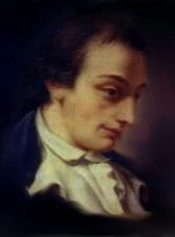
Guglielmi Pietro, Pier, Piero, Alessandro, *9 December 1728 Massa, †19 November 1804 Rome, Italian composer. He initially learned to play the viola and bassoon, probably from his father, Jacopo Guglielmi (kapellmeister at the court of Prince Alderano Cybo in Massa), and to play keyboard instruments and study counterpoint from his uncle, Domenico Guglielmi (organist at Massa Cathedral). He may also have been a pupil of G. Puccini; it is said that as a child he was a violist in Prince Cybo’s orchestra. Around 1746–54, thanks to the patronage of Princess Ricciarda Gonzaga, he studied with F. Durante at the Conservatorio di S. Maria di Loreto in Naples. In 1757, he composed his first stage work for the Teatro dei Fiorentini in Naples – a chelletta pe’museca entitled Lo solachianello ’mbroglione, set to a libretto written in the local dialect. He then worked in Naples for several years, composing comic operas for the local theatres. In 1763, his first opera seria, Tito Manlio, was composed and staged at the Teatro Argentina in Rome. Between 1764 and 1767, he probably resided in Venice, as indicated by the premieres of P.A. Guglielmi’s operas staged there at the time; his works were also performed during this period in the theatres of Rome, Florence, Trier and Milan. Between 1767 and 1772, he worked at the King’s Theatre in London; it was there that fragments of several of his operas (the collection Favourite Songs) and instrumental works were published. Upon his return to Italy, he staged operas in Venice, Rome, Florence, Turin and Milan. He spent the years 1776–93 in Naples – this was the period of P.A. Guglielmi’s greatest compositional successes. His operas successfully rivalled the works of G. Paisiello and D. Cimarosa, who were active in the city at that time. La villanella ingentilita, La quakera spiritosa, Le vicende d’amore, La virtuosa di Mergellina, La pastorella nobile, La bella pescatrice and La serva innamorata gained particular renown. The oratorio Debora e Sisara was also a huge success, which presumably contributed to P.A. Guglielmi’s appointment in 1793 as Kapellmeister of St Peter’s Basilica in Rome. In 1797, P.A. Guglielmi also took on the duties of Kapellmeister at the church of S. Lorenzo in Lucina in Rome. He was, among other things, a member of the Accademia di S. Cecilia in Rome and the Istituto Nazionale in Naples. He had a reputation as a spendthrift and a libertine who cared little for his large family (eight children). He also gained a reputation as an excellent fencer and a participant in numerous duels.
P.A. Guglielmi was one of the most outstanding figures of the last generation of the Neapolitan opera school. Among his numerous stage works, comic genres predominated (opera buffa, intermezzos, farces), in which his compositional talent was most fully revealed. The works, composed over a period of 40 years, underwent a certain evolution in form. Initially (the 1660s and 1670s), three-act operas predominated, in which the da capo aria was dominant, and the relatively few ensembles were constructed on the principle of a chain-like sequence of sections. In P.A. Guglielmi’s later comic operas (generally in two acts), the role of ensembles increased significantly; these created a particular build-up of action in the finales of acts and operas, whilst the da capo aria was replaced by a two-part aria with a repetition, offering considerable scope for formal variation (ABAB, ABA1B1, ABCB1, ABCA1B1CC and others). Alongside this type of aria, there were also solo parts in the form of cavatinas and rondos. Formal changes were also evident in opera overtures. The traditional three-movement Italian sinfonia was, over time, replaced by a single-movement allegro with contrasting themes, but with a development section that had not yet fully evolved. During P.A. Guglielmi’s lifetime, his comic operas enjoyed great popularity not only in Italy, but also in many other European countries. In Warsaw during the reign of King Stanisław August, Italian opera companies staged La sposa fedele (1774), L’impresa d’opera (1775), La pastorella nobile (1791), and La virtuosa di Mergellina (1792, under the title La virtuosa bizarra), while German singers performed La sposa fedele (1782, under the title Robert und Kalliste). Of all Guglielmi’s works, the oratorio Debora e Sisara achieved the greatest fame and acclaim; it was also performed in Warsaw (1791). Following the death of P.A. Guglielmi, his stage works fell into obscurity. Research into the composer’s oeuvre carried out in the 20th century not only restored the rightful status of his comic operas, but also revealed the artistic merits of his previously underappreciated opere serie. P.A. Guglielmi’s church works survived in performance practice for much longer than his operas (they were still being performed in Rome at the beginning of the 20th century), yet they have not yet been studied in detail. His relatively modest body of instrumental works was composed mainly during the composer’s stay in London. The sonatas Op. 3, published there, consist of two movements: a moderate or fast movement and a minuet or rondo; the simple and short, non-contrasting themes are developed through repetition.
Literature: J. Le Breton Notice sur Pietro Guglielmi, “Magasin encylopédique”, Paris 1806; G. Bustico Pietro Alessandro Guglielmi. Appunti biografici, Massa 1898; F. Piovano Elenco cronologico delle opere (1757–1802) di Pietro Guglielmi (1727–1804), “Rivista Musicale Italiana” XII, 1905; G. Bustico P. Metastasio e Pietro Alessandro Guglielmi, “Rivista teatrale italiana” VII, 1908; G. Bustico Un musicista massese. Pietro Alessandro Guglielmi, Barga 1926; G. Bustico Pietro Alessandro Guglielmi nel Il centenario della sua nascita, “Bolletino bibliografico musicale” III, 1928; K. Geiringer Die “Orlando” – Opern von Pietro Alessandro Guglielmi, in: Musicae scientiae collectanea, Festschrift for K.G. Fellerer, Cologne 1973.
Compositions:
Instrumental:
Sei quartetti for harpsichord, 2 violins and cello, Op. 1, published in London 1768 (?)
Six divertissements for harpsichord and violin, Op. 2, published in London 1770
Six sonatas for harpsichord or piano, Op. 3, published in London ca. 1770
A Conversation Quartetto for oboe or flute, violin, tenor and cello, published in London n.d.
The favorite Scotch divertisement, piano arrangement, published in London ca. 1795
numerous symphonies, quartets and harpsichord pieces preserved in manuscript form
Vocal-instrumental:
arias in 10 pasticcios and operas including those by T. Traetta, G. Paisiello, N. Piccinni and Ch.W. Gluck
approx. 20 cantatas (mainly secular) and oratorios, including:
Debora e Sisara text by C. Sernicola, performed in Naples 1789, fragment published in Naples and London
La morte di Oloferne after P. Metastasio’s La Betulia Liberata, performed in Rome 1791
several masses and mass parts
Requiem
2 offertorios
2 Magnificaty
3 Miserere
Te Deum
several motets
Stage:
around 90 operas, including opere buffe:
Lo solachianello ’mbroglione, libretto by D. Pignataro, performed in Naples 1757
Li rivali placati, libretto by G. Martinelli, performed in Venice 1764
Il ratto della sposa, libretto by G. Martinelli, performed in Venice 1765
La sposa fedele, libretto by P. Chiari, performed in Venice 1767, piano reduction published in Berlin 1777 titled Robert und Kalliste, oder der Triumph der Treue, fragments published in London
I viaggiatori ridicoli tornati in Italia, libretto by G. Bottarelli after C. Goldoni, performed in London 1768, fragments published in London 1768
L’impresa d’opera, libretto by B. Cavalieri, performed in Venice 1769
Il disertore, libretto by C. F. Badini, performed in London 1770, fragments published in London 1770
Le pazzie di Orlando, libretto by C. F. Badini, performed in London 1771, fragments published in London 1771
Il carnevale di Venezia, o sia La virtuosa, libretto by C. F. Badini, performed in London 1772, fragments published in London 1772
L’assamblea, libretto by G. Bottarelli after C. Goldoni, performed in London 1772
Mirandolina, libretto by G. Bertati, performed in Venice 1773
Il matrimonio in contrasto, libretto by G. Palomba, performed in Naples 1776
La villanella ingentilita, libretto by S. Zini, performed in Naples 1779
La Quakera spiritosa, libretto by G. Palomba, performed in Naples 1783, fragments published in Vienna
La virtuosa di Mergellina, libretto by S. Zini, performed in Naples 1785
L’inganno amoroso, libretto by G. Palomba, performed in Naples 1786, fragments published in Naples, Paris and Vienna
Le astuzie villane, libretto by G. Palomba, performed in Naples 1786
La pastorella nobile, libretto by S. Zini, performed in Naples 1788
La bella pescatrice, libretto by S. Zini, performed in Naples 1789, numerous fragments published in Vienna, London, Paris
La serva innamorata, libretto by G. Palomba, performed in Naples 1790, fragments published in Paris
Il poeta di campagna, libretto by S. Zini, performed in Naples 1792, fragments published in Naples
Amor tra le vendemmie, libretto by G. Palomba performed in Naples 1792, fragments published in London
La lanterna di Diogene, libretto by N. Liprandi after G. Palomba, performed in Venice 1793
L’amore in villa, libretto by G. Petrosellini, performed in Rome 1797
opere serie:
Tito Manlio, libretto by G. Roccaforte, performed in Rome 1763
L’Olimpiade, libretto by P. Metastasio, performed in Naples 1793
Siroe re di Persia, libretto by P. Metastasio, performed in Florence 1764
Farnace, libretto by A.M. Lucchini (?), performed in Rome 1765
Demofoonte, libretto by P. Metastasio, performed in Trier 1766
Antigono, libretto by P. Metastasio, performed in Milan 1767
Il re pastore, libretto by P. Metastasio, performed in Venice 1767
Ifigenia in Aulide, libretto by G. Bottarelli, performed in London 1768, fragment published in London 1768
Ezio, probably with A. Sacchini, T. Giordani et al., libretto by P. Metastasio, performed in London 1770
Tamas Kouli-Kan nell’Indie, libretto by V.A. Cigna-Santi, performed in Florence 1774
Merope, libretto by A. Zeno, performed in Turin 1775
Vologeso, libretto by A. Zeno, performed in Milan 1775
Laconte, libretto by G. Pagliuca, performed in Naples 1787
Alessandro nell’Indie, libretto by P. Metastasio, performed in Naples 1789
Siface e Sofonisba, libretto by A.L. Tottola, performed in Naples 1802
intermezzos:
I cacciatori, libretto after C. Goldoni, performed in Rome 1762, fragments titled Gli uccellatori published in London ca. 1770–72
La contadina superba, ovver Il giocatore burlato, performed in Rome 1774
Gl’intrighi di Don Facilone, performed in Rome 1775
farces:
Le vicende d’amore, libretto by G.B. Neri (?), performed in Rome 1784
Gli amanti della dote, libretto by S. Zini, performed in Lisbon 1794
Editions:
2 arias from L’inganno amoroso i I finti amori, in: A. Della Corte Piccola antica settecentesca, Milan 1925
Sonata in E-flat major for piano, ed. M. Maffioletti, Milan 1929