
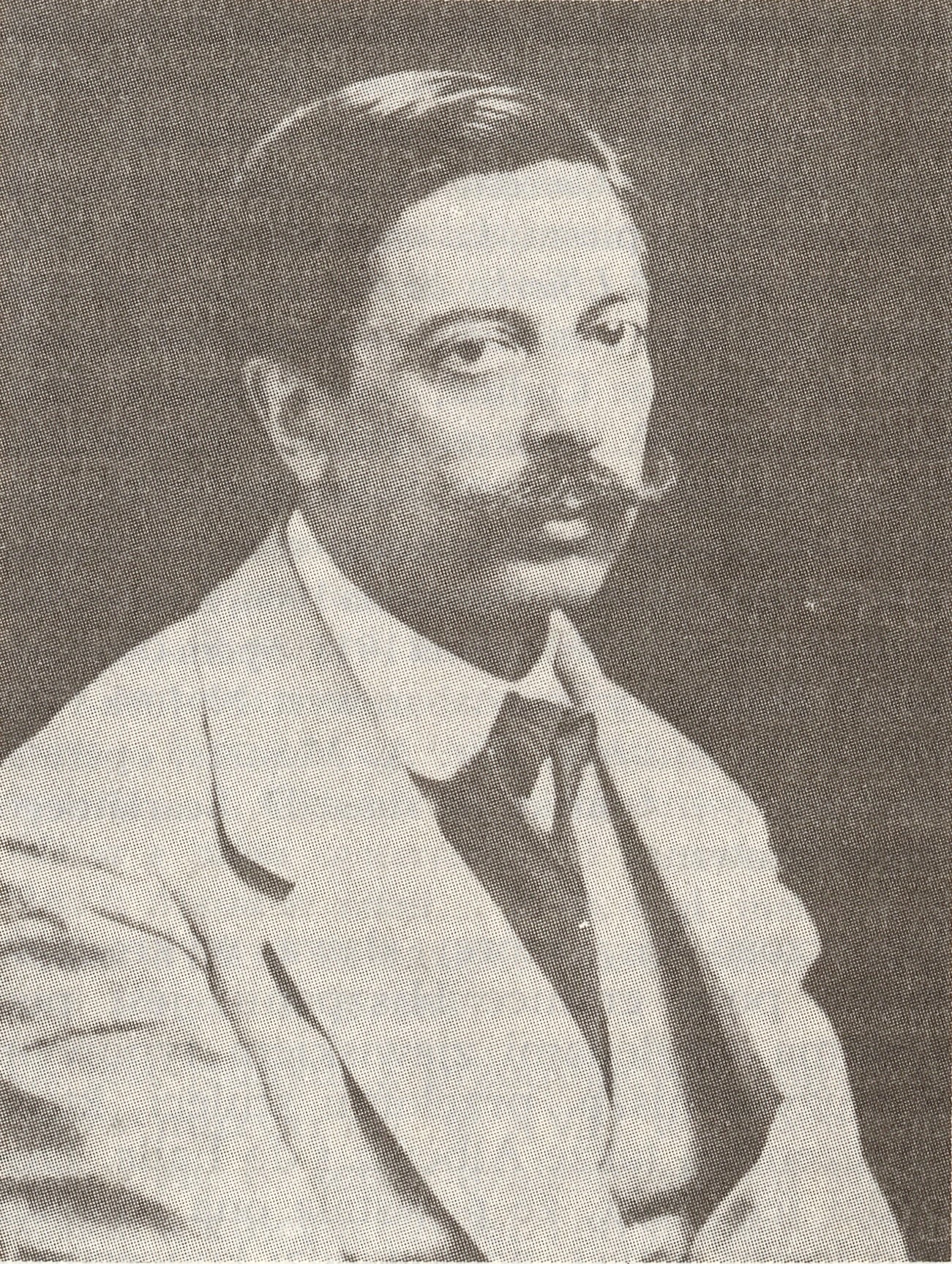
Andaluza [partytura + skrzypce]

Granados y Campiña Enrique, *27 July 1867 Lleida (Castile), †24 March 1916 English Channel, Spanish composer, pianist, and conductor.
He was the son of a Cuban officer in the Spanish army stationed in Havana and a Castilian mother. He began his musical education early, studying piano in Barcelona with F. Jurnet and J. B. Pujol. From 1883 he studied composition with F. Pedrell. In the same year he received an award for his performance of Schumann’s Piano Sonata in G minor. In 1887 Granados went to Paris for further musical studies. There he shared lodgings with the pianist R. Viñes and took private piano lessons from Ch. Bériot. Returning to Barcelona in 1889, he gave his first recital there the following year. In 1892 three of his Danzas españolas were premiered by the orchestra of Pérez Cabrero in an orchestration by Lamote de Grignon; on that occasion Granados also performed Edvard Grieg’s Piano Concerto.
In 1898 he achieved success with the premiere of his first zarzuela María del Carmen, for which he received a royal decoration. The following years filled Granados’s life with compositional activity (including 5 operas staged in Barcelona, the symphonic poem Divina commedia, performed in 1908), pedagogical, organizational, and conducting work (in 1900 he founded in Madrid Sociedad de Conciertos Clásicos, in 1901 a music academy), and he also undertook concert tours with J. Manén, J. Thibaud, P. Casals, and C. Saint-Saëns. However, Granados’s greatest success was the piano cycle Goyescas, performed in Barcelona in 1911; after the Paris performance at the Salle Pleyel in 1914 Granados received the Legion of Honour, and also signed a contract with the Paris Opera to compose a stage work based on Goyescas themes. The premiere of this work took place only in 1916 at the Metropolitan Opera House in New York.
The great compositional success of Granados led to his invitation to give a recital at the White House. On his return journey to Europe, Granados was aboard a ship that was torpedoed in the English Channel by a German submarine; he drowned together with his wife while attempting to save her.
The works of Granados, whose fame extended far beyond the borders of Spain, are in many respects a typical phenomenon of Spanish music at the turn of the century, also represented by Albéniz and de Falla. This is evidenced by the fact that his output also arose as a form of artistic expression by a concert pianist, as shown by certain morphological features (mainly its connection with folklore), as well as its range of genres (almost exclusively piano works, stage works in the form of zarzuelas, and songs, with a lack of classical forms). However, certain different interests, as well as aspects of Granados’s personality, resulted in his output having a somewhat distinctive character.
As a virtuoso, Granados particularly enjoyed performing works by Grieg, Chopin, Schumann, and Liszt. For a time, he remained under the influence of these composers, and certain features of Liszt’s pianistic texture or Schumann’s melodic idiom can still be observed even in his later works (Goyescas). Granados’s settled lifestyle, his aversion to travel, and his infrequent visits to cultural centers such as Madrid or Paris, places often frequented by other Spanish composers, meant that his contact with contemporary European musical life was rather limited and occasional.
The starting point for Granados’s musical language was therefore the repertoire of musical means contained in piano music of the second and third quarters of the 19th century, although he soon freed himself from its direct influence. The final, individual form of Granados’s musical style was shaped under the influence of Spanish folklore, understood in a highly specific way. Like Albéniz, Granados avoided the use of direct quotations from folk music, but the presence of folkloric elements in his music is much more veiled. Frequently drawing on the rhythms of folk dances, he does not foreground them as a primary musical element; instead, by contrapuntally combining rhythmic patterns with free melodic strands in different sound layers, he achieves incidental and constantly changing effects of a polyrhythmic character. He also uses, with similar restraint, the performance idioms so common in Spanish music. Such a multilayered texture gradually led to a weakening of functional harmonic relationships in favor of modal thinking, derived from archaic survivals in folklore. This tendency is perceptible both in individual cadential solutions and in the arrangement of entire melodic sections, whether successive or simultaneous. At times this even leads to suggestions of polytonality. Hence Granados’s harmonyun – like the chordally conceived harmonic technique of Albéniz – is primarily derived from contrapuntal procedures with a folkloric, non-classical origin.
This musical language, thus formed, defines the originality of Granados’s most outstanding works, beginning with Danzas españolas, continuing through Escenas románticas and the song collection Colección de tonadillas, and culminating in the piano cycle Goyescas, in which Granados achieved the full expression of his artistic voice. This is a cycle of impressionistic piano poems, whose total performance time equals that of a symphony, and whose origin is linked to the composer’s fascination with the creative genius of Goya and his vision of the world. Granados, being a painter and collector of paintings, sought in each of the six pieces of the cycle to capture the atmosphere of one of Goya’s canvases, filled with figures of beautiful majos and majas, in whom he saw personifications of Spain’s glorious past. Goyescas thus represent a manifestation of Romantic idealization of the past, while in its musical language it goes beyond Romanticism.
Literature: “Revista musical catalana” from 15 June 1916 (special issue dedicated to Granados); L. Villalba Muñoz E. Granados, semblanza y biografía, Madrid n.d.; G. de Boladeres Ibern E. Granados, Barcelona 1921; H. Collet Albéniz et Granados, Paris 1926, 2nd ed. 1948; J. Subirá E. Granados, Madrid 1926; E. L. Mason E. Granados, Ml XIV, 1933; G. Chase Albeniz and Granados, in: The Music of Spain, New York 1941; A. Livermore Granados and the 19th Century in Spain, “The Music Review” VII, 1946; C. Wilson The Two Versions of „Goyescas”, “The Monthly Musical Record” LXXXI, 1952; P. J. Martinez E. Granados, “Temas españolas” no. 6, Madrid 1952; K. Pahlen M. de Falla und die Musik in Spanien, Otten 1953; F. Vicens E. Granados, Barcelona 1958; A. Fernández Cid Granados, Madrid 1966; A. del Campo Granados, Madrid 1966; P. Villa San-Juan Papeles intimos de E. Granados, Barcelona 1966; S. Martinotti Note critiche su Granados, «Chigiana» XXIV, 1967; K. Rozenschild E. Granados, Moscow 1971.
Instrumental:
orchestral:
Divina commedia, symphonic poem after Dante, 1908
Na nil del mort, symphonic poem
Elisenda, suite for piano and chamber orchestra after a poem by A. Mestres, c. 1910. performed 1912
Escenas poéticas, Paris 1926
3 danzas españolas, Madrid 1912
Marcha de los vencidos
Serenata
Suite arale
Suite gallega
Suite Navidad
chamber:
Andaluza for violin and piano, ca. 1890, pub. Krakow 1959 PWM
Piano Quintet in G minor 1898
Oriental for oboe and strings
Trio for violin, cello, and piano
Serenata for 2 violins and piano
Madrigal for cello and piano
Danza gallega for cello and piano
Romanza for violin and piano
Sonata for violin and piano
3 preludios for violin and piano
piano works:
10 danzas españolas 1892–1900
Goyescas 1911 (1. Los requiebros, 2. Coloquio en la reja, 3. El fandango del candíl, 4. Quejás ó la maja y el ruiseñor, 5. El amor y la muerte, 6. Epílogo. La serenada del espectro)
A la pradera
Allegro de concierto
Aparición
Bocetos (Children’s sketches)
Carezza, waltz
Cartas de amor
3 escenas poéticas
6 escenas románticas
6 estudios expresivos
Rapsodia aragonesa
6 piezas sobre cantos populares españoles
Vocal-instrumental:
Colección de canciones amatorias, 7 songs
Canto gitano
Coleccíon de tonadillas escritas en estilo antiguo, 4 songs
La maja dolorosa, 3 songs
L’herba de l’amor for 3 voices, choir, and organ
Stage:
María del Carmen, zarzuela, libr. J. Feliú y Codina, premiered in Madrid 1898
Petrarca, zarzuela, libr. A. Mestres
Picarol, zarzuela, libr. A. Mestres, premiered in Barcelona 1901
Follet, zarzuela, libr. A. Mestres, premiered in Barcelona 1903
Gaziel, scenic poem, libr. A. Mestres, premiered in Barcelona 1906
Liliana, scenic poem, libr. A. Mestres, premiered in Barcelona 1911
Goyescas, opera, libr. F. Periquet y Zuaznabar, premiered in New York 1916
Miel de la Alcarria, opera, libr. A. Mestres
Ovillejos, operetta
***
transcriptions of 26 sonatas by D. Scarlatti (unpublished)