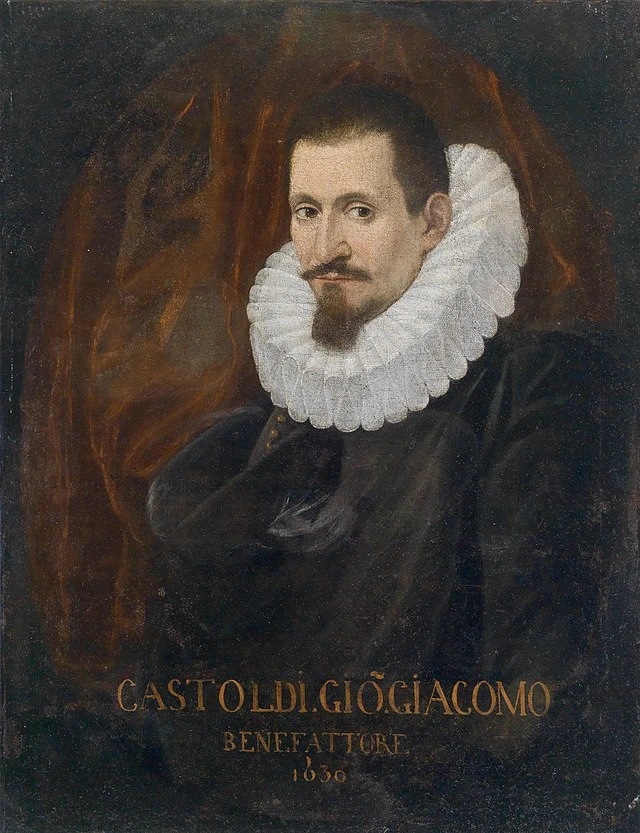
Gastoldi Giovanni Giacomo, *ca. 1555 Caravaggio, †1622, Italian composer and clergyman. Gastoldi’s life and work were primarily associated with the Church of Santa Barbara in Mantua, which was under the special patronage of the Gonzaga family. In December 1572 he was a subdeacon there, and from January 1573 until at least November 1574 he served as a deacon. In 1581 he was listed among the singers of that church. He probably studied music under the guidance of Giaches de Wert, who at that time was the maestro di cappella at the Church of Santa Barbara and at the court of Duke Guglielmo Gonzaga. Between 1579 and 1587, Gastoldi taught as a maestro di contrapunto at Santa Barbara. In 1592, he succeeded Wert as maestro di cappella at the same church, a post he likely held until 1608. Around 1609, Gastoldi was in Milan. There is no information about the later years of his life.
Gastoldi’s oeuvre is rich and varied; it comprises, on the one hand, numerous cycles of sacred compositions, and on the other, balletti, madrigals and canzonettas. The sacred works, preserved mainly in the manuscript collection of the Church of Santa Barbara in Mantua (now in the Biblioteca del Conservatorio di Musica Giuseppe Verdi in Milan) and in contemporary prints, include masses and psalms performed during Vespers. The psalms are notable for their frequent use of the falsobordone technique. One cycle of psalms, intended for only two voices, is didactic in nature. In his sacred music, Gastoldi displayed a particular fondness for the antiphonal and polychoral treatment of choral ensembles.
Of all Gastoldi’s works, his balletti (especially those for 5 voices ones) gained the greatest popularity; they were reprinted many times during the composer’s lifetime, including outside Italy, and even with sacred and biblical paraphrases of the text, as in the Dutch editions. The melodiousness, clarity, and lively rhythm of these balletti attracted the attention of English and German composers, such as Morley, Tomkins, and Hassler, who imitated their style.
The collection of five-voice balletti from 1591 forms a complete work; it consists of the Introduttione, 15 Balletti and the Mascherata. The collection is accompanied by a six-voice Canzonetta and an eight-voice Concerto de Pastori (for two four-voice choruses). The text of the Introduttione serves as an invitation to the balletti. The subsequent 15 pieces bear distinctive titles: L’innamorato, Il bell’humore, Il contento, Speme Amorosa, Lo Schernito, Gloria d’Amore, Il piacere, L’Ardito, Amor vittorioso, Il Premiato, La Sirena, La bellezza, Caccia d’Amore, Il Martellato, L’acceso. These varied titles may have corresponded to characters of dancers in disguise, yet the theme of love in its various shades runs consistently through the texts. An interesting conclusion is provided by Mascherata de Cacciatori (in three parts), in which an additional sixth voice constantly repeats the same phrase and the same text “a la caccia…”. This arrangement of the pieces means that the collection can be regarded as an early form of the madrigal comedy. The three-voice Balletti (16 pieces) also have distinctive titles: Il Ballerino, La Cortigiana, Lo Spensierato, Lo Sdegnato, Il Tedesco, Il Prigioniero, Il Lucchesino, L’Umorista, Il Felice, Il Curioso, Il Risentito, Il Tormentato, Il Costante, Il Fortunato, L’Invaghito, Il Passionao.
Both the three-voice and five-voice pieces have a strophic structure and consist of 2 to 4 stanzas. Musically, each stanza is divided into two parts, each of which is repeated. In balletti for five voices, occur passages consisting solely of the syllables fa–la–la, which the composer usually introduces at the end of individual sections. The fact that the balletti are intended for dancing accounts for their very expressive rhythm and simple, predominantly chordal texture; occasionally, however, short imitations, sometimes in a concertante style, appear. Furthermore, the dance-like character influences the highly symmetrical phrasing. Occasionally, Gastoldi divides the ensemble into groups of higher and lower parts in his five-voice balletti. The introduction of a trio formation in the 1594 collection is also of historical significance – all the works are intended for two canti and bass, a feature already outlined in the 1591 collection of balletti for five voices, where the two highest parts and the bass formed the basis of the composition. As the title suggests (per cantare, sonare…) and in accordance with the practice of the time, the five-voice balletti are vocal-instrumental works in which the individual vocal parts are doubled by instruments. The canto volume containing the ballads for three voices includes lute intavolatura alongside each composition, suggesting that, in addition to the typical performance with instrumental doubling of individual parts and lute accompaniment, a performance for one part (canto) may also have taken place, with the lute playing all three parts (doubling the canto). Many of Gastoldi’s madrigals are in the style of L. Marenzio. His sole collection of instrumental works (Libro della musica) was likely intended for teaching purposes. The interludes, together with the comedy Idropica, were performed during the wedding of Francesco Gonzaga to Margherita di Savoia.
Literature: B. Naudin Ballet Italien de J.J. Gastoldi di Caravaggio (1592), Extrait d’un cahier de musique du XVIe siecle, Paris 1935; E. Kiwi Studien zur Geschichte des italienischen Liedmadrigals im 16. Jahrhundert, Würzburg 1937; A. Einstein The Italian Madrigal, Princeton 1949, reprint 1971 (includes 2 compositions by Gastoldi); A. Obertello Madrigali italiani in Inghilterra, Mediolan 1949; D. Arnold Gastoldi and the English Ballet, “The Monthly Musical Record” LXXXVI, 1956; A. Geddo Bergamo e la musica, Bergamo 1958.
Compositions
Vocal and vocal-instrumental:
sacred:
Sacre lodi a diversi santi… for 5 voices, Venice 1587 R. Amadino
Psalmi ad vesperas in totius anni solemnitatibus…, 16 pieces for 4 voices (it also includes the Magnificat of Giachesa de Wert), Venice 1588 R. Amadino, 2nd edition 1592, 3rd edition 1597, 5th edition 1609 (actually 4th ed.), 5th edition 1616
Completorium… for 4 voices, Venice 1589 R. Amadino; book 2, Venice 1597 R. Amadino
Sacra omnium solemnitatum vespertina psalmodia, cum Beatae Virginis cantico… for 6 voices, Venice 1593 R. Amadino; book 2 titled Salmi intieri che (…) al vespro si cantano, con il cantico della Beata Virgine (…) libro secondo for 6 voices with basso continuo, Venice 1607 R. Amadino
Magnificat per omnes tonos… for two 4-voice choruses, Venice 1597 R. Amadino
Integra omnium solemnitatum vespertina psalmodia, cum cantico Beatae Virginis for 5 voices, 2nd edition Venice 1600 R. Amadino (book basso continuo 1605), 3rd edition 1606, 4th edition. 1609, 5th edition 1614, 6th edition 1616, 7th edition 1626 (these editions also include compositions by F. Gonzaga); book 2 entitled Vespertina omnium solemnitatum psalmodia…, Venice 1602 R. Amadino
Messe a cinque et a otto voci (…) libro primo, Venice 1600 R. Amadino
Tutti li salmi che (…) al vespro si cantano for 8 voices and 2 trumpets, Venice 1601 R. Amadino
Missarum quatuor vocibus liber primus, Venice 1602 R. Amadino, with the addition of basso ad organum, 1611
Messe et motetti a otto voci (…) con la partitura per l’organo, libro primo (…) opera XXX, Venice 1607 R. Amadino
Officium defunctorum integrum… for 4 voices, Venice 1607 R. Amadino
Salmi per tutti li vespri de l’anno… for 2 voices, Venice 1609 R. Amadino
Salmi per tutto l’anno… for 5 voices, Bologna 1673 and Lucca 1705 (reprint of one of the earlier editions)
Mass for 5 voices, Passion for 6 voices, falsobordoni and others, manuscript, Milan
secular:
Balletti a cinque voci (…) con una mascherata de cacciatori a sei voci, et un concerto de pastori a otto (…) novamente ristampati, Venice 1591, 4th edition. 1593, 5th edition 1595, 6th edition 1597, 7th edition 1600, 9th edition 1607, 10th edition 1613, 10 edition Antwerp 1596–1640, Nuremberg 1600, 1606, Paris 1614, Douai 1627, Rotterdam 1628, Amsterdam 1641, in addition, an expanded edition including works by O. Vecchi and others, Amsterdam 1648, 1657, Antwerp 1649 (with Flemish texts)
Balletti a tre voci con la intavolatura del liuto…, Venice 1594, 1604, 1611, entitled Balletti (…) con li suoi versi, wyd. Nuremberg 1600, Antwerp 1602, 1606, 1617, 1631, in addition, expanded to include works by other composers, with texts and titles in German, published in Nuremberg 1607 and in Flemish published in Amsterdam 1628, 1641 no date
Canzoni a cinque voci (…) libro primo, Venice 1581
Il primo libro de madrigali a cinque voci, Venice 1588; book 2 …con un dialogo a dieci et una mascherata a sette, Venice 1589; book 3 for 5, 6 and 8 voices, Venice 1598; book 4 fot 5 and 9 voices, Venice 1602
Il primo libro de madrigali a sei voci, con una danza de pastori a otto, Venice 1592
Canzonette a tre voci, con un baletto nel fine, Venice 1592, 1595; book 2, published in Mantua 1595, Venice 1598, 3rd edition Milan 1615 (expanded to include 4 works by A. Savio)
Concenti musicali (…) commodi per concertare con ogni sorte de stromenti for 8 voices, Venice 1604, Antwerp 1610
2 of 4 interludes (text by G. Chiabrera) for a comedy Idropica of G. Guarini, staged in Mantua 1608 (lost)
Giocco della ciecca, an excerpt from Il pastor fido of G. Guarini
Instrumental:
Il primo libro della musica a due voci, Milan 1598 (including works by other composers)
Editions:
Viver lieto voglio, Magnificat, Al mormorar de liquidi cristali, «L’Arte Musicale in Italia» II, 1900, reprint 1968
Aspice Domine for 2 voices and basso continuo and Sanctus and Benedictus, ed. V. Gibelli, «La Musica Barocca Padana» I: Musiche sacre di G.G. Gastoldi, G. P. Gima, L. Grossi da Viadana, Milan 1975
Passio, ed. V. Gibelli, Milan 1978
G.G. Gastoldi Opere, A. Balletti Canzonette Madrigali: 1. Balletti a cinque voci, 2. Balletti a tre voci, ed. G. Vecchi, «Antiquae Musicae Monumenta Lombarda Excerpta», issue 2 Milan 1969
6 balletti for 5 voices, ed. H.C. Schmidt, New York 1966
Balletti a cinque (from 1591), ed. M. Sanvoisin, «Le pupitre» X, Paris 1968
Balletti à 3, ed. D. Benkő, «Orpheus. Early Music for Plucked Instruments» vol. 3a, Budapest 1981
11 compositions from Il primo libro della musica a due voci, ed. E. Kiwi in Spielstücke für zwei gleiche Instrumente i w Spielstücke für zwei ungleiche Instrumente, «Hortus Musicus» XXIII, XXIV, Kassel