
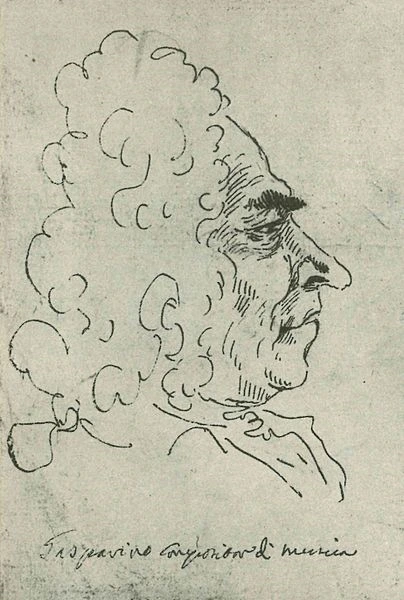
Gasparini, Michelangelo

Gasparini, Gasperini, Guasparini, Francesco, *5 March 1668 Camaiore (near Lucca), †22 March 1727 Rome, Italian composer, music theorist and teacher. In 1685, he sought admission to the Accademia Filarmonica in Bologna. In 1686, he lived in Venice at the home of G. Legrenzi, with whom he may have studied music. In 1689, he became a member of the Accademia di Santa Cecilia in Rome; there he continued his studies, probably under A. Corelli and B. Pasquini. In 1694, he staged his first opera in Rome, and in 1695 he published a collection of cantatas. The works he composed at that time brought him recognition, and in 1701 Gasparini was appointed maestro di coro at the Ospedale della Pietà in Venice. He remained in this post until 1713, contributing to the conservatory’s significant flourishing (partly thanks to the appointment of A. Vivaldi as a violin teacher in 1703). In Venice, Gasparini composed works for the Ospedale, and also occasionally provided several operas a year for the Teatro S Cassiano and other venues. In 1713, he was granted a six-month leave of absence from the Ospedale, but did not return to his post, instead settling in Rome. Around the turn of 1714/15, he was probably staying in Florence, where two of his operas were being performed. In 1717, he became maestro di cappella at S Lorenzo in Lucina in Rome. In 1719, a marriage contract was signed between Gasparini’s daughter, Rosalia (who was a member of the orchestra at S Lorenzo), and P. Metastasio; however, the marriage did not take place. In 1725, Gasparini was appointed maestro di cappella at S Giovanni in Laterano. Although the ailing musician was no longer able to perform this role, he retained the title until his death. Gasparini’s pupils included B. Marcello, J.J. Quantz and D. Scarlatti.
Although Gasparini was one of the most highly regarded Italian composers of the 18th century, his work has not yet been thoroughly researched or properly assessed. Operas occupied a central place in Gasparini’s oeuvre. Most of them were opera seria with historical themes, but Gasparini’s output also included several comic operas (e.g. Anfitrione and L’avaro) and over a dozen intermezzos performed alongside certain opera seria or as standalone works. Gasparini’s operas predominantly follow a recitative-aria structure, mainly da capo arias accompanied by an orchestra, and less frequently by basso continuo. In his later operas, he introduced arias with a homophonic texture and a melody and rhythm characteristic of the style of the next generation. He employed harmonic experiments in his graceful cantatas. Gasparini’s sacred works are written in both strictly contrapuntal and concertato styles. Whilst Gasparini’s compositions were quickly forgotten, his treatise on the practice of basso continuo, L’armonico pratico al cembalo, was reprinted six times and was still in use as a textbook in Italy as late as the mid-19th century. Gasparini was one of the first Italian composers whose operas were staged in England (1711–1712).
Literature: G. Marotti Quasi un incognito. Il camaiorese Francesco Gasparini, “Cenobio” XV, 1966; G. Rose A Fresh Clue from Gasparini on Embellished Figured-bass Accompaniment, “The Musical Times” CVII, 1966; A. Bonaccorsi Francesco Gasparini, in: Maestri di Lucca, Florencja 1967; A. Cavalli Le cantate opera prima di Francesco Gasparini, “Chigiana” XXV, 1968; M. Ruhnke Francesco Gasparinis Kanonmesse und der Palestrinastil, in: Musicae scientiae collectanea, commemorative book of K.G. Fellerer, Cologne 1973; Francesco Gasparini (1661–1727), in: Atti del primo convegno internazionale. Camaiore (…) 1978, reprint F. Della Seta and F. Piperno, 1981.
Compositions:
Vocal-instrumental:
12 Cantate da camera a voce sola, Op. 1, Rome 1695, Lucca 1697
arias, madrigals, canons, over 30 cantatas for voice and basso continuo, 2 oratorios, numerous motets and at least 10 masses preserved in manuscripts
3 lost oratorios
Stage:
around 60 operas and intermezzos (including over 30 works for Venice, a dozen or so for Rome, as well as operas staged in Florence, Naples, Milan, Bergamo, Turin, Reggio, Vienna and Brunswick), including:
Il Roderico, staged in Rome 1694
Mirena e Floro, staged in Naples 1699
Tiberio Imperatore d’Oriente, libretto G. D. Pallavicino, staged in Venice or Naples 1702
Il più fedel fra i vassali, staged in Venice 1703, as Antioco, staged in London 1711; vocal excerpts published in London 1711, instrumental fragments published in London n.d.
Ambleto, libretto A. Zeno and P. Pariati, staged in Venice 1705, as Hamlet, staged in London 1712; vocal excerpts published in London 1712, instrumental fragments published in London n.d.
Flavio Anicio Olibrio, libretto A. Zeno and P. Pariati, staged in Venice 1707 (with intermezzos by Parpagnacco, Melissa and Catulla and Lardone)
Anfitrione, libretto P. Pariati, staged in Venice 1707 (with intermedio by Friletta e Chicone)
Taican Rè della Cina, libretto U. Rizzi, staged in Venice 1707 (with intermezzo by Lisetta e Astrobolo)
Atenaide, libretto A. Zeno, staged in Vienna 1709 (with A. S. Fiore and A. Caldara);
Merope, libretto A. Zeno, staged in Venice 1711
Amor vince l’odio, overo Timocrate, libretto A. Salvi, staged in Florence 1715
Il comando non inteso ed ubbedito, libretto A. Silvani, staged in Florence 171
Teodosio ed Eudossa, with J. Fux and A. Caldara, libretto V. Grimani, staged in Brunswick 1716;
Pirro, libretto A. Zeno, staged in Rome 1717
Il gran Cid, libretto N. Serino, staged in Naples 1717
Democrito, staged in Turin 1718
L’oracolo del fato, libretto P. Pariati, staged in Vienna 1719
La pace fra Seleuco e Tolomeo, libretto A. Trambucco (?), staged in Milan 1720
L’avaro, libretto A. Salvi, staged in Florence or Venice 1720
Dorinda, libretto B. Marcello (?) lub B. Pasqualigo (?), staged in Rome 1723
Tigrane, staged in Rome 1724
Writings:
L’armonico pratico al cimbalo. Regale, osservazioni ed avvertimenti per ben suonare il basso, e accompagnare sopra il cimbalo, spinetta ed organo, staged in Venice 1708, 61802
Guida, ossia Dizionario armonico, in cui si trova il modo di ben modulare, manuscript in Civico Museo Bibliografico Musicale in Bologna
Li principii della composizione, manuscript at the Deutsche Staatsbibliothek in Berlin
Editions:
L’armonico pratico al cembalo, facsimile edition from 1708, New York 1967
The Practical Harmonist at the Keyboard, translation of L’armonico pratico al cembalo, ed. D. L. Burrows, New Haven 1963