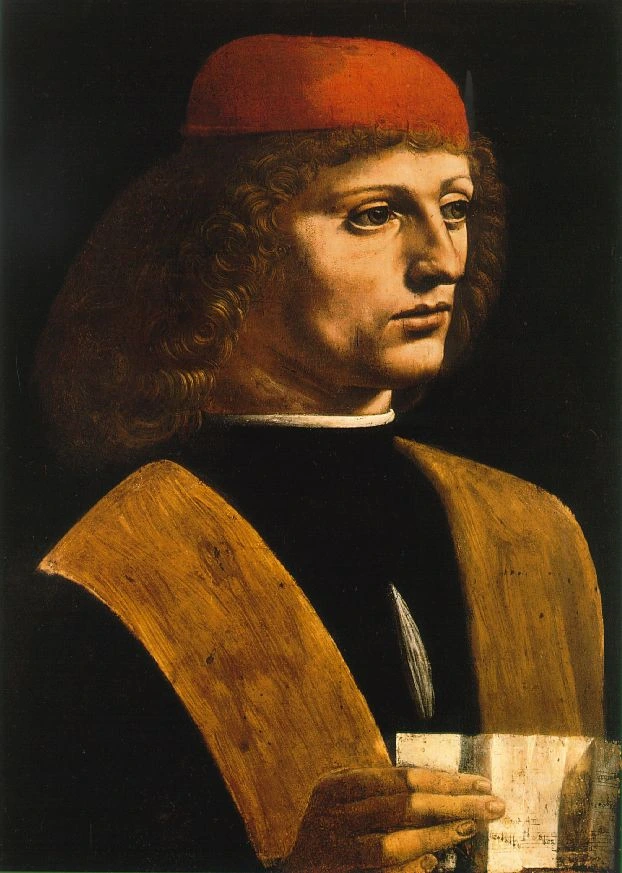
Gaffurius, Gafurius, Gafurio, Gafori, Franchinus, *14 January 1451 Lodi, †25 June 1522 Milan, Italian music theorist and composer. At his parents’ request, he entered the Benedictine convent of San Pietro in Lodivecchio, where in 1473–74 he studied music under the Flemish, Johannes Godendach, learning composition according to Franco-Flemish style and music theory based on the doctrine of Boethius. In addition, for a number of years he copied and studied many compositions and medieval music treatises (including those by Boethius, Guido d’Arezzo, Franco of Cologne, Johannes de Muris, Marchetto of Padua) and works by ancient authors from various fields, either directly (Ptolemy, Aristides, Aristotle, Virgil, Cicero, Pliny, Euclid) or indirectly, most often through Latin or Italian translations (e.g., Nicomachus, Plato). He also sang in the choir of the cathedral in Lodi. However, he soon abandoned monastic life and, after being ordained a priest in 1474, he left with his father for the Gonzaga court in Mantua, where he began his writing and teaching activities on a larger scale, which he continued throughout his life. Because of unrest in Genoa, he accompanied the doge’s court to Naples, residing there from 1478 to 1480 at the court of Ferdinand I of Aragon, where he met several Netherlandish composers, including Johannes Tinctoris. In 1480, probably to escape the plague, he departed from Naples and returned to Lodi. Between 1480 and 1483, he worked as a teacher of young singers for Bishop Carlo Pallavicino at the castle in Monticelli d’Ongina, continuing his scientific and compositional activities. From May until the end of 1483, he worked at the cathedral in Bergamo, directing the local music ensemble. He was also responsible for the enlargement of the organ in the Church of S. Maria Maggiore by the addition of a pedal. In January 1484, he took up the position of chapel-master of the cathedral ensemble in Milan, which he held until his death. Gaffurius performed many functions at Milan Cathedral: he sang in the ensemble, conducted the choir, taught the choirboys, hired new singers, and took care of the selection of the repertoire, which he significantly expanded with his own compositions. He also reformed the cathedral choir, introducing uniforms, increasing discipline, favouring Italian singers and expanding the ensemble, improving the performers’ standards and their training, and reorganizing the Schola Cantorum. He also worked closely with the musical ensemble at the Sforza court and became one of the most popular and respected figures in Milan’s musical life. During his time in Milan, he travelled extensively, including to Mantua and, in 1506, to Varese, where he helped organize a musical ensemble at the Church of S. Maria al Monte. He also obtained benefices: from 1494 – chaplain at the Church of S. Marcellina in Milan, 1495 – cleric in Pontivolo in Bergamo, 1497 – parish priest in Melzo and at the Sant’Ambrogio Church in Lodi. He was also (1494–98?) a music teacher at a gymnasium in Milan, and in 1494–99 he probably ran one of the few music departments at the University of Pavia at that time. He wrote Latin poetry and copied, and sometimes published at his own expense, translations of medieval and ancient treatises on music theory. Gaffurius assembled an extensive library, most of which he donated to the of Tempio dell’Incoronata Church in Lodi. He was friends with Leonardo da Vinci; two paintings of musicians (Ambrosiana Library in Milan and Museo Cívico in Lodi), which were formerly considered portraits of Gaffurius, probably come from the circle of this painter’s school.
Gaffurius is one of the most prominent music theorists of the turn of the 15th and 16th centuries, second only to J. Tinctoris. Gaffurius’s creative output has not yet been fully explored and researched, which makes it difficult to present his theoretical concept in its entirety. Gaffurius began his writing career with treatises on the elements of music and choral practice (Extractus and Tractatus brevis). Extractus, composed of fragments from the writings of various authors, is particularly instructive for research into the sources of Gaffurius’s theory. Among the numerous works he cited, Boethius’s writings, together with the treatises of Ugolino da Orvieto, Marchetto da Padova, and Johannes de Muris – whose work Musica speculativa Gaffurius copied and provided with voice parts – were apparently particularly important in shaping his views. Gaffurius returned to this subject in other compilations (e.g., Micrologus vulgaris). He is also the author of the treatise Apologia…, which documents his famous polemic with Giovanni Spataro, who represented the views of Ramos de Pareja on the division of tetrachords, especially the consonance of thirds. The core of Gaffurius’s theoretical work was his famous “trilogy,” comprising Theoricum opus musicae disciplinae, Practica musicae, and De harmonia musicorum instrumentorum opus. These three works presented the entirety of contemporary music theory; they contained clearly presented knowledge about music theory and practice from antiquity through medieval traditions to the author’s own time. The two extreme positions of the set are works of a strictly theoretical nature – here Gaffurius relies on the Pythagorean system and adheres to the Boetian concept. Theoricum opus musicae disciplinae clearly sums up the classical musical doctrine, and the treatise on harmony draws on ancient authorities as well as Bryennius. Gaffurius’s most comprehensive and original work is contained in the four books of Practica musicae. This work gained enormous popularity, was published several times, and was widely used by contemporary and later theorists. The first book covers the solmization system and a discussion of church modes, the second – the mensural notation, which Gaffurius simplified somewhat, and remarks on poetic metre, the third – the art of counterpoint, and the fourth – proportions in mensural music. This treatise is the most complete and comprehensive source for learning about and understanding how music was composed and performed in the 15th century. It also highlights Gaffurius’s characteristic feature of closely linking theoretical arguments with musical practice, as evidenced by, among other things, approximately 250 musical examples in the form of carefully crafted short compositions. While Gaffurius’s other treatises are clearly traditional in nature, Practica musicae, probably thanks to its reliance on the latest compositional achievements, contains new and original approaches. The most important achievements of Gaffurius’s theory are related to his reflections on counterpoint. In Book III of Practica musicae, he presented – based on Tinctoris’s theory – a set of eight contrapuntal rules concerning: beginning pieces with a perfect consonance in most cases, avoiding parallel perfect consonances, separating these progressions with imperfect consonances, introducing a succession of different intervals, crossing voices, using contrary motion, building cadences, and ending in unison or octave. Gaffurius linked these strictly defined rules, which stemmed directly from musical practice, with the desire to achieve full harmony, thereby laying the foundations for the rules of vertical voice combination formulated half a century later by G. Zarlino. Gaffurius also commented on the construction of melody, the treatment of dissonances, and the temporal value of the semibrevis [semibreve] as equal to the human pulse; he also revised some of the views of medieval theory, especially the solmization system. In connection with his reflections on the interval of a fifth, he drew attention to the problem of equal temperament, which was widely discussed at the time among organists and theorists. Finally, he described the practice of singing in seconds and fourths, used in Milan Cathedral, which was related to ‘organum’ technique. Gaffurius’s theoretical writings played a significant role in the development of European musical theory in the 16th century. It is known that they were constantly used and formed the basis for numerous compilations and imitations. Although Gaffurius did not include any innovative statements in them, he summarized and organized all the theoretical knowledge of the time with great competence. His writings were referred to by the most prominent theorists of the period (e.g., Zarlino) and many lesser-known treatise writers, including Polish authors (Stefan Monetarius).
Gaffurius’ compositions, preserved mainly in four choir books of Milan Cathedral (the so-called “Gaffurius Codices,” Libroni 1–4), present a rich (masses, motets, litanies, hymns, secular songs) yet stylistically uniform corpus. Most of the works are conceived in the style of late 15th-century Franco-Flemish polyphony, with noticeable elements of Italian music. They are characterized by clarity of structure, a smooth and clearly defined melodic line, and the use of full harmonies typical of the period. The composer mostly used four-voice, although he also left a number of three-voice works. He also used the technique of breaking down the four-voice texture into fragments of two-voice dialogue. He wrote mainly liturgical music, most of it intended for performance in the Milan Cathedral. These are primarily sacred motets, as well as numerous masses, which illustrate a feature characteristic of the liturgical practice in Milan at that time, namely the combination of two rites – Roman and Ambrosian. Of the 18 masses, 11 have the regular form of a five-part Roman Ordinarium Missae, while the rest are either three-part Ambrosian cycles without the outer sections (in one case also without the Sanctus) or hybrid forms combining the five-part Ordinarium with motets. Other works intended for church services are associated with the tradition of the so-called “motetti missales” – the creation of larger motet cycles, whose individual parts served as substitutes for successive parts of the Mass. These include four cycles from a fragmentarily preserved codex, call number 2266, and the extensive 10-part Salve mater salvatoris, bearing the annotation cum tota missa. In the latter cycle, the sequence Salve mater salvatoris serves as a unifying leitmotif. Although the assignment of individual motets to the Mass sections for which they are substitutes poses a number of problems, it is certain that the motet Tu thronus et Salomonis, ending with homorhythmic blocks crowned with rests, was performed at the Elevation (ad Elevetionem). The four other cycles represent hybrid forms, with added motets loco Introit, loco Deo gratias (and possibly loco Offertorii). Like Salve mater salvatoris, they were probably intended for Marian devotions (with the exception of Missa quarti toni Sancte Caterine). In accordance with the Milanese musical tradition, their sections are connected by texts that either come from the same poem or refer to a common theme. Moreover, these sections are unified by musical means; apart from an identical set of clefs and a common tonality, they are connected by characteristic musical material. In Missa quarti toni Sancte Caterine, this role is fulfilled by the fourth, while in Missa La bassadanza, is taken by the popular melody La Spagna. Stylistically, Gaffurius’s masses constitute a fairly diverse repertoire. Some of them reveal the influence of Franco-Flemish musicians active in Milan (Gaspar van Weerbeke, L. Compère, Josquin des Prez). This is reflected in the alternation of vocal duets (though without characteristic tonal contrasts), chains of slowly progressing chords with syllabic declamation, usually marked by fermatas, and finally in melodic progressions and sections with a “dance-like” triple meter. Gaffurius’s other masses refer to an older tradition, such as the three-part Missa Trombetta, built on a uniform instrumental motif, or Missa Omnipotens genitor, entirely troped with a new text. However, there are no traces of complex Netherlandish techniques, such as canons or mensural proportions, in Gaffurius’s oeuvre. Only two masses (Missa De tous biens pleine and Missa La bassadanza) are based on cantus prius factus, although the use of the song pattern is limited to quoting the leitmotif. The so-called “short masses,” marked with the inscription brevis, constitute a separate category of masses. These include Missa primi toni brevis, Missa brevis et expedita, Missa brevis eiusdem toni, Missa brevis octavi toni, Missa Trombetta, and Missa Montana, as well as two masses without such an inscription (Missa De tous biens pleine and Missa Carneval).
Gaffurius’s motets are more homogeneous than his Masses and reveal the composer’s good command of the newer Netherlandish techniques. The motets signed with his name or initials are usually four-voice pieces and are compact, single-movement works with varied textures. They are characterized by alternating imitative sections, often with antiphonal duets typical of Franco-Flemish music, and homorhythmic sections, usually in triple meter. The texts selected by Gaffurius suggest that most of his motets were composed for Marian devotions. Only two are closely related to the composer’s place of activity. The first, Ambrosi doctor venerande, is dedicated to Saint Ambrose, the patron saint of Milan, and was probably composed for the celebration of his feast day. The text of the second motet, Salve, decus genitoris, refers directly to the Duke of Milan, Ludovico Sforza il Moro. A small part of Gaffurius’s oeuvre consists of Magnificats (11 works) and hymns, mostly for four voices; the Magnificats are always in alternatim form, with even-numbered verses set for multiple voices. The authorship of the hymns is a matter of dispute, as only one of them (the five-part Audi benigne conditor) bears his name in the Gaffurius Codices. However, researchers attribute to him seven further hymns transmitted anonymously in the Milanese codices; in addition, two works signed with his name are preserved in the Montecassino 871 manuscript, reflecting the repertoire of the Aragonese court in Naples, where Gaffurius stayed for a short time. All these arrangements consist of four sections ending with cadences corresponding to successive verses of the text. In accordance with Italian tradition, the liturgical melody placed in the tenor voice is always paraphrased. Generally, only two voices (superius and tenor) participate in its free imitation. Two other hymns are dominated by a homorhythmic texture, which distinguishes them from the rather uniform body of works. Generally speaking, all these works constitute a repertoire that is not very diverse, and they feature techniques that had already been developed several decades earlier by G. Dufay and J. Martini. Although Gaffurius’s works show strong influences from the 15th-century tradition, he himself was already a typical representative of the late Renaissance. This is reflected in the scope of his intellectual pursuits (composition and thinking about music, performance and teaching, lyrical poetry and polemical writings), as well as his attitude towards music as an art form, guided by specific contrapuntal rules, and at the same time striving to achieve an ideal of beauty realized in the full sonority of polyphonic structure.
Literature: Pantaleo Melegus – Gaffurius’s biography in the appendix to the printed treatise De harmonia…, Milan 1518; E. Praetorius Die Mensuraltheorie des F. Gaffurius und der folgenden Zeit bis zur Mitte des 16. Jahrhunderts, “Publikationen der Internationalen Musikgesellschaft, Beihefte” II, Leipzig 1905, reprint Wiesbaden 1970; H. Riemann Geschichte der Musiktheorie im 9.–19. Jahrhundert, Berlin 2nd edition 1920; P. Hirsch Bibliographie der musiktheoretischen Drucke des F. Gaffurius, Berlin 1921; K. Jeppesen Die drei Gafurius-Kodices der Fabbrica del Duoma, Milano, “Acta Musicologica” III, 1931; A. Caretta, L. Cremascoli, L. Salamina F. Gaffurius, Lodi 1951; G. Barblan Nel V Centenario della nascita di F. Gaffurius, “La rassegna musicale” XXII, 1952; C. Sartori F. Gaffurius a Milano, “Universitas Europae” I, Nos. 4–5, 8–9, 11–12, 1953; C. Sartori Il quatro codice di Gaffurius non e del tutto scomparso and P. Bondioli Per la biografia da F. Gaffurius da Lodi, “Collectanea Historiae Musicae” I, 1953; F. Fano Note su F. Gaffurius, “Rivista Musicale Italiana” LV, 1953; P.O. Kristeller Studies in Renaissance Thought and Letters, Rome 1956; C. Sartori La cappella musicale del duomo di Milano, Milan 1957; F.A. Gallo Le traduzioni dal Greco per F. Gaffurius, “Acta Musicologica” XXXV, 1963; C.A. Miller Gaffurius “Practica musicae”. Origin and Contents, “Musica Disciplina” XXII, 1968; C.A. Miller Early Gaffuriana. New Answers to Old Questions, “The Musical Quarterly” LVI, 1970; F. Fano Lineamenti de F. Gaffurius come teorico musicale, “Arte Lombarda” XVI, 1971; F.A. Gallo Znajomość “Musica speculaliva” Johannesa de Muris w Polsce i we Włoszech. Glosy Uniwersytetu Krakowskiego i “Glossemata” F. Gaffuriusa, «Pagine» III, Krakow 1979; D. Bonge Gaffurius on Pulse and Tempo: A Reinterpretation, “Musica Disciplina” 36, 1982; L.H. Ward The “Motetti Missales” Repertory Reconsidered, “Journal of the American Musicological Society” 39/3, 1986; W.K. Kreyszig Franchino Gaffurio als Vermittler der Musiklehre des Altertums und des Mittelalters: Zur Identifizierung griechischer und lateinischer Quellen in der Theorica musice (1492), “Acta musicological” 65/2, 1993; J. Haar The Frontispiece of Gafori’s “Practica Musicae” (1496), “Renaissance Quarterly” 27, 1974, 7–22, reprint in Haar, The Science and Art of Renaissance Music, ed. P. Corneilson, Princeton 1997; F. Degrada Musica e musicisti nell’età di Ludovico il Moro, in: Milano nell’età di Ludovico il Moro, vol. 2, Milan 1983; C. Gallico Un codice musicale gaffuriano alla Palatina, in: Le capitali della musica: Parma, ed. C. Gallico, Cinisello Balsamo 1985; C.V. Palisca Humanism in Italian Renaissance Musical Thought, New Haven, CT, 1985; L.H. Ward The “Motetti Missales” Repertory Reconsidered, “Journal of the American Musicological Society” 39, 1986; G. De Florentiis Storia della Cappella musicale del Duomo dalle origini al 1714, in: Sei secoli di musica nel Duomo di Milano, ed. G. De Florentiis and G.N. Vessia, Milan 1986; W.F. Prizer Music at the Court of the Sforza: The Birth and Death of a Musical Center, “Musica Disciplina” 43, 1989; M. Kanazawa Franchino Gafori and Polyphonic Hymns, in: Tradition and Its Future in Music: Report of International Musicological Society. International Symposium, eds. Y. Tokumaru, M. Ohmiya, M. Kanazawa, O. Yamaguti, T. Tukitani, Osaka 1990; W.K. Kreyszig Franchino Gaffurio als Vermittler der Musiklehre des Altertums und des Mittelalters: Zur Identizierung griechischer und lateinischer Quellen in der “Theorica musice” (1492), “Acta Musicologica” 65, 1993; P.A. and L.L.M. Merkley Music and Patronage in the Sforza Court, Turnhout 1999; C. Galiano Gaffurio, il conte di Potenza e la prima dedicatoria inedita del “Theoricum opus”, in: Medioevo Mezzogiorno Mediterraneo: Studi in onore di Mario Del Treppo, vol. 2, eds. G. Rossetti, I.G. Vitolo, Naples 1999–2000; B.J. Blackburn Leonardo and Gaffurio on Harmony and the Pulse of Music, in: Essays on Music and Culture in Honor of Herbert Kellman, ed. B. Haggh, Paris 2001; G. D’Agostino Reading theorists for recovering “ghost” repertoires: Tinctoris, Gaffurio and the Neapolitan context, “Studi musicali” 34/1, 2005; S.C.M. and M. Rolsma Theory in practice: Reminiscences of Gaffurius’ music theory in the Milanese choirbooks, in: Uno gentile et subtile ingenio: Studies in Renaissance music in honour of Bonnie J. Blackburn, ed. M. Jennifer Bloxam, G. Filocamo, L. Holford, Tours 2009; W.K. Kreyszig The significance of iconography in the print culture of the late-fifteenth-century music theoretical discourse: The “Theoricum opus musice discipline” (1480) and “Theorica musice” (1492) of Franchino Gaffurio in the context of his trilogy, “Music in Art: International Journal for Music Iconography” 35/1–2, 2010; M. Pantarotto Per la biblioteca di Franchino Gaffurio: i manoscritti laudensi, „Scripta” 5, 2012; D.V. Filippi Text, Form, and Style in Franchino Gaffurio’s Motets, in: The Motet around 1500: On the Relationship between Imitation and Text Treatment?, ed. T. Schmidt-Beste, Turnhout 2012; R.J. Wieczorek Patronat muzyczny w renesansowych Włoszech (1470–1527). Milan, Ferrara, Mantua, Florencja, Rzym, Poznań 2013; B.J. Blackburn Theorists as “Primedonne”: Reviewing Music Theory in the Early Cinquecento, “Studi musicali” 6, 2015; D. Stefani Le vite di Franchino Gaffurio, M. Pantarotto Franchino Gaffurio e i suoi libri, F. Saggio “Il codice Parmense 1158: descrizione del manoscritto ed edizione delle musiche di Gaffurio, G. D’Agostino Il soggiorno di Gaffurio a Napoli e il contesto musicale locale, D. Forasacco Latino e volgare allo specchio nell’ “Angelicum ac divinum opus musice”, D. Daolmi Iconografia gaffuriana: con un’appendice sui due testamenti di Gaffurio, in: Ritratto di Gaffurio, ed. D. Daolmi, Lucca 2017; A. Pavanello The Elevation as Liturgical Climax in Gesture and Sound: Milanese Elevation Motets in Context, “Journal of the Alamire Foundation” 9/1, 2017; M. Pantarotto I manoscritti milanesi di Franchino Gaffurio, “Scripta” 12, 2019; L. Fagnart Gaspar Depicted? Leonardo’s Portrait of a Musician, in: Gaspar van Weerbeke: New Perspectives on his Life and Music, eds. A. Lindmayr-Brandl, P. Kolb, Turnhout 2019; M. Zaggia Materiali per una storia del libro e della cultura a Milano negli anni di Franchino Gaffurio (1484–1522), N. Valli La liturgia a Milano nel Quattrocento: coesistenza di due riti?, M. Pantarotto Franchino Gaffurio maestro di cantori e di copisti: analisi codicologico-paleografica dei Libroni della Fabbrica del Duomo, D.V. Filippi Breve guida ai „motetti missales” (e dintorni), F. Rocco Rossi Franchino Gaffurio compositore: tra indagine stilistica e nuove conferme attributive, D. Torelli Gli inni e il repertorio per l’ufficio nei Libroni gaffuriani, C. Cassia La compilazione del Catalogo dei Libroni: problemi e osservazioni, in: Codici per cantare: I Libroni del Duomo nella Milano sforzesca, «Studi e saggi», 27, eds. D.V. Filippi, A. Pavanello, Lucca 2019; F. Rocco Rossi Surveying the First Gaffurius Codex: Reconsiderations on the “Motetti Missales” Paradigm, J. Rifkin Milan, Motet Cycles, Josquin: Further Thoughts on a Familiar Topic, C. Bokulich Metre and the “Motetti missales”, in: Motet Cycles between Devotion and Liturgy, ed. D.V. Filippi and A. Pavanello, Basel 2019; D.V. Filippi Operation Libroni: Franchinus Gaffurius and the Construction of a Repertory for Milan’s Duomo, in: Sounding the Past: Music as History and Memory, ed. K. Kügle, Turnhout 2020; D. V. Filippi The Making and the Dating of the Gaffurius Codices: Archival Evidence and Research Perspectives, M. Pantarotto “Scripsi et notavi”: Scribes, Notators, and Calligraphers in the Workshop of the Gaffurius Codices, D.V. Filippi Gaffurius’s Paratexts: Notes on the Indexes of Libroni 1–3, C. Cassia Gaffurius at the Mirror: The Internal Concordances of the Libroni, A. Pavanello The Non-Milanese Repertory of the Libroni: A Potential Guide for Tracking Musical Exchanges, in: Reopening Gaffurius’s Libroni, ed. A. Pavanello, Lucca 2021; Gaffurionline, access: http://www.examenapium.it/gaffurio; Gaffurius Codices Online, access: https://www.gaffurius-codices.ch; Sforza Polyphony, access: https://www.fhnw.ch/plattformen/polifonia-sforzesca; Motet Cycles Database, access: http://www.motetcycles.ch.
Works:
Extractus parvus musicae, Lodi 1474, dedication: Filippo Tressenius, musician from Lodi, autograph manuscript in: Parma, Archivio Capitolare, call number Cod. palat. parm. 1158; new edition: F. Gaffurius Extractus parvus musicae, in «Antiqua Musicae Italicae Scriptores» vol. 4, ed. F. A. Gallo, Bologna 1969
Tractatus brevis cantus piani, Lodi 1474, glosses from 1478–80, dedication: Paulus Grecus, cleric from Lodi, autograph manuscript as above
Musicae institutionis collocutiones, Verona 1476, dedication: bishop Carlo Pallavicino, autograph manuscript lost
Flos musicae, Verona 1476, dedication: Ludovico III Gonzaga, autograph manuscript lost
Theoricum opus musicae disciplinae, Naples ca. 1479, manuscript titled Theoriae musicae tractatus, London, British Library, Reference Division (olim British Museum); published under the title Theorica musicae, Naples 1480 F. di Dino (with wood engravings), dedication: Cardinal Giovanni Arcimboldi; Milan 1492 F. Mantegazza (revised and expanded edition), dedication: Ludovico Sforza il Moro; new edition F. Gaffurius Theorica musicae, facsimile edition G. Cesari, Rome 1934; facsimile edition in «Monuments of Music and Music Literature in Facsimile» 2/21, New York 1967
Practica musicae, Monticelli and Bergamo 1481–83, a handwritten copy of Book 1, made in 1487 by Alessandro Assolari based on the lost autograph manuscript, in: Bergamo, Bibliotheca Civica, call number Ms. Sigma IV 37; manuscript of Book 2 titled Musices practicabais libellum from 1480, in: Cambridge, Harvard University Music Libraries, Houghton; manuscript Book 4 titled Tractatus practicabilium proportionum from ca. 1482, in: Bologna, Civico Museo Bibliografico Musicale, call number A 69, dedication: Corradolo Stanga of Cremona; Milan 1496 G. Signerre, dedication: Ludovico Sforza il Moro; edition titled Musicae utriusque cantus practica, Brescia 1497 A. Britannicus; edition titled Practica musicae utriusque cantus, Brescia 1502 A. Britannicus, and ibid. 1508 Venice 1512 V. Zannis de Portezio; Venice 1517 and 1522 (lost); edition titled Tractato vulgare del canto figurato under the name Francesco Caza, Italian translation of Book 2, Milan 1492 L. Pachel; edition titled Angelicum ac divinum opus musicae, Italian translation of excerpts from books 2 and 3 by Gaffurius, Milan 1508 G. de Ponte; new edition: The Practica Musicae of F. Gaffurius, English translation and editing by I. Young, Madison (Milwaukee) – London 1969; facsimile edition M. Turner, Farnborough 1967; F. Gaffurius. Practica musicae, English translation and editing by C. A. Miller, “Musicological Studies and Documents” XX, Rome 1968; F. Caza. Tractato volgare del canto figurato, facsimile and German translation by J. Wolf, Berlin 1922
Micrologus vulgaris cantus plani, Lodi ca. 1482, manuscript in: Bologna, Civico Museo Bibliografico Musicale, call number A 90
Glossemata quaedam super nonnules partes Theoricae Johannis de Muris, autograph manuscript from 1499 in: Milan, Biblioteca Ambrosiana, call number H 165, inf.
De harmonia musicorum instrumentorum opus, Milan ca. 1500, dedication: Bonifacio Simonetta, abbot of the monastery of Saint Stephen in Lodi, autograph manuscript in: Lodi, Biblioteca Laudense, call number cod. miniato XXVIII A 9; manuscript in: Grenoble, Lyon Bibliothèque des Beaux Arts (with miniatures), sent by Gaffurius to Charles Jaufred, president of the parliament in Grenoble; Milan 1518 G. Pontano, dedication: Jean Grolier, secretary to Louis XII; new edition, facsimile edition, “Biblioteca Musica Bononiensis” II/7, Bologna 1972
Apologia adversum loannem Spatarum, Turin 1520 A. de Vicomercato; new edition The Apologia of F. Gaffurius, English translation and editing I. Young, Southern, California 1952
Epistula prima in solutiones obiectorum Io. Vaginarii Bononiensis, Milan 1521
Epistula secunda apologetica (to Antonio Alberti of Florence), Milan 1521
Compositions:
18 masses: one for three voices, the rest for four voices (four preserved in fragments)
Missa brevis et expedita
Missa primi toni brevis
Missa quarti toni Sanctae Caterine
Missa sexti toni irregularis
Missa brevis octavi toni
3 Missa sine nomine
Missa Montana
Missa Trombetta
Missa de Carnaval
Missa De tous biens plaine
Missa Omnipotens genitor
Missa O clara luce
Missa Ave maris stella
Missa brevis eiusdem toni
Missa Imperatrix gloriosa
Missa La bassadanza
51 motets (for 5 voices, other for 4 voices) and hymns for 3 and 4 voices
11 Magnificats for 3 and 4 voices
2 litanies:
Salve mater salvatoris for 4 voices
Virgo Dei digna for 4 voices
all of the great compositions mentioned above are preserved in four manuscripts at Milan Cathedral, so-called Gaffurius Codices, handwritten choir books compiled by Gaffurius from works by various composers for use in Milan Cathedral (Milan, Archivio del Duomo, call numbers 2269, 2268, 2267, 2266, the last codex partially destroyed in a fire in 1906)
La sera ogni Nimpha, Illustrissimo Marchese, Alto standardo, Ayme fortuna, secular works for 3 voices
and a piece without lyrics for 3 voices in Archivio Capitolare in Parma (call number Cod. palat. parm. 1158)
2 hymns for 4 voices: Chrisie redemptor and Hostis Her odes in Biblioteca Abbaziale in Monte Cassino (call number 871).
It is also known that there were works by Gaffurius that have been lost (including those in the fourth Gaffurius Codex) and several masses and motets of uncertain authorship (preserved anonymously)
Editions:
Istitutioni e monumenti de l’arte musicale italiana, ed. G. Cesari, Milan 1934
Archiwum musices metropolitanum Milanense, vols. 1–3 Messe, ed. A. Bortone, Milan 1958–60; vol. 4 Magnificat, ed. F. Fano, 1959; vol. 5 Mottetti, ed. L. Migliavacca, 1959; vol. 16 Liber capelle ecclesie maioris. Quarto codice Gaffurius, ed. A. Cicero, L. Migliavacca, 1968