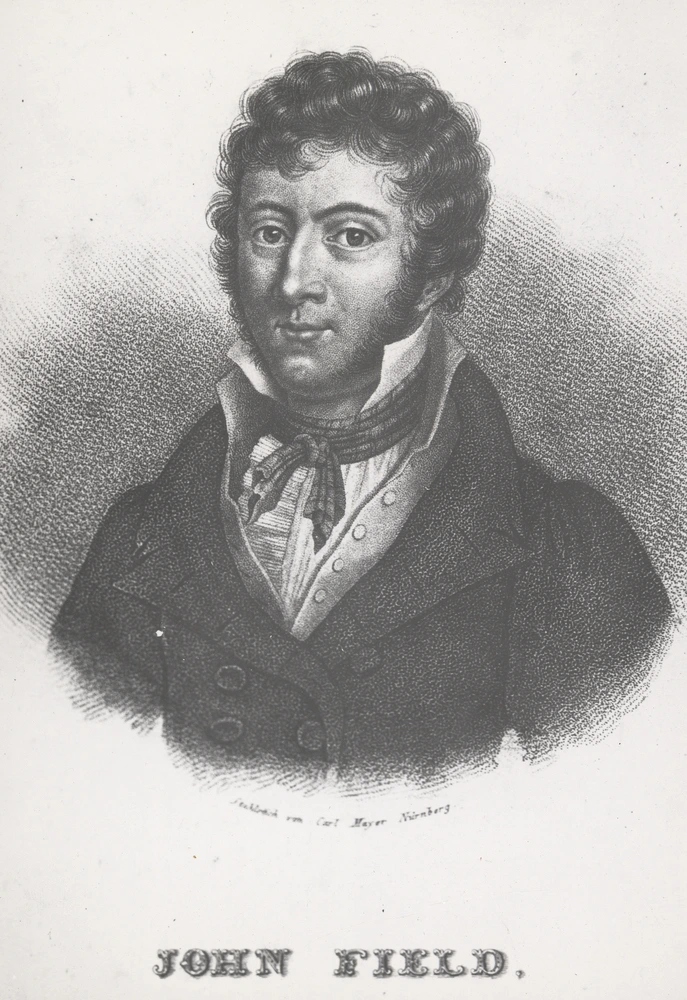
Field John, *26 July 1782 Dublin, †11 January 1837 Moscow, Irish pianist and composer. His father was a violinist in a theatre orchestra in Dublin, and from 1792 in the orchestra of the Haymarket Theatre in London. Field studied under M. Clementi and, from 1794, enjoyed success as a pianist in London (he made his debut in 1792 in Dublin), performing works by Clementi, L. Dusik and his own Piano Concerto in E flat major (1799). Haydn, having heard him playing in 1794, predicted a great future for him. In 1802, Field travelled with Clementi to Paris and then to Vienna, where he began studies under J. Albrechtsberger, but interrupted them to accompany Clementi to St Petersburg. He remained there, soon becoming a renowned pianist and teacher. He undertook concert tours, including to Riga and Moscow. In 1807 he married Mlle Percheron, a French pianist, but in 1821 he divorced and moved to Moscow, where he continued his concert and teaching activities. In 1832, he travelled to London to give concerts, and subsequently visited Belgium, France, Switzerland and Italy. His irregular lifestyle took its toll on his health; Field had to spend many months in hospital in Naples. In 1835 he returned to Moscow, giving a concert in Vienna on the way. He taught in Moscow until early 1837. Among Field’s pupils were Antoni Kątski and M. Szymanowska.
Among the piano virtuosos of the first decades of the 19th century, John Field stands out as a distinct figure. His playing was characterised by clarity, fluidity and a refined touch. Even in his later years, he adhered to a strict regime of practice, striving to maintain a steady hand position. He preferred square pianos to grand pianos. Although he did not parade his virtuosity, indulge in strong dynamic contrasts, or adopt an affected style of playing, the assurance of his passagework, the refinement of his phrasing, and the lyrical expression – especially in his nocturnes – made a strong impression on listeners. Opinions on his pianistic skills were, however, divided. When Field played in Vienna at C. Graff’s, E. Wolff described as Field’s playing had “no speed, no elegance, incapable of executing difficulties: in a word, feeble. Yet he has his merits: a steady, slow German style of play.”
Similarly to Chopin, Field focused almost exclusively on piano music. His piano concertos, highly praised by Schumann, as well as some of his sonatas, have been undeservedly forgotten. In the history of music, Field is remembered primarily as the composer of Romantic piano nocturnes, a genre that reached its fullest expression in Chopin’s work. The sources of inspiration for Field’s nocturnes, characterised by a lyrical mood and expressive melodies, lie, among other things, in the exalted attitude of the artists of that time towards nature. The sonic capabilities of English pianos, which were distinguished by their considerable projection and power of sound, were also of great significance here. Field’s nocturnes were not the direct starting point for the development of the Romantic instrumental miniature. It is significant, however, that around 1830 Field began to introduce the form of the lyrical piano miniature into concert halls. Some of the nocturnes are reminiscent in character of Mendelssohn’s Songs Without Words, whilst others take the form of a lyrical narrative (No. 11 in E-flat major) or a concert fantasia (No. 14 in C major). Chopin met Field in Paris in 1832; he held him in high regard as both a pianist and a composer. He had already heard Field’s works in Warsaw circles. He found particular charm in Field’s nocturnes and the slow movements of his concertos. He would set them for his pupils to practice. Field did not return the favour with much affection for Chopin, calling him “un talent de chambre de malade.” He praised Hummell, for example, more highly, but criticised Herz or Liszt far more; Liszt, incidentally, wrote a panegyric preface to the publication of Field’s 9 nocturnes (Schuberth & Co, 1859).
Literature: C. Hopkinson A Bibliographic Thematic Catalogue of the Works of John Field, London 1961; F. Liszt John Field und seine Nocturnes, in: Gesammelte Schriften, vol. 4, ed. L. Ramann, Leipzig 1882; H. Dessauer John Field, sein Leben und seine Werke, Langensalza 1912; W.H. Grattan Flood John Field of Dublin, the Inventor of the Nocturne, Dublin 1921; J. Prosnak Środowisko warszawskie w życiu Fryderyka Chopina, “Kwartalnik Muzyczny” 1948 No. 28; J. Iwaszkiewicz Przegrywając nokturny Fielda, “Ruch Muzyczny” 1949 No. 5/6, French translation En jouant les nocturnes de Field, “Cahiers J.” Brussels 1949 special issue; A.A. Nikolajew John Field, Moscow 1960; B. Chmara Das Problem der Agogik der Nocturni von Field und Chopin, in: The Book of the First International Musicological Congress, devoted to the Works of F. Chopin 16th-22nd February 1960, ed. Z. Lissa, Warsaw 1963; F.D. Hibbard The Slow Movements of the Sonatas of John Field, “The Music Review” XXII, 1961; F.D. Hibbard John Field’s rondeaux on “Speed the Plough,” “The Music Review” XXIV, 1963; A. Tyson John Field’s Earliest Compositions, “Music and Letters” XLVII, 1966; P. Piggott John Field and the Nocturne, “Proceedings of the Royal Musical Association” XCV, 1968/69; W. Krueger Das Nachtstück. Ein Beitrag zur Entwicklung des einsatzigen Pianofortestiickes im 19. Jh., «Schriften zur Musik» IX, Munich 1971; D. Branson John Field and Chopin, Londyn 1972; P. Piggott The Life and Music of John Field, 1782–1837, Creator of the Nocturne, London 1973; N. Temperley John Field’s Life and Music, “The Musical Times” CXV, 1974; N. Temperley John Field and the First Nocturne, “Music and Letters” LVI, 1975.
Piano Concerto in E-flat major, performed in 1799, published in 1815
Piano Sonata in A major, dedicated to Clementi, 1802
Piano Sonata in E-flat major, dedicated to Clementi, 1802
Piano Sonata in C minor, dedicated to Clementi, 1802
Piano Sonata in B major, 1814
Piano Concerto in C major (L’incendie par l’orage), 1817
Piano Concerto in C minor, performed in 1822, published in 1835
Piano Concerto in C major, 1823
20 nocturnes for piano (only 12 of which were given this title by Field himself), 18 of which were published between 1814 and 1835: E-flat major, C minor, A-flat major, A major, B-flat major, F major, C major, A major, E-flat major, E minor, E-flat major, G major, D minor, C major, C major, F major, E major, E major “le midi.”
2 Airs anglais variés for piano
2 Airs en rondeau for piano
2 divertimenti for piano, flute and strings
Fantaisie sur le motif de la polonaise “Ah, quel dommage” for piano
Grande Valse for piano
Piano Concerto in A-flat major
Piano Concerto in E-flat major
Piano Concerto in E-flat major
Piano Quintet
Polonaise en forme de rondeau for piano
Rondeau écossais for piano
Rondo for piano and strings
“Vive Henri IV” varié for piano
Variations on a Russian Folksongs (piano duet)
Edition:
Piano Concertos (Nos. 1–3), ed. F. Merrick, «Musica Brittanica» XVII, London 1961