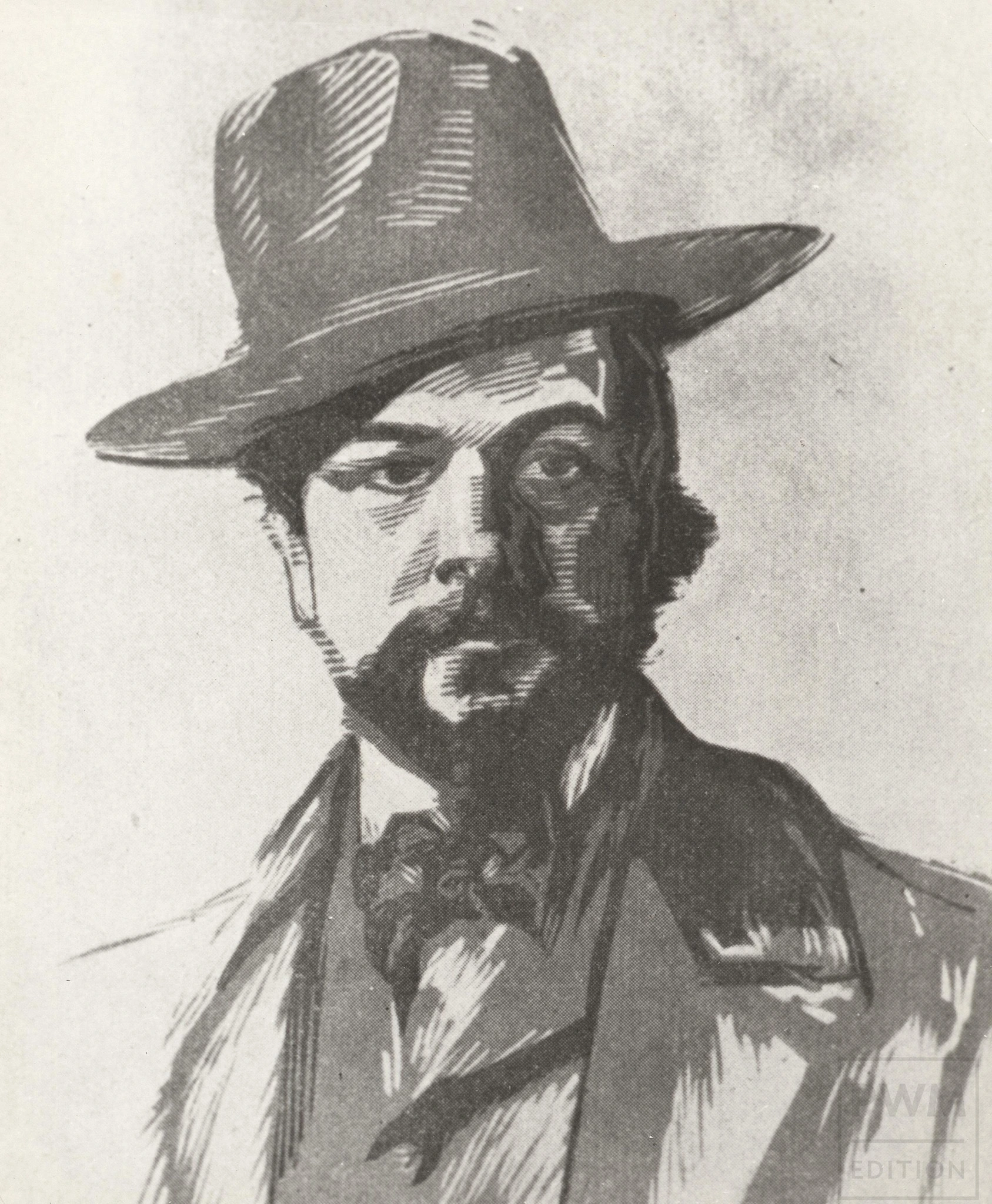
Debussy Achille-Claude, *22 August 1862 Saint Germain-en-Laye, †25 March 1918 Paris, French composer. His parents (Manuel-Achille Debussy and Victorine Manoury) initially ran a faience shop, and in later years, Debussy’s father found permanent employment in Paris as an assistant accountant. Debussy took his first piano lessons at the age of eight with J. Cerutti during the family’s stay in Cannes, and then in Paris with A. F. Mauté de Fleurville (mother of Mathilde, wife of P. Verlaine), an alleged pupil of Chopin. He was admitted to the Paris Conservatory in October 1872, to the piano class of A.-F. Marmontel and the solfège class of A. Lavignac; he joined the harmony class of E. Durand in 1877, and the piano accompaniment and practical harmony class of A. Bazille in 1879. In the summer and autumn of 1880, recommended by Marmontel, he stayed with Nadezhda von Meck as a home music teacher and chamber musician, travelling with her family to Switzerland and Italy. In December of that year, he began studying composition with E. Guiraud. In the following two years, during the holidays, he travelled with the Meck family to Russia and Italy, and in 1882 he was also in Vienna, where he saw Wagner’s Tristan und Isolde for the first time, conducted by H. Richter. Debussy’s acquaintance with the Vasnier couple was of great importance in life at that time, especially with Marie Blanche Vasnier, whom the composer met at singing courses, where he was employed as an accompanist. With her in mind, he composed his first songs to words by Th. de Banville, P. Bourget, Leconte de Lisle and P. Verlaine, and dedicated many of them to her. In 1883, he won the 2nd prize in the competition for the Grand Prix de Rome for the cantata Le gladiateur to a text by E. Moreau. In 1884, he entered the competition again, presenting the cantata L’enfant prodigue, and this time won the 1st prize. This distinction provided him with a three-year scholarship at the Villa Medici in Rome. According to the regulations, he was required to present new vocal and instrumental compositions to the Academy every year. As Debussy’s letters show, the atmosphere at the Villa Medici was extremely tiring for him and inhibited his creative work. Some of the pieces he was working on at the time remained unfinished, including Diane au bois. The first compulsory piece he sent to the Academy in 1886 was the symphonic ode Zuleima with text by G. Boyer after Heine’s Almanzor (a lost piece), and the following year the symphonic suite Printemps. The Academy’s assessment of this work marked the first time the word “impressionism” was used about Debussy’s music: “It is greatly to be hoped that [Debussy] would avoid that vague impressionism which is one of the most dangerous enemies of truth in works of art.”
In February 1887, Debussy returned to Paris and presented the third obligatory work – cantata La damoiselle élue – only the following year. He travelled to Bayreuth in 1888, where he saw Die Meistersinger von Nürnberg and Perceval. Initially, he was a great admirer of Wagner’s work, ever sharing his appreciation for his art with Mallarmé and the entire circle of French intellectuals; however, after his next visit to Bayreuth (1889), his former enthusiasm gave way to critical reflection on the basic assumptions of Wagnerian dramaturgy. Residing permanently in Paris, Debussy had numerous contacts with the intellectual and artistic circles of the capital. He was interested in Far Eastern art (which he became acquainted with during the Paris World Exhibition; Javanese gamelan and Annamite theatre, in particular, made a strong impression on him), the paintings of P. Gauguin and J. Turner, he read Verlaine, H. Régnier, M. Maeterlinck, E. Poe, P. B. Shelley, J. K. Huysmans, studied the works of Ch. Morice, attended the famous Tuesdays at S. Mallarmé’s, visited the Librairie de l’Art Indépendant, where the literary elite gathered, and the Chat Noir cabaret, and also he participated in C. Mendès’s Wagnerian séances. He was friends with, among others, E. Satie and E. Chausson, with the painter H. Lerolle, with the poets G. Mourey and P. Louys. With the latter, he even undertook several joint creative plans, of which only the Chansons of Bilitis were realised. Debussy was accepted into the Société Nationale de la Musique on 8 January 1889.
In the 1890s, Debussy’s creative personality developed fully – the first wave of his popularity came. The following pieces were created at that time: Prelude to the Afternoon of a Faun, Nocturnes, String Quartet, cycle of songs Proses lyriques, and the 1st cycle Fêtes galantes as well as the 1st version of Pelléas and Mélisande. A concert of Debussy’s compositions took place in 1894 in Brussels, conducted by E. Ysaye; in the same year, the Afternoon of a Faun was performed for the first time in Paris. In 1899, Debussy married Rosalie (Lilly) Texier. After 1900, he wrote feuilletons, mainly for “Revue Blanche” and “Gil Blas.” It was then that he created the character of Monsieur Croche – his alter ego, modelled on Monsieur Teste by P. Valéry. He also dealt with journalism in later years, writing reviews of concerts and operas, among others, in “La Revue SIM.” The Paris premiere of Pelléas et Mélisande took place on 30 April 1902, conducted by A. Messager. The performance became a real event in Paris’s musical life, although, alongside enthusiastic voices, there were also negative, even aggressive and hostile ones. In 1903, Debussy received the Legion of Honour. In 1904, he became involved with Emma Bardac, for whom he left his wife, Lilly Texier. In 1905, Debussy and Emma’s daughter, Emma-Claude (Chouchou), was born. In the first decade of the 20th century, Debussy created other famous works: La Maison, Iberia, Rondes de printemps, the piano cycles Estampes and Images, and Children’s Corner; among songs, there was the 2nd cycle Fêtes galantes and Three Ballades to words by F. Villon. In 1905, Debussy signed a publishing contract with Durand’s company to publish all of his future works. By that time, his works were already widely performed in France and other European centres. They were in the repertoire of famous conductors (G. Doret, G. Pierné, D. E. Inghelbrecht, A. Caplet, R. Baton, and others), pianists (R. Viñes, H. Bauer, M. Ravel), and singers (M. Garden, M. Teyte, J. Bathori). The opera Pelléas et Mélisande appeared in the repertoire of the largest stages: in 1907 in Brussels and Frankfurt am Main, in 1908 in Milan and New York, and in 1909 in London. In 1908 and 1909, Debussy led concerts of his own works in London, and in 1910 in Vienna and Budapest. The first two books about him were published (by F. and L. Liebich and L. Laloy). In February 1909, Debussy became a member of the board of the Paris Conservatoire. In 1911, the ballet mystery Le Martyre de saint Sébastien was performed in Paris, with I. Rubinstein in the leading role. The years 1912–13 saw Debussy’s collaboration with S. Diaghilev, which resulted not only in the staging of The Afternoon of a Faun, but also in a new ballet, Jeux, written by Debussy on Diaghilev’s inspiration; this ballet was to express “the plastic-movement apology of the man of 1913.” At the end of 1913, Debussy travelled to Moscow and St. Petersburg, where he conducted his own works; in 1914, he undertook further concert tours to Rome, Amsterdam, The Hague, Brussels and London. After the outbreak of World War I, the composer moved to Angers with his family; commissioned by Durand, he prepared an edition of Chopin’s works. The cancer that had been progressing since 1909 weakened his strength, but he did not stop his creative work until the end. A few days before his death, he was accepted to the Académie des Beaux Arts. He died during the difficult period of warfare, buried on 29 March 1918, in the Père Lachaise cemetery; a year later, his ashes were transferred to the Passy cemetery.
Debussy’s work was for a long time considered synonymous with impressionist music, and thus, its basic issues were considered in analogy to the technique and style of French painting from the end of the 19th century. The first researchers emphasised above all the “impressionism” of Debussy’s music, the lack of tonal-harmonic logic, replaced only by the play of sound colours, the blurring of melodic contours, the fluidity of rhythm and the loss of clarity of the formal arrangement (e.g. W. Niemann, Die Musik der Gegenwart seit Wagner, 1922, O. Wartisch, Studien zur Harmonik des musikalischen Impressionismus, 1934, E. Kurth, Romantische Harmonik…, 1920). Later, the purposefulness of using the term “impressionism” not only in relation to Debussy’s work but to music in general, was questioned from a theoretical and methodological point of view (e.g. H. G. Schulz, Musikalischer Impressionismus und impressionistischer Klavierstil, 1938). Some authors also pointed to the deep affiliations connecting Debussy’s music and his creative poetics with other trends in art at the turn of the 19th and 20th centuries – with symbolism (S. Jarociński, Debussy a Impressionizm i Symbolizm, 1966), l’art nouveau (H. Hollander, Musik und Jugendstil, 1971), and even sought in Debussy the beginnings of neoclassicism and expressionism (A. Goléa, Claude Debussy, 1968). The term “impressionism” can therefore be considered too narrow in relation to Debussy’s music; this music should rather be considered in the context of various trends in the modernist period. However, any comparisons with poetry, painting or the decorative art of art nouveau seem unconstructive when they aim to explain the autonomous means of music by the stylistic and technical properties of other arts. The connections with the entire spiritual culture of the period, on the other hand, gain fundamental significance in considerations of the poetics of Debussy’s work. It was not always expressed explicitly, and even in musical writings, the composer expressed his artistic credo in an allusive, metaphorical way. It is precisely poetics, seen in the cultural context of the era, that reveals a specific system of values, inspirations and choices under the influence of which the composer’s musical style was shaped.
In Debussy’s aesthetic attitude, the cult of beauty gains dominant significance. Derived from the tradition of romantic idealism and pan-aestheticism, in Baudelaire, Ruskin and the French Parnassians, it transforms into a religion of beauty. In this approach, art became a superior value as a sublime and higher domain, accessible only to the chosen ones; closing oneself within its circle was a form of escape from the tragedy and ugliness of life into an imaginary sphere of dreams about a more beautiful world, “where the cult of beauty was combined with the cult of art” (Open Letter to the Chevalier de Guerre Ch.W. Gluck from Monsieur Croche). If the sense of beauty was assumed to be the guiding aesthetic principle guiding the artist’s actions, then the creative act was, in turn, attributed to creative power. The beauty of art results from the constructive action of spiritual factors; it is not the result of reproduction (mimesis) but of discovery and exploration. The search for novelty, originality, and individual workshop solutions – was supposed to protect art from templates, banality and ordinariness.
Conformity with the ideals of the modernist era is also manifested in Debussy’s choice of texts in vocal-instrumental music or in extra-musical inspirations and associations carried by the titles of instrumental music. In Debussy’s works, there is an emotional climate similar to that in the poetry and painting of the end of the century, an escape from monumental and pathetic themes into the sphere of matters left unanswered until the end, allusive and ambiguous (Pelléas and Mélisande); we find the same circle of inspiration and similar symbolism: images of nature – a moonlit night, the sea (The Sea, The Sirens) and the sky (Clouds); phenomena of movement – wind, flowing water, dance; evocation of French traditions and the scenery of 18th-century French painting (Love Games, Masques, The Island of Joy, Hommage à Rameau, songs to the words of old French poets); the Arcadia of the ancient world (Prelude to the Afternoon of a Faun, Syrinx, Chanons de Bilitis, Epigraphes antiquated); the exoticism of the Orient (Pagodes, designed music for a Buddhist drama by V. Segalen, Siddhartha); the theme of love and death (Pelléas et Mélisande, Cinq poèmes de Charles Baudelaire, Le Martyre de saint Sébastien); the indefiniteness of time and place (Pelléas et Mélisande); the grotesque and irony (Jeux, cycle 2, Général Lavine – eccentric); fascination with images of the macabre and destructive force (La Chute de la maison Usher). The very principle of combining music with words and the action of scenes, or the extra-musical inspirations expressed in the title, are nothing new, but one can speak of a specific circle of phenomena stimulating Debussy’s musical imagination. Debussy’s programmatic titles do not refer to literary “actions,” as was often the case in Romantic music, but their role is secondary to an autonomous musical meaning. They are rather intended to express the unity of mood aroused by a given music, landscape, object, colour, phenomenon, etc. (e.g. Clair de Lune, Feux d’artifice, La cathédrale engloutie). Here, as in Baudelaire, we see influences from the aesthetic idea of correspondence, referring to Swedenborg’s doctrine, according to which sounds, colours, shapes, lights, moods, and mental states are equivalent to each other, in accordance with the mystical principle of universal analogy, and unite in the primordial unity of being.
The aesthetics of modernism, strongly emphasising the role of creative individuality, combating all normativism and established conventions, imposed on artists the obligation to rethink every element of their art, to return to its foundations, to its material. This individuality in the approach to technical issues, the search for the extraordinary and the primacy of creative imagination also characterise Debussy’s creative personality. In the 1980s, the starting point for him were the traditional assumptions of major-minor tonality, although even then some pieces foreshadowed the future creator of Pelléas… Gradually in the 1990s, his music saw a loosening of the functional chord relationships, the model of which was the cadence, and a broadening of the range of scales used. Therefore, the system underlying Debussy’s music could be described as a new modality. In addition to the material of major and minor scales in their various varieties, Debussy introduces pentatonic scales, a six-step whole-tone scale and old church scales freely transposed. It modifies pure scales by creating their variants while maintaining one centre, or – conversely – often changes the centre of the scale, which blurs the clarity of the mode. The selected scale material is relatively rarely the basis for the formation of the entire piece or its part; such a rare case is the prelude Voiles (book 1, no. 2), where a whole-tone scale appears in the outer parts, and a pentatonic scale in the middle. Most often, however, scales appear only for short sections and then undergo transformations, or different scales are contrastingly juxtaposed, complementing each other to the full chromatic scale.
Scales can also be combined simultaneously, e.g. the heptatonic scale of the white piano keys and the pentatonic scale of the black ones (the beginning of the prelude of Brouillards, bar 2, no. 1). The twelve-tone material used in one piece most often turns out to be the sum of different scales or their sections. It can be assumed that scales with a limited number of notes had a specific colourful and expressive quality for Debussy. The full chromatic scale is therefore sometimes used as an effect of condensing the sound or increasing its intensity. Debussy most often uses sections of the chromatic scale (e.g. the beginning of the prelude Feux d’artifice, bar 2, no. 12), less often its full range (e.g. fragments of the prelude Ce qu’a vu le vent d’ouest, bar 1, no. 7). We also find 9- and 10-note complexes, which are free choices of the full range of 12 notes. As M. Emmanuel points out, Debussy also considered the possibility of using a 24-note scale in vocal music.
The sound combinations in Debussy’s works are not subordinated to a uniform principle of intervallic construction. Major and minor triads still have basic significance but are expanded, with ninth or eleventh chords gaining the rank of independent units that do not require resolution to consonance. The composer also adds second or tritone intervals to the third chords. He often uses major-third triads, especially in combination with a whole-tone scale. He likes empty fifth-fourth chords (the prelude La cathédrale engloutie, book 1, no. 10) or fourth-second chords. He also uses polyharmonic combinations of triads. In principle, therefore, the material of the scale can be used vertically and horizontally without the limitations of the vertical construction principle. Cadential connections and dominant-tonic connections are loosened; the role of leading notes disappears, which changes and expands the choice of chord sequences and the way they are combined. By maintaining the principle of the tonic centre, although not always integrated with the scale, Debussy modifies the relations of chords; they are not determined by oppositions: dissonance – consonance, leading sound – resolution. The connections are often fluid, ambiguous. The final cadences become not so much harmonic formulas as they consist in resonating and quieting the musical progression. The limitations in the selection and consequences of chords in the piece result only from the structural principles established by the composer. Some of them are repeated so often that we can speak of chords, connections, etc. typical for Debussy. Such a typical means is, for example, chord parallelisms, i.e. parallel shifting of chords of the same structure. What is important in this phenomenon, interpreted differently by theoreticians, seems to be not so much the harmonic principle of chord progression, but its melodic genesis – increasing the density of the melodic line (band of sounds instead of a line).
The new assumptions of the organisation of pitches stem from the composer’s particular sensitivity to sound qualities. The whole set of factors defining the sonoristic properties of Debussy’s music consists, apart from melodic-harmonic structures, of the combination of instruments and the way of using their technical properties, rhythmic formula and agogics, dynamics and articulation. Not only do Debussy’s scales, the ordering of intervals and consonances change, but also the instrumental texture – innovative and original in both piano pieces, orchestral and chamber pieces. In terms of piano technique, Debussy introduces very diverse sound figures, operates with all ranges of registers, juxtaposes extreme registers, uses the effects of chord decay and swelling, diversifies the methods of pedalling, and uses extremely varied means of articulation. Dynamics becomes particularly rich in piano shades, and the effects of intensity and volume are the result not only of a specific force of the strike, but also of its density. The use of very small rhythmic values (thirty-second, sixty-four) and the maximum intensification of the speed of movement causes the blurring of the distinctness of individual sounds and the transformation of the harmonic quality into a murmuring background for melodic motifs or detached individual sounds and chords. Characteristic of Debussy’s piano texture are also layered arrangements, i.e. the isolation of several simultaneous sound planes contrasted in terms of registers, rhythmic order, articulation and dynamics.
The most striking innovation in sound is in orchestral works. Debussy’s starting point was the traditional “Tristan” orchestral apparatus, but the instrumentation technique is completely different. Debussy attached great importance to the “purity” of sounds, achieved through the expressiveness of the colours of individual instruments and their groups. He described Wagner’s orchestra as “a kind of multicoloured conglomeration” in which it is impossible “to distinguish the sound of a violin from a trombone.” Debussy primarily highlights wooden and string instruments, while sparingly using brass, often employing horns and trumpets with mutes. He willingly adds instruments such as the harp, celesta, and gongs to the traditional composition, as well as human voices treated instrumentally (the choir singing with closed mouths in Sirens and in the symphonic suite Printemps); sometimes he also introduces instruments rarely encountered in the orchestra, such as the sarrusophone in the dance poem Jeux, oboe d’amour, guitars and castanets in Iberia. He abandons the choral arrangement within individual groups of instruments, expanding the range of registers beyond the so-called natural register. He uses doublings of instrument parts, often in thirds or sixths, within a group of homogeneous instruments in order to strengthen the sound (parallelisms) and emphasise the colour of a given group. In the string instruments, he introduces divisi in violins, violas and cellos, with the number of independent parts increasing to 8–12, and sometimes even to 15 in La Mer. The articulation in the string group is vibrant, with various ways of playing and attacking the sound. Playing sul tasto and sul ponticello, glissando, harmonics, the use of mutes and tremolo – these are devices that appear very often in Debussy’s scores. In addition to the traditional arrangement of melodic and harmonic instruments, the composer most often divides the orchestra into smaller sub-assemblies, constantly changing their composition and entrusting individual instruments and groups of homogeneous instruments with various functions. Debussy attaches a great role to ornamental elements (trills, runs, glissandi) as means of enriching the sound. The character of harmony changes in Debussy through the fragmentation of rhythmic values, figuration, ostinato formulas in place of fixed chords, and tremolos; the chords are mobile, undefined, often acting as a murmuring background. As a result, Debussy’s instrumentation is a factor inseparable from the sound matter; themes gain a characteristic colour, they are not something abstract (e.g. the flute theme in Prélude à l’après-midi d’un faune, the English horn theme in Nuages). Instrumentation individualises each musical structure, at the same time becoming a means of shaping the form thanks to the possibilities of sound variants and metamorphoses. The most outstanding example of the exposure of sonoristic factors is the dance poem Jeux.
Debussy introduced a whole range of additional performance terms (in French) suggesting appropriate sensory impressions and types of expression: comme une buée irisée – like a rainbow mist (Cloches à travers les feuilles from Images for piano, book 2, no. 1), ainsi qu’une flûte – similar to a flute (Faun from Fêtes galantes, book 2, no. 2), mélancolique et lointain – melancholy and from a distance (Fêtes galantes from Fêtes galantes, book 2, no. 3), dans une brume doucement sonore – in a mist of delicate sounds, peu à peu sortant de la brume – gradually emerging from the mist (the prelude La Cathédrale engloutie), often also moqueur – mockingly, aérien – airily, angoissé – timidly, etc.
The choice of tonal, tonal-harmonic and expressive means results each time from the overall formal concept of the piece. Debussy did not accept any conventional architectural schemes. Even where he uses traditional names of genres, such as sonata, quartet, prelude, suite, he departs from classical-romantic patterns of formal shaping – from periodic symmetry and from the principle of thematic transformation. In Debussy, the organisation of form consists in arranging sections, which can be described as sound planes. These are structures with a specific selection and ordering of sounds and relatively constant relations between individual components. The more factors act unifyingly, the greater the internal stability of a given structure (fixed notes, ostinato, uniform texture, repetition principle, scale, sound centres). Such a structure can also be mobile thanks to figuration in small rhythmic values, melodic movement, articulatory and dynamic changes (a type of consonance in movement). Within one plane, the composer obtains many nuances of the same essentially sound complex.
The planes of sound are juxtaposed on the principle of repetition, variant or contrast. A special role in the repetition of equivalent sections is played in particular by various types of modifications of a melodic, harmonic, rhythmic and dynamic nature. Despite all the unconventional nature, the architectural concept in Debussy’s works is exceptionally clear, lucid and deliberate in detail. The form gains a “spatial” character rather than a dynamic-developmental one. In their external outlines, Debussy’s works have a tripartite structure; the principle of tripartite structure is also transferred to the structure of the cycle (e.g. Nocturnes, La Mer, Iberia, two cycles of Images for piano, Estampes). The composer also juxtaposes piano miniatures into more extensive collections (two books of preludes with 12 pieces each, two books of etudes with six pieces each).
A significant group in Debussy’s compositional legacy are songs for voice and piano. Debussy’s originality in this field is expressed not so much in his approach to genre and form, but in the creation of a specific vocal style and musical language. Debussy’s aesthetic attitude is already revealed in the selection of texts, initially predominated by the poetry of the Parnassians, later of the Symbolists. He also wrote to his own texts (Proses lyriques, Noël des enfants). A separate group consists of songs to the words of old French poets – Charles d’Orléans, F. Villon, and T. L’Hermite. The most outstanding song cycles were written to the words of Baudelaire, Verlaine and Mallarmé. Debussy’s vocal melody is a musical transposition of poetic declamation – recitative, most often syllabic, with irregular rhythm, ideally suited to the accentuation of the poem and emphasising its phonic values. The interval pattern of the melody, its ambitus, the distribution of climaxes, the emphasis of individual key words – depend each time on the text, its structure, expressive and semantic content. In Debussy’s songs, one can notice the independence of the vocal melody plan and the piano part, which results partly from the nature of the harmonic and sound means. The melody becomes an exponent of the verbal text, its specific musicalisation, while in the piano part, the composer interprets the internal content of the text, creating a musical equivalent of emotional states and the mood conveyed by the text. Debussy’s songs provide many examples of semantic treatment of music. Of particular importance is the presentation of movement phenomena evoked in the text through music, e.g. the gushing water of the fountain in Le Jet d’eau (Cinq poèmes de Charles Baudelaire, no. 3), the rustling of raindrops in Ariettes oubliées, No. 2), the mechanical movements of the marionettes in Fantoches (Fêtes galantes, no. 1), the spinning carousel in the song Paysages belges. Chevaux de bois (Ariettes oubliées, no. 4). Such an illustration may seem too literal, but it allows for a symbolic interpretation: the monotony of the “rainy” ariette serves to recreate the “internal landscape” (crying in the heart), the mechanical rhythmic movement in Chevaux de bois symbolises the soullessness of the world of things, the fairground “cirque bête.” Illustrating the external world therefore has a symbolic meaning. Movement is a symbol of life, transience; stillness, nothingness, night, death become the contrast. All means can participate in emphasising the semantic aspect of the text – rhythmic movement, tempo, dynamics, articulation, harmonic means (e.g. contrasts of diatonic and chromatic, use of expressive meaning of scales, increased role of single intervals, especially tritone, etc.). In later songs, Debussy introduces motifs symbolising key words of the text, e.g. in the song Faun (Fêtes galantes, book 2) a “flute” motif repeated throughout the song. In the song Colloque sentimental from the same cycle, there appears a reminiscent motif, taken from the song En sourdine, which opens the first cycle of Fêtes galantes; returning at the end, this motif sounds like an echo and ironic recollection of the dead past.
The sum of Debussy’s musical ideals is the lyrical drama Pelléas et Mélisande, a work in which the composer gives his own interpretation of the eternal story of love and death, consciously contrasted with the pathos and romantic exaltation of Wagner’s Tristan. The external action does not have much significance in Debussy’s drama, it is only a background for important, internal conflicts. Mysterious images with symbolic meaning show the tragedy of existence and the mystery of human destinies, which cannot be predicted and cannot be counteracted. The real meaning of events remains elusive, unspoken. Debussy’s work is static, focused on the nuances of the text, on internal experiences, and not on dramatic situations. The composer abandons elaborate ensemble scenes, pushing the elements of theatricality and operatic virtuosity into the background. The main role is played by recitative, emphasising the natural melody and expression of the text, sometimes similar to psalmody, sometimes more developed in intervals, rhythmically varied. The leading motifs (M. Emmanuel lists 13 of them) have a different character than in Wagner, they are rather similar to old motifs reminiscent of French drama; in Wagner, motifs referring to people and things are specific, often treated realistically, even naturalistically, while in Debussy, they are exclusively a bearer of symbolic meanings. This is visible, for example, in the three main motifs that appear already in the orchestral prelude: the forest motif (secret forces of nature, eternity), the Golaud motif (expressing anxiety, fear, uncertainty) and the Mélisande motif (lyricism, subtlety).
These motifs are not transformed or developed, but return unchanged or in variants, in accordance with Debussy’s typical understanding of form. Despite the triple composition of wood and brass, the orchestra has a chamber character. Orchestral tutti is extremely rare, usually appearing in interludes. As in songs, the instrumental part often mimetically emphasises external details of the text in order to reveal its symbolic meaning – e.g. throwing a ring into a well (Act 2, Scene 1), the fluttering of doves’ wings (Act 3, Scene 1), the castle’s underground (Act 3, Scene 2) or falling stars (Act 4, Scene 4). The orchestral background is never intrusive, the composer uses subtle means of sound colouring as a sound basis for vocal dialogues and monologues, always leaving a sphere of understatement, in accordance with the assumptions of symbolic drama.
The significance of Debussy’s music has only been fully appreciated in modern times. J. Chailley wrote: “The last musician of the 19th century is the first musician of the 20th century.” Indeed, the innovation and originality of Debussy’s musical language revealed new perspectives of compositional thinking, especially in the field of sonorism. In the times of the overwhelming influence of Wagnerism, Debussy created the concept of a new style, marking the path of future exploration. Of significant importance to his successors were not only the new technical means he created, but also his poetics, emphasising the creativity of compositional work, individuality and uniqueness of choices, unconventionality of technical and formal means while maintaining ties with tradition. However, the value of Debussy’s music lies primarily in itself, in its internal harmony, in the sublime beauty of sound, in the balance with which it combines compositional skill with naturalness and spontaneity.
Editions:
Claude Debussy. Oeuvres complètes, ed. F. Lesure, Paris 1985–.
Literature:
Documentation — J.R. Briscoe Claude Debussy. A Guide to Research, «Garland Composer Resource Manuals» XXVII, New York 1990 (includes a bibliography).
Correspondence: Claude Debussy. Lettres 1884–1918, ed. F. Lesure, English ed. London 1987; J. Charette Claude Debussy. Through His Letters, New York 1990.
Special editions — Claude Debussy, «Musik-Konzepte» 1–2, ed. H.-K. Metzger and R. Riehn, Munich 1977; Pelléas et Mélisande, “L’Avant-Scène Opéra” no. 9, 1977; “Analyse musicale” no. 12, 1988; “Analyse musicale” no. 16, 1989 (La terrasse des audiences du clair de lune de Debussy. Neuf analyses pour une étude de méthodologie comparée).
Monographs of life and work — J. Barraqué Debussy, Paris 1962, 21979; J. Kremlow Claude Debussy, Moscow 1965; C. Zenck-Maurer Versuch über die wahre Art Debussy zu analysieren, Munich 1974; F.C. Ricci Claude Debussy, Bari 1975; A. Jakobik Claude Debussy oder die lautlose Revolution in der Musik, Würzburg 1977; A. Liess Claude Debussy. Das Werk im Zeitbild, Baden-Baden 1978; Th. Hirsbrunner Debussy und seine Zeit, Laaber 1981; R. Holloway Debussy and Wagner, New York 1982; W. Keil Untersuchungen zur Entwicklung des frühen Klavierstils von Debussy und Ravel, Wiesbaden 1982; R. Terrasson Pelléas et Mélisande ou l’initiation, Paris 1982; E. Lang-Becker Debussys Nocturnes, Munich 1982; A. B. Wenk Claude Debussy and 20th-Century Music, Boston 1983; R. Howat Debussy in Proportion. A Musical Analysis, Cambridge 1983 (review in “Muzyka” 1983 no. 3–4); J. Trillig Untersuchungen zur Rezeption Claude Debussys in der zeitgenössischen Musikkritik, Tutzing 1983; Ch. Goubault Claude Debussy, Paris 1986; S. Sowa-Winter Die Harfe im Art Nouveau, Munich 1988; G.-P. Biasin Móntale, Debussy and Modernism, Princeton 1989; P. Holmes Debussy, London 1989, Polish transl. R. Kowal, Kraków 1999; R.S. Parks The Music of Claude Debussy, New Haven 1989; M. Guertin De la lecture à Taudition dun texte musical. Une étude des thèmes dans le Livre I des Préludes pour piano de Debussy, Montreal 1990; R. Beyer Organale Satztechniken in den Werken von Claude Debussy und Maurice Ravel, «Neue musikgeschichtliche Forschungen» XIX, Wiesbaden 1992; F. Lesure Claude Debussy avant Pélleas, ou Les années symbolistes, Paris 1992; G. Macassar and B. Mérigaud Claude Debussy. Le plaisir et la passion, Paris 1992; R. Nichols Debussy Remembered, Portland (Oregon) 1992, German ed. Zurich 1993; J. Arndt Einheitlichkeit versus Widerstreit. Zwei grundsätzlich verschiedene Gestaltungsarten in der Musik Claude Debussys, «Europäische Hochschulschriften», Frankfurt am Main 1993; J. Arndt Der Einfluss der javanischen Gamelan-Musik auf Komposition von Claude Debussy, Frankfurt am Main 1993; D. Fischer-Dieskau Fern die Klage des Fauns. Claude Debussy und seine Welt, Stuttgart 1993; F. Lesure Claude Debussy. Biographie critique, Paris 1994; V. Raad The Piano Sonority of Claude Debussy, Lewiston (New York) 1994; S. Trezise Debussy. La mer, New York 1994; Z. Weber Impresionizam u hrvatskoj glazbi. Recepcija glazbe Claudea Debussya u Hrvatskoj 1918– 1940, Zagreb 1995; P. Roberts The Piano Music of Claude Debussy, Portland (Oregon) 1996; S. Bruhn Images and Ideas in Modern French Piano Music. The Extra-musical Subtext in Piano Works by Ravel, Debussy and Messiaen, Stuyvesant (New York) 1997; D. Studies, ed. R.L. Smith, Cambridge 1997.
N. Ruwet Les duplications dans l’oeuvre de Debussy, in: Langage, musique, poésie, Paris 1972; J.-J. Nattiez and L. Hirbour-Paquette Analyse musicale et sémiologie. A propos du Prélude de Pélleas, “Musique en jeu” 1973 no. 10; J. Paja-Stach Rola instrumentacji w kształtowaniu brzmienia utworów Claude’a Debussy’ego, “Muzyka” 1975 no. 4; C. Zenck-Maurer Form- und Farbenspiele. Debussys, “Jeux”, AfMw XXXIII, 1976; Th. Hirsbrunner Claude Debussy und Pierre Louys. Zu den „Six épigraphes antiques” von Debussy, “Die Musikforschung” XXXI, 1978; Th. Hirsbrunner Zu Debussys und Ravels Mallarmé-Vertonungen and Debussys Ballett „Khamma”, “Archiv für Musikwissenschaft” XXXV, 1978, XXXVI, 1979; J. Paja-Stach Uwagi o formie w muzyce Debussy’ego (on the basis of “Preludia”), “Muzyka” 1982 no. 1–2; B. Gousset La prééminence du timbre dans le langage musical de „La mer” de Debussy, “Analyse musicale” no. 3, 1986; Ph. Charru La cathédrale engloutie, prélude de Claude Debussy. Le mouvement musical au rythme de la forme and S. Gut La cathédrale engloutie, prélude de Claude Debussy. Interférences entre le matériau, la structure et la forme, “Analyse musicale” no. 4, 1986; E. Andreani Texte et musique ou les aventures du sens. A propos de Pelléas et Mélisande. Maeterlinck et Debussy, “Analyse musicale” no. 9, 1987; S. Caillat Le geste du chef de choeur. Analyse de sa mise en oeuvre dans l’interprétation dune chanson a cappella de Debussy „Dieu! Qu’il fait bon regarder!”, “Analyse musicale” no. 10, 1988; N. Meeus Le Prélude à l’après-midi d’un faune. Une analyse harmonique and H.C. Fantapié Direction d’orchestre, interprétation et rythme dans le „Prélude à l’après-midi d’un faune de Claude Debussy, “Analyse musicale” no. 13, 1988; S. Kunze Le chant parlé et l’indicible. Remarques sur le Pelléas et Mélisande de Debussy, »Analyse musicale” no. 30 and 31, 1993; S. Gut Le Prélude de Pelléas. Les ambiguités du contraste et de la cohésion, J.J. Velly Quelques aspects de l’orchestration dans Pelléas et Mélisande. Economie de moyens et richesse sémantique, D. Piston Debussy et Massenet. Invitation à une étude comparative and T. Malengreau Du Pelléas de Maeterlinck au Pelléas de Debussy, “Analyse musicale” no. 31, 1993; D. Kopp Pentatonic Organization in Two Piano Pieces of Debussy, “Journal of Music Theory” XLI, 1997; J. Viret Debussy l’aquatique, Strawinsky le tellurique. Eléments naturels et poétique musicale, “Revue musicale de Suisse Romande”, March 1997; W. Schröter „Pelléas et Mélisande” ou la polémique des silences, “Revue musicale de Suisse Romande”, March–May 1998; S. Gut Analyse formelle et structure fondamentale dans Canope de Debussy, Eléments constants et éléments mobiles dans Jeux de Claude Debussy, Pelléas et Mélisande — Un anti-Tristan?, in: Musicologie au fil des siècles, Paris 1998.
List of compositions will be published soon.