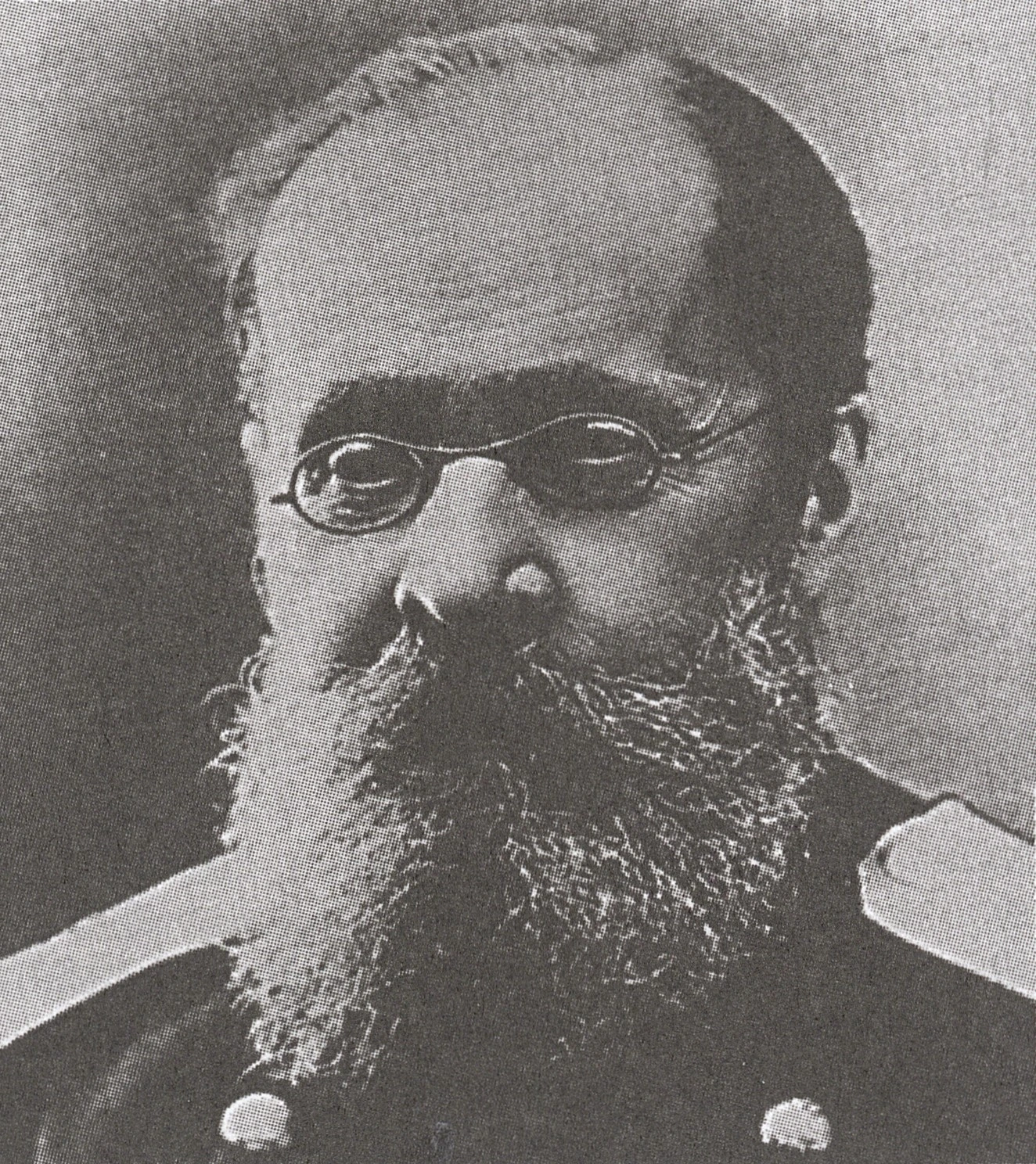
Cui, Kyui, César, Tsezar′, Antonovich, *18 (6) January 1835 Vilnius, †26 March 1918 Saint Petersburg, Russian composer and music critic. He received his secondary education at the gymnasium in Vilnius, where his father – a former Napoleonic officer married to a Polish woman, Julia Gucewicz – taught French. In 1850, for six months, Cui took lessons in harmony and counterpoint with S. Moniuszko, whilst at the same time writing his first vocal compositions under his guidance: around 50 songs to Polish and French texts. After studying engineering at universities in Saint Petersburg (1851–1857), he became a lecturer and, in 1878, a professor of fortifications at the Engineering School and at the Academy of Military Engineering, eventually becoming a highly regarded specialist in this field (in 1904 he was promoted to the rank of general). He continued the musical studies he had begun under Moniuszko on his own, combining them from 1856 onwards with his creative work as a composer for the Mighty Handful. Between 1864 and 1900, Cui worked as a journalist and music critic, publishing longer articles, columns and reviews in the following periodicals: “Sankt-Peterburgskie Vedomosti” (1864–1877), “Novoye Vremya” (1877–1880), “Golos” (1880–1882), “Nedelya”(from 1884), “Muzykalnoe obozrenie”, which he edited (1885–1888), “Grazhdanin” (1887–1888), as well as “Novosti”, “Rossiya”, “Iskusstvo” and “Artist”. In addition, he published articles on Russian music in French and Belgian newspapers: “Revue et Gazette Musicale”, “L’Art”, “Le Ménestrel” and “Guide Musical”.
Cui’s artistic personality was shaped by many factors. He was significantly influenced by M. Balakirev, chiefly in the field of orchestral technique; by A. Dargomyzhsky, who influenced the operatic dramaturgy and the melodics of Cui’s vocal works; and by A. Serov, who played a key role in the development of his aesthetic views. Nevertheless, Cui’s work developed independently of the ideology of the Mighty Handful, although he initially co-led the group and promoted its aesthetic principles as a journalist and critic. Raised in a Polish environment and with French roots, Cui was easily influenced by Western musical traditions. These are particularly evident in his operas, in which he sought to imbue foreign themes (Scottish, Italian, French) with an appropriate sound colour. In contrast, in his solo and choral songs set to Russian texts, he shunned direct inspiration from folk material, drawing instead on the Russian romance genre, from which he drew national intonations, but also a salon-style character that came to dominate his solo and chamber music. Predestined for concise forms of musical expression, he expressed his talent most fully in vocal lyricism and piano miniatures; he composed atmospheric works characterised by expressive harmony and – in his songs – a declamatory structure of melodics. He began his piano output by emulating the style of Chopin (Mazurka in G minor), whose stylistic and textural models he remained closely attached to (preludes, polonaises, mazurkas, waltzes, impromptus). Between 1856 and 1858 he went through – as Moniuszko put it – “a paroxysm of admiration for Schumann” (two scherzos on the letter themes BABEG and CC). In later years he was also influenced by Liszt (Suite Op. 21). After 1874, Cui adopted a conservative stance towards new developments in music, including certain works by composers of the Mighty Handful (Mussorgsky’s Boris Godunov). Later, in defending their principles, he opposed the New Russian composers from Belyayev circle. His aversion to new trends in Western music is, in turn, evidenced by the piano piece Rêverie d’un faune, après la lecture de son journal (from Op. 83), which is a parody of Debussy’s The Afternoon of a Faun.
Literature: L. de Mercy-Argenteau César Cui: esquisse critique, Paris 1888, reprint Charleston (South Carolina) 2009, 2022; V. V. Stasov César Antonovich Cui, “Artist” 1894 No. 34, reprint in V.V. Stasov Izbrannye sochineniya: zhivopis’, skulptura, muzyka, vol. 3, Moscow 1952, pp. 387–408; N.F. Findeisen Bibliograficheskiy ukazatel′ musïkal′nïkh proizvedeniy i kriticheskikh statey Ts.A. Kyui’, Moscow 1894; P. Weymarn Tsezar’ Antonovich Kyui kak romansist, Saint Petersburg 1896; A. Koptyayev Tsezar Antonovich Kyui kak fortepiannïy kompozitor’, Saint Petersburg 1897; E. Wrocki Cezar Cui. Życie i działalność, Warsaw 1925, a copy featuring an extract from the magazine “Rytm” 1924 No. 15; H. Anglés Relations épistolaire entre César Cui et Philippe Pedrell, Fontes Artis Musicae 1966 No. 13; B.W. Asafiew Russkaja muzyka XIX i XX wieka, Moscow 1968; A. Guglielmi César Cui e 1’Ottocento musicale russo, “Chigiana” 1968 No. 25; A.A. Gozenpud Russkiy opernïy teatr XIX veka, 1873–1889, Leningrad 1973; T.N. Livanova Ts.A. Kyui, in: Opernaya kritika v Rossii, vol. 2, Moscow 1973, pp. 134–188; R. Taruskin Opera and Drama in Russia. As Preached and Practiced in the 1860s, Rochester (New York) 1981; R.C. Ridenour Nationalism, Modernism, and Personal Rivalry in Nineteenth-Century Russian Music, Ann Arbor (Michigan) 1981; V. Kuznetsov Kamerno-vokal′noye tvorchestvo Kyui’, in: Stilevïye osobennosti russkoy musïki XIX–XX vekov, ed. M. Mikhailov, Leningrad 1983; B.G. Rosenthal Wagner and Wagnerian Ideas in Russia, in: Wagnerism in European Culture and Politics, eds. D. C. Large and W. Weber, Ithaca (New York) 1984, pp. 198–245; A.F. Nazarov Tsezar′ Antonovich Kyui, Moscow 1989; S. Neef Handbuch der russischen und sowjetischen Oper, Kassel 1989; A. Gaub Die kollektive Ballett-Oper ‘Mlada‘: Ein Werk von Kjui, Musorgskij, Rimskij-Korsakov, Borodin und Minkus, Berlin 1998; César Cui’s Opera ‘Feast in Time of Plague’, (includes a new translation of the libretto, an introduction and a translation by L.K. Neff), “The Pushkin Review“, I (1998 ), pp. 121–148; S. Neef Die Russischen Fünf. Balakirew, Borodin, Cui, Mussorgski, Rimski-Korsakow. Monographien – Dokumente – Briefe – Programme – Werke, «Musik Konkret» III, Berlin 1992; L.K. Neff Story, style, and structure in the operas of Cesar Cui, doctoral thesis at Indiana University, Bloomington 2002, e-book containing a complete, chronological list of Cui’s compositions available at https://imslp.org/wiki/Category:Neff%2C_Lyle_K.
A. Sutherland Children in Opera, Newcastle-upon-Tyne 2020, e-book 2021.
Compositions:
Instrumental:
Scherzo Op. 1 for 2 pianos (four hands), 1857, also in an orchestral version 1857
Scherzo a la Schumann Op. 2 for 2 pianos (four hands), 1857, also in an orchestral version 1857
Tarantella Op. 12 for orchestra, 1859
Suite miniature Op. 20 No. 1 for orchestra, 1882
Suita Op. 21 for piano, 1883
Deux morceaux Op. 24 for violin and orchestra, 1884
Suite concertante Op. 25 for violin and orchestra, 1884
polonaises for piano, including Deux polonaises Op. 30, 1886
Deux morceuax Op. 36 for cello and orchestra, 1886
Suite Op. 38 No. 2 for orchestra, 1887
miniatures for piano, including, amongst others, cycles: A Argenteau Op. 40, 1887, excerpts (Nos. 1, 4, 5, 8, 9) in the orchestral version as Suite No. 4
Suite Op. 40 No. 4 for orchestra, 1887
Suite Op. 43 No. 3 “In modo populari” for orchestra, 1890
String Quartet in C minor Op. 45, 1890
cycles of miniatures, including 24 pieces Kaléidoscope Op. 50, 1893
waltzes, impromptus, preludes for piano, amongst others 25 preludiów Op. 64, 1903
String Quartet in D major Op. 68, 1907
mazurkas for piano, including Three Mazurkas Op. 79, 1909
Three Scherzos Op. 82 for orchestra, 1910
Five Pieces Op. 83 for piano, 1911
numerous works for violin and piano, including Sonata Op. 84, 1860–70, Petite suite Op. 14, 1879
String Quartet in E-flat major Op. 91, 1913
Five Pieces Op. 95 for piano, 1914
variation cycles for piano, including, amongst others, Eighteen Variations Op. 100, 1916
Sonatina Op. 106 for piano, 1916
Vocal and vocal-instrumental:
numerous works for a cappella choir, including:
Six Choruses Op. 63, 1903
Three Psalms Op. 80, 1910
approx. 330 solo songs, including over 30 cycles set to French, Russian, Polish and German texts, such as:
Vingt poèmes de Jean Richepin Op. 44, Paris 1890 Heugel
Twenty-Five Poems by A. Pushkin Op. 57, Moscow 1899 Jurgenson
Twenty-One Poems by N. Nekrasov Op. 62, Moscow 1902 Jurgenson
Eighteen Poems by A.K. Tolstoy Op. 67, 1904
songs to words by A. Mickiewicz: in Op. 10 – Rozmowa, Polały się łzy me, 1876, Moscow 1894 Jurgenson; in Op. 11 and 13 – Moja pieszczotka, Gdy mię spokojnym zowią dzieci świata, Gdybym się zmienił, Rezygnacja, 1877, 1878, Op. 48 – Cisza morska, Dzień dobry, Ranek i wieczór, Do Niemna, Berlin 1892, Simrock; Sześć pieśni… Op. 71 – Zaloty, Dwa słowa, Pieśń Strzelca (from Dziady Part I), Naprzód ciebie wspomina (from Dziady Part IV), Stepy akermańskie, Czym jest me czucie (from Dziady Part III), 1907; Uwagi chromego (excerpt from Myśli i uwag… in Miniatury muzyczneOp. 87, 1913); ballad Budrys i jego synowja na głos i orkiestrę, 1915
Sześć pieśni polskich Op. 76, to text by K. Brodziński, J. Czeczot, S. Witwicki, Moscow, Jurgenson
Tvoy stikh Op. 96, a cantata in memory of M. Lermontov, for choir and orchestra, 1915
Stage:
operas:
Kavkazskiy plennik, libretto W. Krylov after A. Pushkin, Act 1 and 3 1857–1858, Act 2 1881–1882, staged in Saint Petersburg 1883
William Ratcliff, libretto by A. Pleshcheyev after H. Heine, 1861–1868, staged in Saint Petersburg 1869
Angelo, libretto by W. Burenin after V. Hugo, 1871–1875, staged in Saint Petersburg 1876
Mlada (Act 1 of the planned opera-ballet, composed jointly with A. Borodin, M. Mussorgsky, N. Rimsky-Korsakov and N. Minkus), libretto by W. Krylov, 1872, stage performances in Saint Petersburg 1911
Le flibustier, libretto after J. Richepin, 1888–89, staged in Paris 1894
Saratsin, libretto after A. Dumas (father), 1896–98, staged in Saint Petersburg 1899
Pir vo vremya chumï, libretto after A. Pushkin, staged in Moscow 1900
Mademoiselle Fifi, libretto after G. de Maupassant, 1900, staged in Moscow 1903
Matteo Falcone, libretto after P. Mérimée, 1901, staged in Moscow 1907
Kapitanskaya dochka, libretto after A. Pushkin, 1907–09, staged in Saint Petersburg 1911
Sïn mandarina, operetta libretto by W. Krylov, 1859, staged in Saint Petersburg 1878
children’s operas:
Snezhnïy bogatïr′, libretto by M. Pol, 1905, staged in Yalta 1906
Krasnaya shapochka, 1911
Kot v sapogakh, 1913, staged in Tbilisi 1915
Ivanushka-durachok, 1913
Writings:
La musique en Russie, Paris 1880, reprint 1974
Istoriya literatury fortepyanovey muzïki, Saint Petersburg 1889
Kol′tso Nibelungov: musïkal′no-kriticheskiy ocherk, Saint Petersburg 1889, 2nd ed. 1909
Russkiy romans: ocherk yego razvitiya, Saint Petersburg 1896
numerous articles and papers
Editions:
C. Kyui Izbrannïye stat′i, ed. I.L. Gusin, Leningrad 1952
Izbrannïye pis′ma, ed. I.L. Gusin, Leningrad 1955
zbrannïye stat′i ob ispolnitelyakh, ed. I.L. Gusin, Moscow 1957