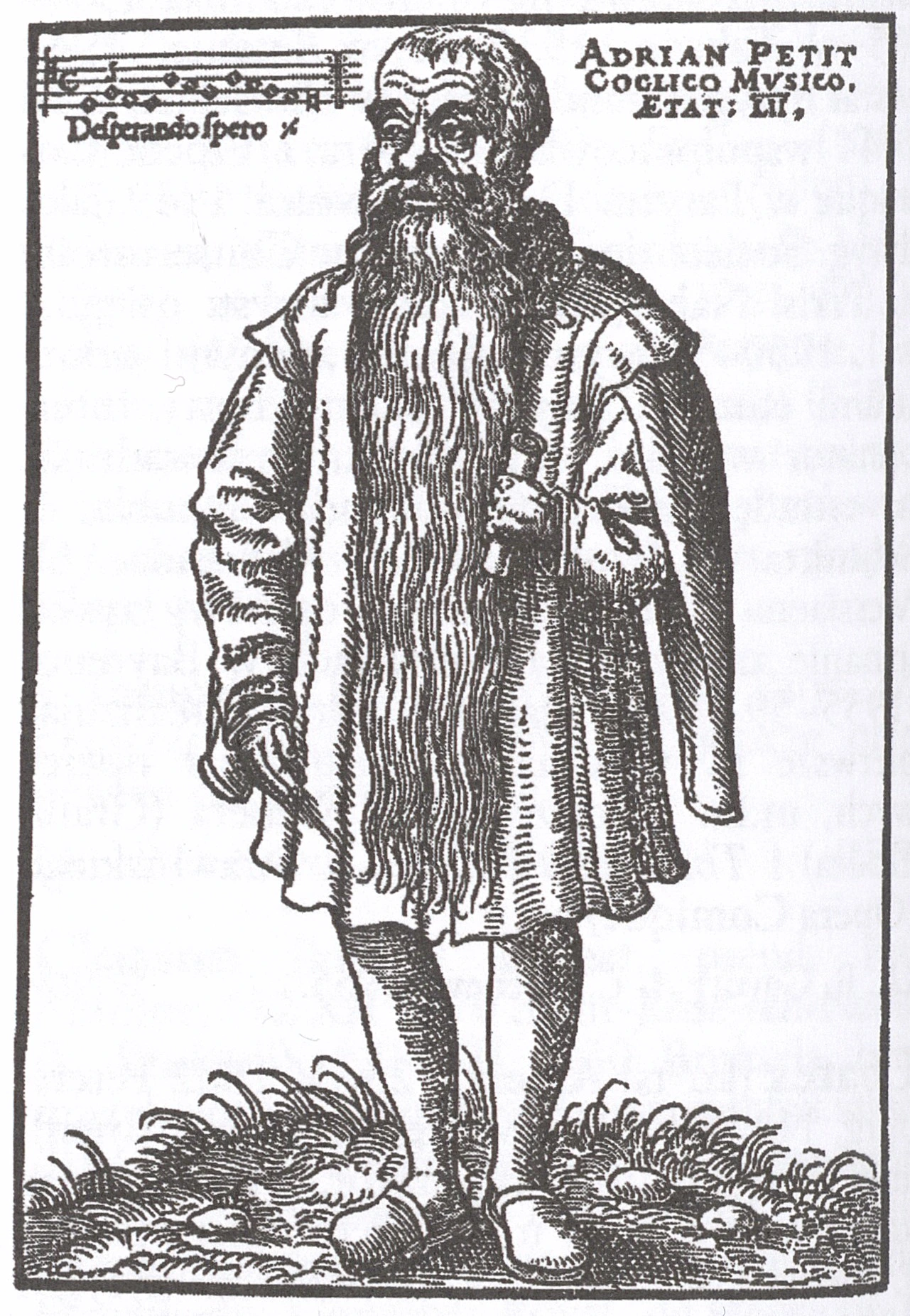
Coclico Adrianus Petit, *1499 or 1500 Flanders, †after September 1562 Copenhagen, Flemish composer and music theorist. Coclico’s date of birth can be determined based on an inscription in his Compendium musices… (1552), where he states that he is 52 years old. He regarded himself as a Fleming and a pupil of Josquin des Prés. His claims that he served the kings of England and France, worked at the papal court, and held high ecclesiastical offices are not corroborated by documentary evidence. For some time, Coclico was reportedly imprisoned as a victim of religious persecution. He left the Netherlands after converting from Catholicism to Protestantism and settled in Germany. The first confirmed fact about his life is his enrolment at the University of Wittenberg in September 1545. He also taught music privately to students at the university, and in 1546 he unsuccessfully applied for the position of artis musicae professor, presenting the Elector of Saxony with a composition (now lost) to a text by Melanchthon. Then, owing to family complications, he left for Frankfurt an der Oder, where he became part of the circle of the humanist Jodokus Willich. In 1547 he left Frankfurt and travelled to Szczecin, and from there to Königsberg, where he enrolled at the local university and was active in the chapel at the court of Duke Albert. In 1550, he left for Nuremberg, where he published a collection of motets and a treatise on music in 1552. In 1555, he stayed in Schwerin and conducted a boys’ choir at the court of Duke Johannes Albrecht I of Mecklenburg. Coclico’s last known place of residence was the court of King Christian II in Copenhagen, where he was appointed cantor and musician; the last mention of him in the court accounts dates from September 1562. The only surviving work by Coclico is the treatise Compendium musices… (Nuremberg 1552) and the collection Musica reservata, consolationes piae ex psalmis Davidicis (Nuremberg 1552), containing 41 four-part motets.
Coclico is considered to be the first composer and music theorist to use the term musica reservata, which continues to provoke controversy and debate to this day. This term has been used to refer to: 1. music with heightened expression and presentation of verbal text, 2. music using ancient genera, genus chromaticum and enharmonicum, 3. music “reserved” for the elite. Coclico’s comments suggest that musica reservata referred to a style that was already a thing of the past in the mid-16th century and was associated with the work of Josquin des Prés, whom Coclico considered the ideal composer and teacher. Coclico attributed most of the views set out in Compendium musices to Josquin.
The treatise is divided into two parts, the first of which is devoted to the general principles of music (definition, classification, influence of music) and the problems of musica plana, while the second deals with the problems of rhythm and mensural notation; it also contains a chapter on ornamental singing and the rules of counterpoint according to Josquin des Prés. According to Coclico, music consists in proper and ornamented singing as well as in composition, a definition he attributed to Josquin. He distinguished four categories of musicians: 1. “inventors” of music, which included Tubal, Orpheus, Guido, and, in his opinion, the most creative composers, whom he considered to be Ockeghem and Obrecht; 2. mathematicians who, despite their knowledge of the principles and power of art (ars), care less about the beauty (suavitas) and sweetness (dulcedo) of singing, among whom he included Dufay, Tinctoris and Gafurius; 3. the most outstanding musicians familiar with both theory and practice, among whom Josquin des Prés is the “princeps”, and others include Pierre de la Rue, Brumel, Isaack, Willaert, Gombert and Clemens non Papa; 4. poets, who included musicians who appealed to the emotions of their listeners, as he claimed, coming mainly from Belgium and France. He required composers not only to be proficient in counterpoint, but also to show passion and vocation. Arguing that music has much in common with poetry, he paid close attention to the relationship between words and sound, pointing on the one hand to the need to choose a tone appropriate for the expression of a given text, and on the other hand, warning against errors resulting from ignorance of syllable lengths. These views earned him a reputation as one of the most influential music theorists of the Renaissance.
By virtue of its title, Coclico’s motet collection is the sole musical source that may illuminate the concept of musica reservata in terms of compositional technique. Music historians have divided opinions on the value of these compositions. For a long time, they were considered worthless. According to G. Reese, they display considerable technical ineptness, while the connection between words and music is manifested primarily in naive illustrative effects. Chromaticisms and dissonances are not always justified in the text. B. Meier, on the other hand, states that Coclico’s motets display all the characteristics attributed to the concept of musica reservata. On the one hand, they contain a number of technical devices that testify to considerable compositional skill, and on the other, they vividly depict the emotional side of the text. Coclico’s work demonstrates a profound knowledge of Josquin’s works, and for this reason alone Coclico had the right to consider himself his pupil.
Literature: M. van Crevel A.P. Coclico. Leben und Beziehungen eines nach Deutschland emigrierten Josquinschülers, The Hague 1940; M. van Crevel Vervante Sequensmodulaties bij Obrecht, Josquin en Coclico, “Tijdschrift van de Vereniging voor Nederlandse Muziekgeschiedenis” XVI, 2, 1941; E.E. Lowinsky Secret Chromatic Art in the Netherlands Motet, New York 1946; J. Kreps Le mécénat de la cour de Bruxelles (1430–1559), in : La Renaissance dans les provinces du Nord, ed. E Lesure, Paris 1954; G. Reese Music in the Renaissance, New York 1954, 2nd edition 1959; B. Meier The “Musica Reservata” of A.P. Coclico and its Relationship to Josquin, “Musica Disciplina” X, 1956; B. Meier Reservata – Probleme, “Acta Musicologica” XXX, 1958; H. Leuchtmann Die musikalischen Wortausdeutungen in der Motetten des Magnum Opus Musicum von Orlando di Lasso, Strasbourg 1959; H. Erdmann Zu A.P Coclicos Aufenthalt in Mecklenburg, “Die Musikforschung” XIX, 1966; A. Leszczyńska The Königsberg manuscript from the Kugelmann circle, “Journal of the Alamire Foundation” 2 (1), 2010; L.F. Bernstein The modern receptionńska of the music of Jean d’Ockeghem, in: The Cambridge history of fifteenth-century music, Cambridge 2015.
Composition:
Cantio (…) in laudem natalis Domini Nostri Iesu Christi for 4 voices, n.p. (Nuremberg?) 1552, unique copy in Jagiellonian Library
Editions:
Compendium musices…, in: «Documenta Musicologica», series I: «Druckschriften Faksimiles» IX, ed. M.F. Bukofzer, Kassel 1954
Musica reservata…, in: «Das Erbe Deutscher Musik» XLII, series «Motette und Messe» V, ed. M. Ruhnke, Lippstadt 1958
A.P. Coclico, Musical Compendium (Compendium musices), English translation by A. Seay, «Translations Series» V, Colorado Springs 1973