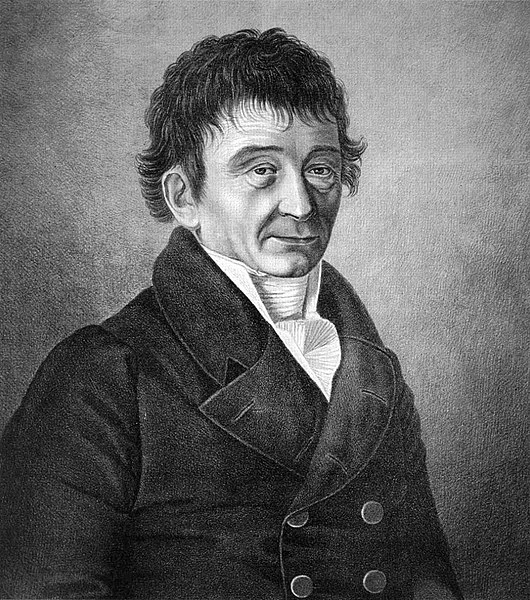
Chladni Ernst Florens Friedrich, *30 November 1756 Wittenberg, †3 April 1827 Wrocław, German physicist. He studied in Wittenberg and Leipzig, and, in 1780, was working toward a doctorate in law. Soon, however, he devoted himself entirely to physics, particularly acoustics. He shared the results of his research in numerous lectures and presentations while traveling throughout Europe. During these travels, he demonstrated instruments he had invented: the euphon and the clavicylinder (1790), which, despite attracting considerable interest, did not come into wider musical practice.
Chladni was a pioneer in experimental acoustics. Building on the theory of string and rod vibrations formulated by L. Euler and D. Bernoulli, he studied the vibrations of rods, plates, and bells. During this research, he discovered longitudinal and torsional vibrations in rods. He was the first to accurately determine the speed of sound propagation in various gases and concluded that sound propagates through solids at a finite speed. In 1787, he invented a method for visualizing nodal lines on the surfaces of vibrating objects. These lines, which form characteristic patterns, are called Chladni figures.
Literature: F. Melde Ober Chladnis Leben und Wirken, Marburg 1866, 2nd edition 1888.
Writings
Entdeckungen über die Theorie des Klanges, Leipzig 1787
Über die Longitudinalschwingungen der Saiten und Stäbe, Erfurt 1796
Die Akustik, Leipzig 1802, 2nd edition 1830 (also includes Chladni’s autobiography), French edition: Traité d’acoustique, Paris 1809
Neue Beiträge zur Akustik, Leipzig 1817
Beiträge zur praktischen Akustik und des Instrumentenbaues, Leipzig 1821
Kurze Übersicht der Schall- und Klanglehre, Mainz 1827
articles in journals.