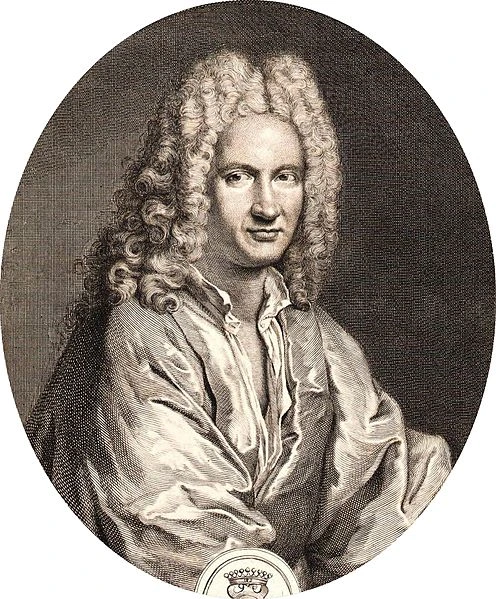
Campra André, baptised 4 December 1660 Aix-en-Provence, †29 June 1744 Versailles, French composer of Italian origin. In 1674, he became a choirboy in the choir of the Church of St Sauveur in Aix, where he was taught music by the choirmaster, G. Poitevin. In 1678, Campra was ordained a priest, and in May 1681 he was appointed to a prebend at the parish church in Aix. In the same year, he moved to Arles and took up the post of maître de chapelle at the Church of St Trophime, where he remained until 1683, working not only on church music but also on secular music. There he composed, among other works, his first opera, written for the city’s festivities. From May 1683, he ran a singing school at the Church of St-Etienne in Toulouse, teaching singing and the playing of string instruments. In 1694, he arrived in Paris and became maître de musique at Notre Dame Cathedral. In 1695, Airs sérieux et à boire, marked with the initials M. C., were published; these were later identified as works by André Campry. Campra published some songs under the name of his brother Joseph Campry (1662–1744), a composer and violinist. In 1696, André Campra became a canon at the church of St Jean-le-Rond. In 1697, he staged his first major stage work, the opera-ballet L’Europe galante, under his brother’s name; this was followed by a series of other highly successful stage works. In 1700, the composer resigned from his post at Notre Dame and, until 1722, devoted himself exclusively to secular music. From 1702, when his lyric tragedy Tancrède was staged, Campra enjoyed the reputation of a great dramatic composer. In 1718, in recognition of his achievements in the field of stage composition, the king granted him a permanent pension. In 1722, following the resignation of A.C. Destouches from the post of artistic director of the Académie Royale de Musique, Campra took over the role. In 1740, the elderly composer resigned from the post of royal Kapellmeister, which was taken over by J.C. de Mondonville. In the same year, Campra wrote his last stage work, the ballet Les noces de Vénus. His pupils included, amongst others, A.C. Destouches and F.A. Philidor.
Campra was the most outstanding French opera composer in the period between J.B. Lully and J.Ph. Rameau. His work exemplified the pastorale opera style characteristic of that era. Campra contributed significantly to the development of dramatic music. Like most of his contemporary opera composers, he remained under the overwhelming influence of c, yet he introduced his own ideas, which were later developed by his successors. He introduced keys not used by Lully (B major, B flat minor, C sharp minor), distant modulations and bold harmonics. Innovative instrumentation served to emphasise the expressive quality. In some of Campra’s operas, thematically related motifs appear, anticipating later leitmotifs. Among Campra’s compositions, ballet operas enjoyed the greatest success, particularly L’Europe galante – performed until 1755 (individual sections of this work were performed for even longer) – and Les fêtes vénitiennes. These feature short arias in the Rococo style, devoid of dramatic tension. Campra, gifted with great lyrical talent, paid little heed to dramatic qualities. The entire work consisted of a series of thematically unrelated vocal pieces and dances, which the composer would sometimes transfer from one work to another. At that time, so-called “spectacles coupés” were in vogue, bringing together acts or scenes from various operas into a single production. Campra, together with A. Danchet, the librettist of many of his stage works, adapted in this way excerpts from the works of Lully (Fragments de Monsieur de Lully and Triomphe de l’amour) as well as those of P. Collasse, H. Desmarets, M.A. Charpentier and other composers (Télémaque).
Campra set out his views on music in the preface to the first volume of cantatas. There he wrote, amongst other things, about his attempts to combine the characteristics of French and Italian music in his work. Italian influences are reflected in his expressive treatment of the text, his orchestral phrasing, lively instrumental coloratura, and the use in the arias of an elaborate da capo form, a leading motto and elements of the concertato style. Campra was one of the first French composers to work in the cantata genre. His work was highly regarded by Rameau. Campra’s motets, cantatas and excerpts from his operas were frequently included in the programmes of the Concerts Spirituels.
Literature: A. Pougin André Campra, “Revue et gazette musicale de Paris” 1861; L. de La Laurencie Notes sur la jeunesse d’André Campra, “Sammelbände der Internationalen Musikgesellschaft” X, 1908/09; L. de La Laurencie André Campra, musicien profane, «L’Année musicale» III, 1913; L. de La Laurencie “L’Orfeo nell’Inferni” d’André Campra, “Revue de Musicologie” IX, 1928; P.-M. Masson “Les Fêtes Vénitiennes” de Campra, “Revue de Musicologie” XIII, 1932; M. Barthélemy L’orchestre et l’orchestration des oeuvres de Campra, “La Revue Musicale” 1955 nr 226; M. Barthélemy André Campra, w: «La vie musicale en France sous les rois Bourbons» IV, Paris 1957; M. Barthélemy Le premier divertissement connu d’André Campra, “Revue Belge de Musicologie” XI, 1957; H.A. Durand Sur une prétendue Messe des morts de Gilles et Campra, “Revue de Musicologie” XLV/XLVI, 1960; J.R. Anthony Thematic Repetition in the Opera-Ballets of André Campra, “The Musical Quarterly” LII, 1966; J.R. Anthony Printed Edition of André Campra’s “L’Europe galante,” “The Musical Quarterly” LVI, 1970. M. Barthélemy André Campra, Paris 1957, revised and extended edition, Paris 1995; M. Lütolf André Campras “Les fêtes vénitiennes.” Zur Geschichte eines Werks, “Neue Zürcher Zeitschrift” V, 1978; J. Boyer Nouveaux documents sur la jeunesse d’André Campra et la vie musicale à Aix-en-Provence au XVIIe siècle and A. Baker The Church Music of André Campra. A Reconsideration of the Sources, «Recherches sur la Musique Française Classique» XXII, 1984; D. Heartz Idomeneo and the Tradition of Sacrifice Drama, in Glyndebourne Festival programme book, ed. B. Dickie, Lewes (Sussex) 1985; A. Baker The “Exaudiat te Dominus” of André Campra. A Celebrated Motet Rediscovered, in: Le grand motet français, proceedings of the Sorbonne Conference 1984, ed. J.-R. Mongrédien and Y. Ferraton, Paris 1987; J. de La Gorce L’orchestre de l’Opéra et son évolution de Campra à Rameau, “Revue de Musicologie” LXXVI, 1990; G. Garden “Les amours de Vénus” (1712) et le second livre de „Cantates” (1714) de Campra, “Revue de Musicologie” LXXVII, 1991; G. Garden A Link Between Opera and Cantata in France. Tonal Design in the Music of André Campra, “Early Music” XXI, 1993; E. Schmierer Campras und Watteaus “Fêtes vénitiennes.” Zur Problematik eines Bezugs, in: Töne, Farben, Formen. Über Musik und die bildenden Künste, commemorative book of E. Budde, ed. E. Schmierer et. al., Laaber 1995; H. Schneider Danchets und Campras “Idoménée”, in: G.F. Händel. Ein Lebensinhalt, commemorative book of B. Baselt, ed. K. Hortschansky and K. Musketa, Halle and Kassel 1995; W. Seidel Ilia und Ilione. Über Mozarts “Idomeneo” und Campras “Idoménée”, in: Studien zur Musikgeschichte, commemorative book of L. Finscher, ed. A. Laubenthal and K. Kusanwindweh, Kassel 1995.
Compositions:
Vocal-instrumental:
3 books of cantatas, Paris 1708, 1714, 1728
La Guerre, cantata, 1699
39 Italian and French arias (Airs sérieux et á boire) on 1 and 2 voices, as well as 20 arias for 1 and 2 voices with basso continuo, were published in anthologies of the time
Missa 4 vocibus (…) Ad majorem Dei gloriam, Paris 1699
5 volumes of motets for 1–3 voices with instrumental accompaniment and basso continuo, Paris 1695, 1700, 1703, 1706, 1720
2 books of psalms, Paris 1737 and 1738
as well as individual motets and psalms
Te Deum, manuscript
Magnificat, manuscript
Stage:
(all published and issued in Paris)
Vénus, feste galante, divertissement, 1698
L’Europe galante, with A.C. Destouches, opera-ballet, 1697
Le carnaval de Venise, ballet, 1699
Hesione, lyrical tragedy,1700
Aréthuse, ou La Vengeance de l’amour, lyrical tragedy, 1701
Les fragments de Monsieur de Lully, ballet, 1702
Tancrède, lyrical tragedy, 1702
Les muses, opera-ballet, 1703
Iphigénie en Tauride, with H. Desmarets, lyrical tragedy, 1704
Amarillis, pastorale,1704
Télémaque, lyrical tragedy, 1704
Alcine, lyrical tragedy, 1705
Le triomphe de l’amour, ballet, 1705
Hippodamie, lyrical tragedy, 1708
Les fêtes vénitiennes, opera-ballet, 1710
Idoménée, lyrical tragedy, 1712
Les amours de Vénus et Mars, ballet, 1712
Téléphe, lyrical tragedy, 1713
Camille, reine des Volsques, lyrical tragedy, 1717
Les Ages, ballet, 1718
La fête de l’isle Adam, pastorale, 1722
Les Muses rassemblées par l’amour, divertissement, 1724
Euloge, ou Le danger des richesses, tragicomedy, 1725
Les nouveaux fragments, ballet (?), 1729
Achille et Déidamie, lyrical tragedy, 1735
La génie de la Bourgogne, pièce allegorique, 1732
Les noces de Vènus, divertissement, 1740
Editions:
individual opera arias in: Lacôme d’Estalenx Les fondateurs de l’opéra français, Paris 1878
Les fêtes vénitiennes oraz Tancréde, wyciąg fortepianowy, ed. A. Guilmant, «Chefs d’Oeuvre classiques de l’Opéra français», Paris 1893
3 pièces de danse for oboe (flute, violin) and basso continuo, ed. L. Boulay, «L’astrée», no number, Paris 1966
L’Europe galante, facsimile of the edition from 1724, London 1967
Les fêtes vénitiennes, ed. M. Lütolf, «Le Pupitre» XIX, Paris 1972
Tancrède, ed. R. Blanchard, Paris 1973
opera arias ed. G. Sadler, «The Baroque Operatic Arias» II, red. D. Arnold, London 1973
Le carnaval de Venise. Comédie lyrique, introduction J.R. Anthony, «French Opera in the 17th and 18th Centuries» XVII, New York 1990
André Campra. Cantatas, ed. D. Tunley, «Eighteenth-Century French Cantata» II, III, New York 1990
Grands motets, ed. S. Bouissou and B. Lespinard, «Musica Gallica», Paris 1993