
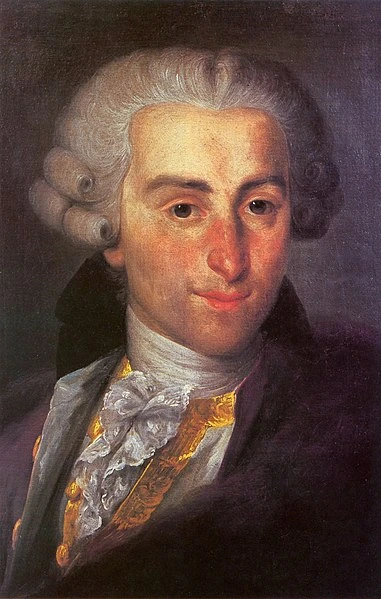
Sammartini, Giuseppe (EN)

Sammartini, Saint-Martin, San Martini, San Martino, Giovanni Battista, *1700 (1701?) Milan (?), †15 January 1775 Milan, born into an Italian-French family of musicians, composer, oboist, organist, conductor, brother of Giuseppe. He was taught music by his father, Alexis Saint Martin, an oboist, and probably by the leaders of the musical ensembles of which he was a member from an early age. From 1717, he played the oboe at the Church of S. Celso, and from 1720 in the orchestra of the Regio Ducal Teatro. In 1726, he was deputy bandmaster, and from 1728 bandmaster at the church of S. Ambrogio, probably from 1728 (and probably until the end of his life) bandmaster and director of the Congregazione del Santissimo Entierro music ensemble at the Jesuit church of S. Fedele, and in 1742 also at the church of S. Paolo de Barnabiti in Vigevano near Milan. Highly regarded as a performer and composer of religious music, he also worked in other churches between 1761 and 1775, including as bandmaster (from 1768) at the ducal chapel of St. Gottardo. In addition, he conducted ensembles during the most important secular celebrations, e.g. at the Regio Ducal Teatro and during concerts organised by G.L. Pallavicini on the banks of the moat of the Castello Sforzesco, as well as in the Sforza castles. From 1733, Giovanni Battista Sammartini served on the judging panels of competitions for musicians applying for positions in the church; in 1758, he was one of the founders of the Accademia Filarmonica. He maintained lively contacts, especially with artists working with him in the so-called Milanese symphonic school (including A. Brioschi, F. Galimberti, G.B. Lampugnani, M. Chiesa, N. Jommelli), as well as with numerous composers of the younger generation, including J.Ch. Bach, L. Boccherini and L. Mozart. He was friends with Ch. Burney and the poet G. Parini. Sammartini was also active in the circle of members of the Accademia dei Trasformati. He was also involved in teaching; his students were Count G. Giulini and, probably between 1737 and 1741, Ch.W. Gluck, and in the 1750s, possibly also Ch. Cannabich and C.G. Toeschi. Giovanni Battista Sammartini was married twice: first, in 1727, to Margherita Benna (†1754), and then, in 1755, Rosalinda Acquanio. His daughter, Marianna Rosa (*1733), was a singer.
Giovanni Battista Sammartini is one of the most outstanding Italian composers of the 18th century. He was perhaps more highly regarded abroad than in Milan, where he spent his entire life. Many of his works were performed outside Italy, e.g.: his opera Memet was probably staged in Vienna in 1732; one of his symphonies was played in Amsterdam in 1738; his symphonies and concertos were performed in Paris as part of the Concerts Spirituels; and his choral music was performed there in 1746–58 and 1751, among other years. In 1738, his concertos and Passion cantatas were performed in Prague. Giovanni Battista Sammartini’s works were published mainly in London, as well as in Paris and Nuremberg; from the middle of the century, manuscripts and prints were collected in private collections, including the Blancheton Collection in Paris, the Waldstein Library in Doksy (later in Prague), and the Esterházy Collection in Vienna.
Giovanni Battista Sammartini’s oeuvre played an important role in shaping the galant style and, at the same time, in the transition from the Baroque to the early Classical period. Most researchers agree that his work developed in three phases (1720–40 Baroque-Classical, 1740–60 early Classical and 1760–75 Classical), but this does not seem justified, as Giovanni Battista Sammartini’s music, especially his instrumental music, does not show clear signs of continuous and logical development, but rather gives the impression of a conglomeration of the aforementioned styles; this does not diminish his merits as one of the precursors of the classical style. The oldest symphonies and sonatas for string orchestra, often featuring wind instruments, as well as chamber works (e.g. quintets and quartets), resemble Vivaldi’s concertante style, while many of them are characterised by a three-movement structure (allegro, slow movement, and lively finale), and there is also a three-phase structure in the initial allegro. In addition to a single theme, there are sometimes two thematic structures using rhythmic and dynamic contrasts; at the beginning of the development and at the end of the allegro, the theme appears in the principal key. Homophonic texture prevails, with few contrapuntal interjections. In his later symphonies, two-movement structures with rhythmic, dynamic, and textural contrasts reappear. Short thematic phrases serve as motifs that are repeated literally or with variations. The slow movements are characterised by delicate expression; they are often kept in a parallel minor key.
Giovanni Battista Sammartini’s concertos for various ensembles are both two- and three-movement. Elements of sonata form are represented by the tonal structure (the beginnings and endings of episodes are in the principal key); the middle episodes have three movement structure and feature quasi-development elements. The most numerous group in Giovanni Battista Sammartini’s oeuvre are chamber works; most of them consist of two or three movements, usually with a minuet. The most popular were string trios with a characteristic dominance of the first violin. The harpsichord sonatas, in one and three movements, are characterised by a developed virtuoso technique. L. Boccherini drew on Giovanni Battista Sammartini’s chamber and solo works in terms of harmony and texture. His vocal works are of much lesser importance; most of them have been lost or preserved only in fragments, e.g. opera seria, containing almost exclusively da capo arias. The galant style dominates in music set to religious texts and intended for liturgical use. The few surviving cantatas usually include an overture, three arias with recitatives and a final choral section. The arias sometimes refer to the simplicity of the oldest, two-part sonata forms; they are characterised by lyrical melodies and dramatic expression.
Not all aspects of Giovanni Battista Sammartini’s work have been thoroughly researched. The process of establishing the authorship and chronology of his compositions is still ongoing. Despite the uneven nature of his work, the composer’s contribution to the development of the classical style and instrumental music genres should be considered particularly valuable.
Literature: G. de Saint-Foix La chronologie de l’oeuvre instrumentale de Jean Baptiste Sammartini, “Sammelbände der Internationalen Musikgesellschaft” XV, 1913/14; G. Cesari Sei Sonate notturne di Giovanni Battista Sammartini, “Rivista Musicale Italiana” XXIV, 1917; R. Sonderheimer Giovanni Battista Sammartini, “Zeitschrift für Musikwissenschaft” III, 1920/21; L. de La Laurencie Inventaire critique du Fonds Blancheton de la Bibliothèque du Conservatoire de Paris, 2 vols., Paris 1930–31; G. Roncaglia Una sonata inedita di Giovanni Battista Sammartini, “Rivista Musicale Italiana” XLII, 1938; H. Mishkin Five Autograph String Quartets by Giovanni Battista Sammartini, “Journal of the American Musicological Society” IV, 1953; G. Barblan Sammartini e la scuola sinfonica milanese, in: Musicisti lombardi ed emiliani, ed. A. Damerini and G. Roncaglia, «Accademia Musicale Chigiana» XV, Siena 1958; H. Mishkin The Published Instrumental Works of Giovanni Battista Sammartini. A Bibliographical Reappraisal, “The Musical Quarterly” XLV, 1959; G. Barblan Boccheriniana, “La rassegna musicale” XXIX, 1959; C. Sartori Giovanni Battista Sammartini e la sua corte, “Musica d’ oggi” III, 1960; C. Sartori Sammartini post mortem, commemorative book of H. Albrecht, ed. W. Brennecke and H. Haase, Kassel 1962; G. Barblan Contribute alla biografia di Giovanni Battista Sammartini alla luce dei documenti, in the commemorative book of E. Schenka, ed. O. Wessely, “Studien zur Musikwissenschaft” XXV, 1962; B. Churgin New Facts in Sammartini Biography. The Authentic Print of the String Trios, Op. 7, “Journal of the American Musicological Society” XX, 1967; M. Donà Notizie sulla famiglia Sammartini, “Nuova Rivista Musicale Italiana” VIII, 1974; B. Churgin Giovanni Battista Sammartini and the Symphony, “The Musical Times” CXVI, 1975; L. Inzaghi Nuova luce sulla biografia di Giovanni Battista Sammartini and Nozze affretatte di Giovanni Battista Sammartini, “Nuova Rivista Musicale Italiana” IX, 1975 and X, 1976; N. Jenkins, B. Churgin Thematic Catalogue of the Works of Giovanni Battista Sammartini. Orchestral and Vocal Music, Cambridge (Massachusetts) 1976; H. Brofsky J.Ch. Bach, G.B. Sammartini and Padre Martini. A Concorso in Milan in 1762, in the commemorative book of M. Bernstein, ed. E.H. Clinkscale and C. Brook, New York 1977; N. Jenkins The Vocal Music of Giovanni Battista Sammartini, “Chigiana” XXIV, 1977; S. Kirakowska Giambattista Sammartini’s Concerto, Op. 8 and E.B. Lance The London Sammartini, “The Music Review” XXXVIII, 1977; R. McGowan Italian Baroque Solo Sonatas for the Recorder and the Flute, Detroit 1978; B. Churgin Alterations in Gluck’s Borrowings from Sammartini, “Studi musicali” IX, 1980; G. Houle The Oboe Sonatas of Giambattista Sammartini, “The Journal of Musicology” III, 1984; D.E. Freeman The Earliest Italian Keyboard Concertos, “The Journal of Musicology” IV, 1985–86; B. Churgin The Recapitulation in Sonata-Form Movements of Sammartini and Early Haydn Symphonies, in: J. Haydn, proceedings of the international congress in Vienna 1982, ed. E. Badura-Skoda, Munich 1986; D. Prefumo Nuovi documenti sui fratelli Sammartini, “Nuova Rivista Musicale Italiana” XX, 1986; J. LaRue A Catalogue of 18th-Century Symphonies, vol. 1: Thematic Identifier, Bloomington 1988; B. Churgin Did Sammartini Influence Mozart’s Earliest String Quartets?, “Mozart-Jahrbuch,” 1991; A. Cattoretti 1771–1773: gli ultimi quintetti per archi di Giovanni Battista Sammartini, i primi di Luigi Boccherini and B. Churgin Sammartini and Boccherini. Continuity and Change in the Italian Instrumental Tradition of the Classic Period, “Chigiana” XXIII, 1993; A.B. Gehann Giovanni Battista Sammartini. Die Konzerte, Frankfurt am Main 1995; Sammartini e il suo tempo. Fonti manoscritte e stampate della musica a Milano nel Settecento, ed. M. Brusa and A. Rossi, supplement in “Fonti Musicali Italiane” I, 1996; L. Inzaghi, D. Prefumo Giambattista Samartini, primo maestro della sinfonia (1700–1775), Turin 1996; Giovanni Battista Sammartini and His Musical Environment, ed. A. Cattoretti, Turnhout 2004; A. B. Gehann “Thematische Einheit” und “Themenkontrast” in Sammartinis Konzerten der 1750er und 1760er Jahre als historische Vorbedingungen für Mozarts Schaffen, “Mozart-Studien” 18 (2009); M. Dellaborra Ein seltener Fall der Mailänder Quartett-Spielpraxis: Die drei ‘concertini con flutta traversiera’ 1750 von Giovanni Battista Sammartini, “Tibia” 40/3 (2015); F. E. Ravizza Le sonate per clavicembalo di Giovanni Battista Sammartini, in: The Early Keyboard Sonata in Italy and Beyond, ed. R. H. Stewart-MacDonald, Turnhout 2016.
Compositions:
Instrumental:
approximately 70 symphonies, as well as over 70 others of dubious attribution
17 concerts with an orchestra of varying instrumentation, most often for violin, but also for flute, oboe, two violins, two oboes and violin
concertina for orchestra or chamber ensembles
chamber and solo sonatas, including:
25 for harpsichord
7 for harpsichord and violin
9 for violin
6 for cello
6 for flute, as well as for 2 flutes/2 violins and harpsichord/organ
4 marches and minuets for orchestra
6 string quintets, 1773
approximately 30 quartets for string instruments or flute and string instruments
approximately 180 trios (including works of uncertain attribution)
Vocal and vocal-instrumental:
religious:
48 choral cantatas to religious texts, including 8 preserved Lenten cantatas:
Il pianto di S. Pietro, performed in Milan 1751
Il pianto delle pie donne, performed in Milan 1751
Il pianto degli angeli, performed in Milan 1751
Pianto di Maddalena al Sepolcro, performed in Milan 1751
Maria addolorata, performed in Milan 1751
Gerusalemme sconoscente ingrata, performed in Milan 1759
L’addolorata divina madre, performed in Milan 1759
La perfidia giudaica, performed in Milan 1759
2 oratorios:
Gesù bambino adorato dalli pastori, performed in Milan 1726, 1 aria preserved
L’impegno delle virtù, text by T.A. Ricchini, lost
1 aria (lost, possibly G.B. Sammartini’s oldest work) from oratorio La calunnia delusa written with other composers, text by G. Machio, performed in Milan 1724
Mass parts:
Kyrie–Gloria
Kyrie
Gloria
Credo
2 litanies
2 Magnificat (1 lost)
2 Te Deum (one from 1771)
Stabat Mater, 1762, lost
psalm arrangements:
Beatus vir
2 Dixit Dominus
2 Laudate pueri
Miserere, 1750
Nisi Dominus
secular:
4 choral cantatas to secular texts:
Paride riconosciuto, performed in Milan 1750, lost
La reggia de’ fati, with N. Jommelli, text by G. Pascali, performed in Milan 1753
La pastorale offerta, with N. Jommelli, text by G. Pascali, performed in Milan 1753,
Iride, text by F.A. Mainoni, performed in Milan 1772, lost
tercets:
Perché sì lento il giorno for 3 sopranos and instruments
Campana che suona for soprano, alto and bass
6 arias:
Chiusi i lumi cheto giace for soprano, 2 violins, viola and basso continuo
Se voi che serva almen for soprano, 2 violins, viola and double bass
Deh spiegate quel affanno for soprano, 2 trumpets, 2 violins, viola and basso continuo
Fieri venti già soffiano for soprano, 2 trumpets, 2 violins, viola and basso continuo
Non così rapido scende dal monte for soprano, 2 trumpets, 2 violins, viola and basso continuo
Non ha dolor più rio for alto, 2 violins, viola and double bass
Stage:
Memet, tragedy, staged in Lodi 1732
L’ambizione superata dalla virtù, drama, libretto after A. Zena, staged in Milan 1734
L’Agrippina, moglie di Tiberio, dramma per musica, libretto G. Riviera, staged in Milan 1743
La gara dei geni, componimento drammatico, libretto G. Riviera, staged in Milan 1747, 1 aria preserved
several excerpts from ballet music
Editions:
The Symphonies of Giovanni Battista Sammartini, ed. B. Churgin, vol. 1: The Early Symphonies, «Harvard Publication of Music» II, Cambridge (Massachusetts) 1968 (contains 19 symphonies and the overture to the opera Memet)
Magnificat, ed. M. Alberti, London 1972
6 sonatas, Op. 4, for 2 flutes/2 oboes/2 violins (London 1748), ed. F. Dov, London 1980
6 sonatas for 3 string instruments (Milan 1760) and 6 Sonate notturne Op. 7, for 3 string instruments (Paris ca. 1763–67), ed. B. Churgin, «Early Musical Masterworks» V, Chapel Hill 1981
Ten Symphonies, facsimile, ed. B. Churgin, «The Symphony 1720–1840» ser. A, II, New York 1984
6 sonatas Op. 1, for 2 violins and basso continuo (London 1744) and 6 sonatas Op. 5, for 2 violins and basso continuo (London 1756), facsimile, ed. K. Cooper, «Three Centuries of Music in Score» IX, New York 1990
cantata Il pianto delle pie donne, ed. M. Marley, «Recent Researches in the Music of the Classical Era» XXXIV, Madison (Wisconsin) 1990
Sonate per organo o cembalo, ed. M. Dellaborra, Milan 1999
3 concertos for violin and string orchestra/chamber orchestra: F major, E-flat major, A major and Concerto in D major for flute and string orchestra, ed. A.B. Gehann, «Recent Researches in the Music of the Classical Era» LXVII, Middleton (Wisconsin) 2002
Sonate per clavicembalo, ed. C. Bacciagaluppi, 2 vols., Bologna 2002–03
cantatas L’addolorata divina madre and Il pianto di S. Pietro, ed. M. Vaccarini Gallarani, Lucca 2005
Due sinfonie concertate per violino, ed. A. B. Gehann, Lucca 2015