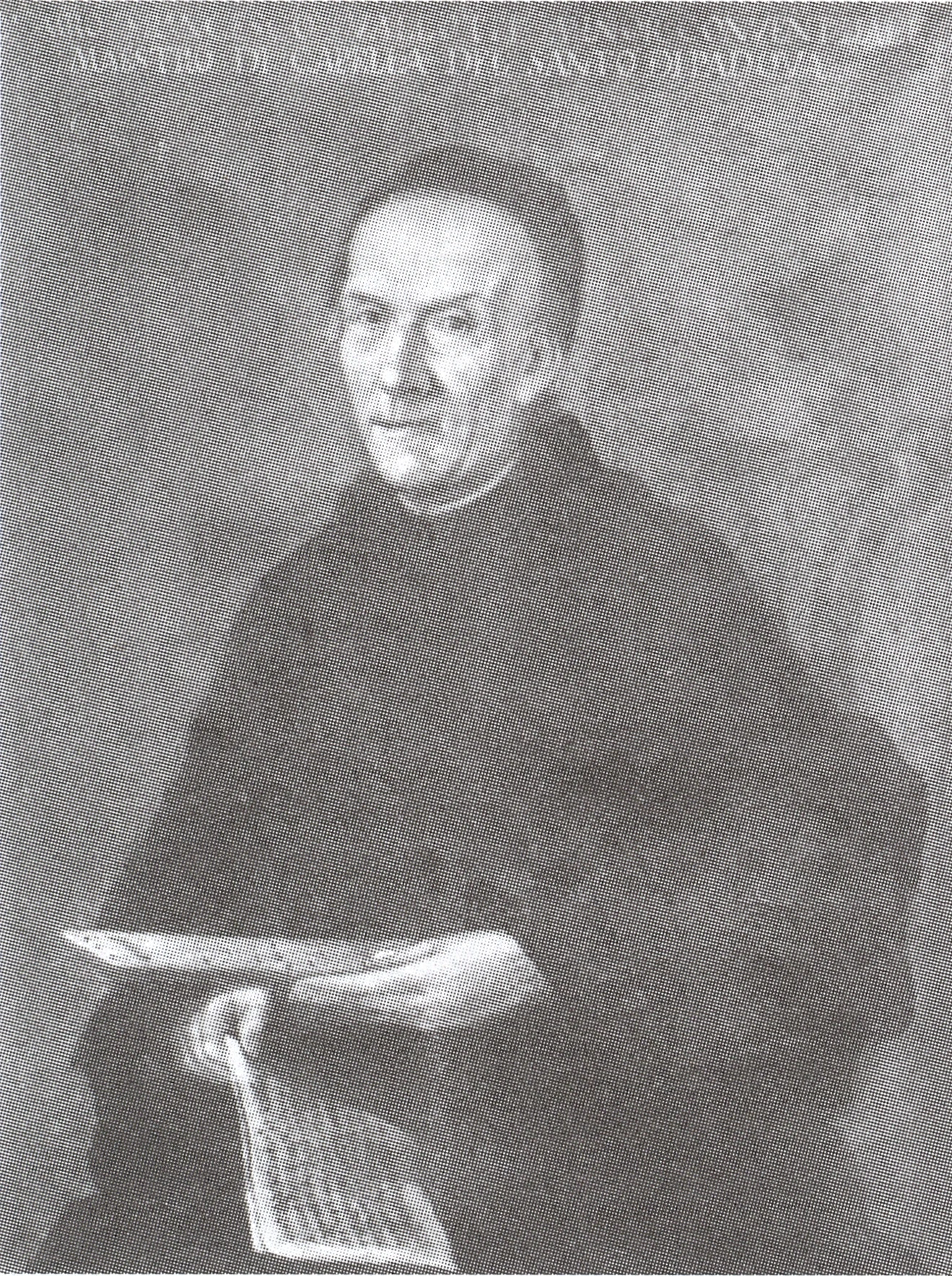
Vallotti Francesco Antonio, *11 June 1697 Vercelli, †10 (19?) January 1780 Padua, Italian organist, composer, and music theorist, Ordo Fratrum Minorum. He studied at the seminary in Vercelli (his music teacher was G.A. Bissone, among others). At the age of 18, he joined the Franciscan order (staying at the monastery in Chambery, then in Crest), and in 1720 he was ordained a priest. He studied in Cuneo under P. Castellani Sr. (philosophy), in 1721 under D.F. Donati in Milan (theology), and then in Padua, where he settled permanently that same year and continued his theological studies. In Padua, he befriended F.A. Calegari (capellmeister of the Basilica of St. Anthony from 1703 to 1727), who taught him music. In 1722, he became the third organist, in 1727 the deputy bandmaster, in 1728 the assistant (maestro sostituto) to bandmaster G.A. Rinaldi, and in 1730 the bandmaster of the Basilica of San Antonio. He remained in this position until the end of his life, directing a choir and orchestra (G. Tartini was the concertmaster there). Vallotti taught G.J. Vogler, as well as possibly L.A. Sabbatini, for a short time. During Vallotti’s lifetime, his works were not published; the manuscripts are mainly kept in the Archivio della Cappella Antoniana in Padua.
Vallotti’s compositional legacy consists of approximately 400 works, which he wrote for the Basilica of San Antonio and other churches. He was also famous for his religious music outside of Italy, with his compositions being performed in Padua until the end of the 19th century. He was an excellent contrapuntist; he wrote both in a strict polyphonic style, derived from 16th century vocal polyphony (he studied the works of Palestrina, C. Porta, M. Asola, C. de Morales, and A. Willaert), as well as vocal-instrumental works in a concertante style. The first group is mainly represented by introits, mostly for 8 voices (for two 4-voice choirs) with basso continuo, based on cantus firmus, and antiphons for 4 and 8 voices with basso continuo, as well as, among other pieces, about 10 psalms (for 2 choirs and basso continuo or 4 voices a cappella). The vocal parts in Vallotti’s works are usually written for 4 or 8 voices and divided into two groups, with solo or choral parts; in accordance with the prevailing practice, the vocal parts could be doubled by instruments. In vocal-instrumental works, the orchestra consists of string instruments and basso continuo (usually of 2 organs or harpsichords), often also of 1 or 2 trumpets (mostly in Kyrie, Gloria, Credo, but, for example, only in 16 psalms, which are dominated by strings), 2 horns, and, less frequently, oboes. The variable parts of the Mass are dominated by solo arias accompanied by violins, oboes, cellos, or an instrumental ensemble. The compositions have preludes, interludes, and postludes, and are characterized by frequent alternations of short solo fragments, duets, trios, vocal quartets, and choir. Some, such as Gloria and psalms, are composed of a series of closed episodes. Numerous fugues reveal the composer’s melodic and rhythmic inventiveness. All of Vallotti’s works are in major-minor harmonics.
As a theorist, Vallotti, along with G. Tartini and L.A. Sabbatini, was one of the most important representatives of the Paduan school, which brought together musicians and mathematicians and was founded by F.A. Calegari, from whom he adopted the principles of music theory, including the theory of chord inversions. From 1727, he conducted scholarly correspondence with G.B. Martini. His greatest work, Della scienza…, on which he had been working since the early 1730s, was devoted to fundamental problems of music, particularly to the theory of harmony and counterpoint. This treatise possesses both historical and didactic value. In it, Vallotti discussed musical terminology, Greek scales, Gregorian modes, major-minor system, cadences, principles of modulation, intervals, chords with successive additions from the ninth to the fourteenth, the theory of consonance and dissonance, the mathematical foundations of music, and other elements of musical theory. He wrote about the rules of good composition, compositional techniques (including the a cappella style), counterpoint, canon, and fugue. Vallotti developed an unequal temperament system that allowed playing in all keys, in which a series of six fifths (F–C–G–D–A–E–B) is tempered by 1/6 of a Pythagorean comma, while the remaining fifths are pure. One of the most important issues explored by Vallotti is the relationship between the root position and chord inversions. Calegari and Vallotti probably addressed this topic independently of J.-P. Rameau; their system was described by the mathematician, physicist, acoustician, and music theorist Giordano Riccati (with whom Vallotti corresponded on the subjects of acoustics, the relationship between music and mathematics, and temperament), “to demonstrate, contrary to the opinions of contemporary mathematicians, that music is not only a sentimental art (…), but a truly mathematical science” (Saggio sopra le leggi del contrappunto, Castelfranco 1762).
Although Vallotti only published the first volume of Della scienza… (volumes 2–4 remained in manuscripts form despite Martini’s very favourable opinion, who provided a preface to each of them; the entire work was not published until 1950), his ideas spread, notably thanks to L.A. Sabbatini. In his Trattato sopra le fughe musicali, Sabbatini discussed the types of fugues specified by Vallotti (real, tonal, imitative) and cited numerous examples from Vallotti’s works. Furthermore, Sabbatini summarized Vallotti’s theoretical system in La vera idea delle musicali numeriche signature, as well as his theory of chord inversions in Trattato di contrappunto. Vallotti’s temperament system was cited, among others, by W. Jones in Physiological Disquisitions (London 1781), and it continues to be employed in contemporary performance practice. Vallotti, esteemed as a musical erudite of great authority and renown, was highly regarded by G.B. Martini, A. Lotti, and G.J. Vogler – the latter deriving his theory of harmony and composition from Vallotti’s ideas. He also earned the admiration of his contemporaries as an organist, with G. Tartini praising him as the most outstanding of his era.
Literature: L.A. Sabbatini Notizie sopra la vita e le opere del rev. P. Francesco Antonio Vallotti, Padua 1780; O. Wessely Johann Joseph Fux und Francesco Antonio Vallotti, «Jahresgabe der J.J. Fux-Gesellschaft» 1966, Graz 1967; Francescantonio Vallotti nel II centenario dalla morte (1780–1980). Biografia, catalogo tematico delle opere e contributi critici, ed. G. Cattin, Padua 1981; M. Lindley La „Pratica ben regolata” di Francescantonio Vallotti, “Rivista Italiana di Musicologia” XVI, 1981; P. Revoltella A proposito di un inno di Vallotti, “Rassegna veneta di studi musicali” 1985 no. 1; P. Barbieri Martini e gli armonisti “fisico-matematici.” Tartini, Rameau, Riccati, Vallotti and S. Hansell Padua Viewed from Bologna. Martini’s Opinion of Calegari and Vallotti Conjectured, in: Padre Martini. Musica e cultura nel Settecento europeo, volume of the proceedings of the Bologna Congress 1984, ed. A. Pompilio, Florence 1987; P. Barbieri Calegari, Vallotti, Riccati e le teorie armoniche di Rameau. Priorità, concordanze, contrasti, “Rivista Italiana di Musicologia” XXVI, 1991; P. Revoltella Musiche di Vallotti nell’epistolario di Giordano Riccati, in: Contributi per la storia della musica sacra a Padova, eds. G. Cattin and A. Lovato, Padua 1993; M.N. Massaro Francescantonio Vallotti. Un aggiornamento bibliografico, “Il Santo” no. 39, 1999; M.N. Massaro «Cum harmonicis numeris». Polifonia cinquecentesca con il basso numerato di Francescantonio Vallotti, in: Et facciam dolçi canti, memorial book of A. Ziina, ed. B.M. Antolini et al., Lukka 2004; L. Konfic Francescantonio Vallotti’s theoretical system as reflected in Giuseppe Michele Stratico’s theoretical writings on music, in: Barocco padano e musici francescani, II. L’apporto dei maestri conventuali, Padua conference proceedings book 1–3 VII 2016, eds. A. Colzani, A. Luppi, M. Padoan, Padua 2018.
Compositions:
Messa a due (Kyrie, Gloria, Credo) for tenor, bass, and basso continuo
Messa per i defunti for 8 voices, string instruments, and basso continuo, 1759
27 Kyrie and 26 Gloria for 4–5 and 8 voices, instruments, and basso continuo
21 Credo for 4–5 voices, instruments, and basso continuo, 1 for 8 voices and basso continuo
arrangements of other parts of the Mass, including 13 introits for 4, 5, and 8 voices
5 Gloria Patri
29 Marian antiphons
over 50 other antiphons, mainly for 4 voices and basso continuo
approx. 70 psalms, mainly for 2–5 and 8 voices, instruments, and basso continuo
approx. 50 hymns, mainly for voice, instruments, and basso continuo, including two Te Deum for 8 and 4 voices, instruments, and basso continuo, 1742, 1760
18 responsories, mainly for 4 voices, instruments, and basso continuo
8 Magnificats
4 Benedictus
2 Nunc dimittis
9 lamentations for voice, string instruments, and basso continuo, or voice, cello, and basso continuo
3 sequences: Lauda Sion Salvatorem for 4 voices and basso continuo, 1749, 2 Dies irae – for 5 and 4 voices, instruments and basso continuo, 1738, 1756
litanies, verses, vespers, motets, and others.
Figli, quai duol v’ingombra?, solo cantata
22 fugues for 4 instruments, 8 fugues for 8 instruments
Works:
Della scienza teorica e pratica della moderna musica, vol. 1, Padua 1779
in manuscripts:
Della scienza…, vols. 2–4
Una memoria di varie decisioni teorico-pratiche spettanti al giusto intendimento delle materie musicali 1725
Serie di vari autori greci, latini, italiani e francesi che hanno scritto della musica o antica o moderna con varie erudizioni ed opinioni diversi 1732
Trattato de tuoni modali, si ecclesiastici corali, che musicali ed armoniali, vol. 2, 1733–35
Se il tuono minore naturale abbia per base la corda e ottava di D la sol re ovvero quella di A la mi re
Dell’estensione e carattere dei più comuni stromenti
Contrappunto principij
Bassi
Editions:
Della scienza teorica e pratica della moderna musica, eds. G. Zanon and B. Rizzi entitled Trattato della moderna musica, Padua 1950
Dies irae (1756), fac., «Monumenta Musicae Revocata» XVIII, Florence 1996
Gratias agimus for tenor and cello obbligato with basso continuo, eds. N. Pyron and A. Lawrence, «Early Cello Series» XXXVIII, London 1986.
as part of the «Corpus Musicum Franciscanum» series, Padua:
Gloria, D major (1759), eds. P. Tognon and M. Medicato, 2009
Gloria, D major (1749), ed. C. Zambon, 2012
Magnificat, E major (1747), ed. A. Zanotelli, 2019
6 Kyrie: B minor, G minor, B minor, D major, F major, C major, ed. R. Frigato, 2019
Gloria, F major (1767), ed. R. Frigato, 2019
Te Deum, D major (1760), ed. E. Marcuzzo, 2019
5 Marian antiphons: 2 Ave Regina Caelorum, 2 Alma Redemptoris Mater, Salve Regina, ed. G. Cinciripì, 2020
De profundis, C major, ed. R. Frigato, 2020
Credo, B-flat minor and Te Deum, D major (1742), ed. R. Frigato, 2020
Gloria, D major (1733–45), ed. R. Frigato, 2020
Nisi Dominus, F major (1761), ed. R. Frigato, 2020
2 Magnificats: F major (1733), G major (1739), ed. A. Zanotelli, 2019
2 Magnificats: A major, D major, ed. R. Frigato, 2020
Gloria, G major (1769), Gloria, D major (1745), Gloria, C major (1741–68), ed. R. Frigato, 2020
Introiti a 4, 5, 8 voci, eds. M.N. Massaro and A. Trasatti, 2020
4 Kyrie (1735, 1736, 1737, 1738), ed. P. Del Nunzio, 2020
Gloria, D major (1728–61), ed. R. Frigato, 2021
Confitebor (1743), ed. P. Del Nunzio, 2021
Beatus vir, D major (1744), ed. R. Frigato, 2021
Dies irae (1756), ed. R. Frigato, 2021
2 Beatus vir, G major (1754, 1748), ed. R. Frigato, 2021
Lezioni per la Settimana Santa. Lamentazioni del Profeta Geremia (1732–43), ed. L. Ambrosio, 2022
8 O lingua benedicta, ed. R. Frigato, 2022
Beatus vir, D major (1782), ed. R. Frigato, 2022