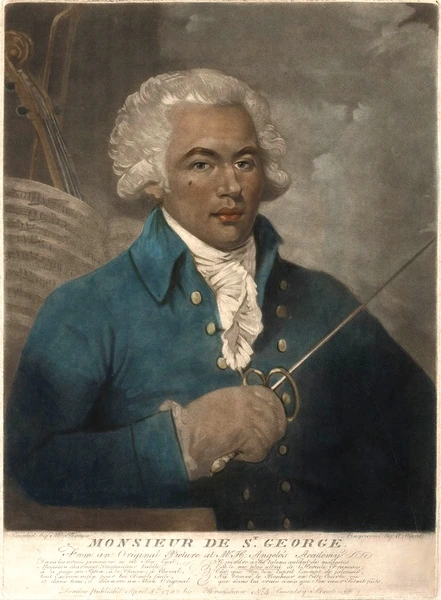
Saint-Georges, Saint-George, Joseph Bologne, Boulogne, Chevalier de, *probably 25 December 1745 Guadeloupe, †between 9 a 12 June 1799 Paris, French composer, and violinist. The son of a French plantation owner and a slave of Senegalese origin. Some documents also confirm his dates of birth as 1739 and 1748, most likely incorrectly. Saint-Georges’ family left Saint-Domingue (now Haiti) for France in the 1750s, where the boy received an education as a nobleman. A versatile talent, he was an excellent fencer and musician. From the age of 13, he studied for six years at N.T. de La Boëssière’s fencing academy, after which he became a member of the Gendarmes de la Garde du Roi. He probably studied composition with F.-J. Gossec, violin with J.-M. Leclaire, and possibly also with A. Lollie (Lollie composed two violin concertos for Saint-Georges, and Gossec dedicated a collection of six string trios to him); he also played the harpsichord.
In 1769, Saint-Georges became the first violinist of the Concert des Amateurs orchestra, founded by Gossec, which was one of the best in Europe. In 1772, he made his debut with the orchestra as a soloist in two of his own violin concertos, Op. 2, achieving success both as a performer and a composer; in 1773, he became the orchestra’s conductor. From 1775, he was director of music at the court of Queen Marie Antoinette and, for a time, her teacher. In 1776, Louis XVI appointed him director of the Academie Royale de Paris (Opéra), but he did not accept the position due to protests by several singers over Saint-Georges’ origins.
Between 1777 and 1785, Saint-Georges was associated with the court of Louis Philippe, Duke of Orléans (1725–1785). He took up the position of musical director of the private theatre of the Marquise de Montesson, the Duke’s wife. In 1777, he made his debut as an opera composer with the staging of Ernestine at the Comédie-Italienne, without much success. After the dissolution of the Concert des Amateurs in 1781, he founded the Masonic orchestra Concert de la Loge Olympique, which was disbanded a few months after the outbreak of the French Revolution. Haydn’s six Paris symphonies, Nos. 82–87, were written for this ensemble, and Saint-Georges conducted their premiere in 1787.
Between 1786 and 1789, he travelled to London several times, giving fencing demonstrations, among other things. After 1789, he became heavily involved in the French Revolution. He belonged to a group centred around Louis Philippe Joseph, Duke of Orléans, known as Philippe Egalité (1747–1793). In 1790, he became captain of the National Guard in Lille, and in 1792, colonel of the newly formed Légion Franche de Cavalerie des Américains, known as the Légion de Saint-Georges. During the Reign of Terror, he spent several months in prison. In 1795 or 1796, he sailed to Saint-Domingue, where he took part in the uprising. In 1797, he returned to Paris, where he took over the leadership of the orchestra of the masonic Cercle de l’Harmonie.
Before the revolution, Saint-Georges played a significant role in the musical life of Paris. He published most of his compositions. As a violinist, he was admired for combining excellent technique (he used the entire range of the instrument and high positions) with emotional intensity and beautiful tone. Saint-Georges’ compositional output focused on instrumental music, especially for the violin. He contributed to the development of the solo concerto, string quartet and violin technique in France; together with Gossec, he was among the first French composers to write concert symphonies (in two movements, for two or three solo instruments and orchestra) and string quartets, of which six concert quartets are particularly noteworthy. The string quartets are generally in two movements, both in the same key. In the opening movements, the composer treated sonata form freely, substituting new thematic material for a conventional development section. The second movements are in lively tempos, sometimes developed through variation technique and at other times drawing on dance conventions. In the quartets Op. 14, both the second violin and the viola and cello participate in the presentation of the thematic material; in the 6 quartetto concertans, the instruments are treated almost equally as concertante.
Composed in the galant style, Saint-Georges’s works are marked by virtuosity, especially in the violin concertos, and by heightened expressivity, featuring an abundance of lyrical melody, particularly in the slow movements. His later compositions show the influence of orchestral texture (e.g. instruments playing in unison) and Sturm und Drang aesthetics (the F minor and G minor quartets from Op. 14), with richer harmonies and accompanying instruments treated more independently. With the exception of La fille garçon, Saint-Georges’ operas met with little success, a shortcoming ascribed to the weakness of the librettos (F.M. von Grimm); the music itself, however, was praised for its lightness and melodic charm.
Literature: F.M. von Grimm Correspondance littéraire, philosophique et critique, 16 vols., ed. M. Tourneux, Paris 1877–82; L. de La Laurencie The Chevalier de Saint-Georges, “The Musical Quarterly” V, 1919; E. Derr J. Boulogne, Chevalier de Saint-Georges. Black Musician and Athlete in Galant Paris, Ann Arbor 1972; D.-R. de Lerma The Chevalier de Saint-Georges, “The Black Perspective in Music” IV No. 1, 1976; G. Banat Le chevalier de Saint-Georges, “Black Music Research Journal” X, 1990; E. Smidak J. Boulogne nommé Chevalier de Saint-Georges, Lucerne 1996, also published in English; C. Ribbe Le Chevalier de Saint-Georges, Paris 2004; L. Nemeth Un état-civil chargé d’enjeux. Saint Georges, 1745–1799, “Annales historiques de la Révolution française” No. 339, 2005; G. Banat The Chevalier de Saint-Georges. Virtuoso of the Sword and the Bow, Hillsdale (New York) 2006; P. Bardin Joseph de Saint-George, le Chevalier Noir, Paris 2006; M. Garnier-Panafieu Un contemporain typique de Mozart. Le Chevalier de Saint-George, Paris 2011; J.A. Ledford Joseph Boulogne, the Chevalier de Saint-George and the Problem with “Black Mozart,” “Journal of Black Studies” I, 2020; C. Ribbe Le chevalier de Saint-George. Né esclave, musicien et escrimeur au temps des Lumières, Paris 2022.
Compositions
Instrumental:
orchestral:
Symphony in G major, Op. 11, Paris 1799
Symphony in D major, Op. 11 (overture do L’amant anonyme), Paris 1799
Symphonies concertantes, including:
2 Symphonies concertantes, Op. 6, for 2 violins and orchestra, Paris 1775
2 Symphonies concertantes, Op. 9, for 2 violins and orchestra, Paris 1777
Symphonie concertante, Op. 12, for 2 violins and orchestra, Paris ca. 1777
Symphonie concertante, Op. 13, for 2 violins and orchestra, Paris 1782
2 Symphonies concertantes, Op. 10, for 2 violins, viola and orchestra, Paris 1779
violin concertos, including:
2 Violin Concertos, Op. 2, Paris 1773
2 Violin Concertos, Op. 3, Paris 1774
2 Violin Concertos, Op. 4, Paris 1774
2 Violin Concertos, Op. 5, Paris ca. 1775
2 Violin Concertos, Op. 7, Paris 1782 (?)
Violin concerto, Op. 8, Paris ca. 1776
Violin concerto, Op. 11, Paris 1777
Violin concerto, performer in Paris 1782, lost
chamber:
6 String Quartets, Op. 1, Paris 1773
6 Quartetto concertans, Paris ca. 1777
6 String Quartets, Op. 14, Paris 1785
3 Sonatas, Op. 1, for harpsichord/piano with obbligato violin accompaniment, Paris 1781
6 Sonatas for violin with violin accompaniment, 3rd ed., Paris 1800
Recueil de pièces for piano and violin, manuscript
Sonata for harp and flute, manuscript
violin and piano pieces
other works in 18th-century anthologies and manuscripts
Vocal:
romances, arias, vocal duets
Stage:
comic operas, including:
Ernestine, libretto P. Choderlos de Laclos, staged in Paris 1777, fragments preserved
La partie de chasse, libretto Desfontaines (F.G. Fouques), staged in Paris 1778, lost
La fille garçon, libretto Desmaillot (A.F. Eve), staged in Paris 1787, lost
L’amant anonyme, comédie melée de ballets, libretto after S.F. de Genlis, staged in Paris 1780, manuscript, overture published as Symphonie in D major, Op. 11
Editions:
Symphonie concertante in G major, Op. 13, published in: B.S. Brook La symphonie française dans la seconde moitié du XVIIIe siècle, vol. 3, Paris 1962
String Quartet in C major, Op. 1 No. 1, ed. D.-R. de Lerma, New York 1978
6 String Quartets, Opp. 2, 5, 7 and 2 Symphonies concertantes, facsimile, ed. G. Banat, introduction D.-R. de Lerma, «Masters of the Violin» III, New York 1981
Symphony in G major, Opp. 11 and 2 Symphonies concertantes, «The Symphony 1720–1840» series D, IV, ed. B.S. Brook, New York 1983
3 sonatas, Op. 1, facsimile, «Clavecinistes Français du Dixhuitième Siècle» XXV, Geneva 1989, ed. also A. Badley, Wellington 2004
violin concertos: C major and A major, Op. 5 and G major, Op. 8, ed. A. Badley, Wellington 1999
Violin concerto in D major and C major, Op. 3, G major No. 10, D major, Op. Post. No. 2, ed. A. Badley, Wellington 2002
Violin concerto in D major, Op. 2 No. 2, «Cahiers de musique» CXLVII, Versailles 2006
6 Concertante Quartets, ed. A. Badley, Wellington 2008
Symphonies concertantes: C major and A major, Op. 9, F major, Op. 10, No. 1, ed. A. Badley, Hongkong 2020
Six String Quartets, Op. 1, ed. A. Badley, Hongkong 2021
Symphonies: G major and D major, Op. 11, ed. R. Blundell, Hongkong 2021
Symphonies concertantes: C major and B-flat major, Op. 6 and E-flat major and G major, Op. 13, ed. A. Badley, Hongkong 2022
String concertos: G major, Op. 2, No. 1, A major and B-flat major, Op. 7, D major, Op. 2, No. 2, ed. A. Badley, Hongkong 2021
String concerto in D major, Op. 4, No. 2, ed. A. Badley, Hongkong 2022