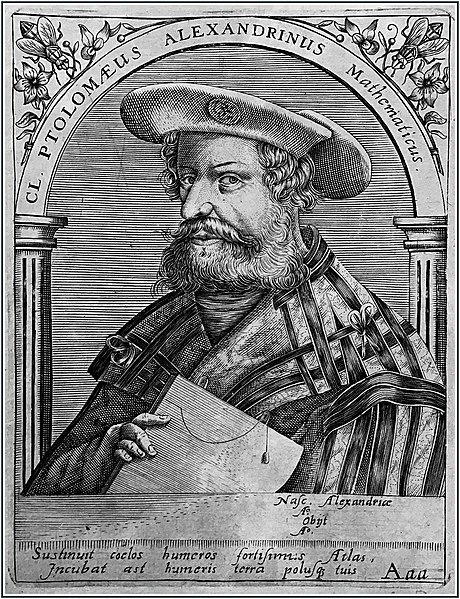
Ptolemy, Klaudios Ptolemaios, Claudius Ptolemaeus, *after 83 Ptolemais (Egypt), †161 Alexandria, Greek mathematician, geographer, astronomer, and music theorist. He probably worked at the observatory in Alexandria. His most important work was Almagest (from Arabic al-majistī, original Greek title Mathēmatikē sýntaxis), a compendium of contemporary astronomical knowledge (geocentric system). Written in the middle of the 2nd century, the three-volume Harmonika is the most famous and lucid description of ancient music theory. Ptolemy considered it essential that there be no contradiction between empirical observations and rational conclusions in scientific research. However, distrusting sensory perception, he used a monochord, an instrument on which the numerical intervals ratios could be represented visually and geometrically by dividing the string, for his acoustic research on consonances. He thus attempted to express elements of music theory through mathematics. He criticised Pythagoras for postulating theoretical interval ratios that did not correspond to practice, and the Aristoxenians for designating intervals by diastēma (summation) rather than in terms of mathematical ratios. He also proved mathematically and acoustically that Aristoxenus had wrongly defined the fourth as consisting of two and a half whole tones, and the octave as six whole tones. He attacked the Pythagoreans for defining intervals greater than an octave differently than intervals smaller than an octave. He proved mathematically that they had wrongly excluded the interval of an eleventh from the consonances, while admitting the consonance of a fourth. Similarly, examining the classification of tetrachords made by his predecessors, he showed that their theory was not confirmed by empirical observation. Ptolemy calculated his own tetrachords: enharmonic – 5:4 x 24:23 x 46:45, two chromatic: ‘soft’ (chroma malakon) – 6:5 × 15:14 × 28:27 and ‘high’ or ‘tense’ (chroma syntonon) – 7:6 x 12:11 x 22:21, three diatonic: ‘tense’ (diatonon syntonon) – 10:9 x 9:8 x 16:15, ‘soft’ (diatonon malakon) – 8:7 x 10:9 x 21:20 and ‘even’ (diatonon homalon) – 10:9 x 11:10 x 12:11.
Ptolemy also made a correction of the tuning in instrumental practice, using different genera of tetrachords. The lyre of that time had two tunings: sterea – ‘hard’ (?diatonic) and malaka – ‘soft’ (?chromatic); the kithara had six different tunings: tropoi in the Hypodorian mode, iasti-aiolia in the Hypophrygian, hypertropa in the Phrygian, tritai in the Hypodoric, parhypatai and lydia in the Dorian. For his research on intervals, Ptolemy used a ‘monochord’ with one string for each of the 15 notes of the double octave covering the systēma téleion (‘Perfect System’). The notes could be identified by thésis, i.e. their absolute position on the strings, or by dynamis, i.e. their relative function relative to other notes within the mode in question. Reflecting on the concept of metabolē, which includes alterations (i.e. transpositions and modulations), Ptolemy distinguished between ‘transposition,’ which consisted of simple transferring the entire melody to a different pitch while retaining the same intervals within it, and the more significant ‘modulation,’ i.e. the transposition of part of the melody, entailing changes in the interval sequence and, consequently, a change of tetrachord’s genus. This, in Ptolemy’s understanding, was true modulation – including alteration of not only the mode but also of the ethos. Ptolemy also described the helicon in Harmonica the monochord, which is an instrument similar to the monochord used to measure interval ratios with stretched strings.
The work concludes with a metaphysical discussion of Pythagoras’ and Plato’s theory of the music of the spheres. Ptolemy pointed out analogies the relationships of the elements of music and those of the human soul (the microcosm) and the movements of the planets (the macrocosm). He compared intervals (symphōnoi) to parts of the soul, modes and tetrachord’s genera to the virtues, and the Perfect System to the ecliptic. The last chapter contains astrological characteristics of the planets and their corresponding notes. Ptolemy’s views were reported to medieval Europe by Boethius at the turn of the 5th and 6th centuries, who mentioned his Harmonica extensively. In the 9th century, the work was translated into Arabic, in the 14th century two Byzantine editions were published, and in 1562 a Gogavinus’s Latin translation appeared in Venice.
Literature: S. Wantzloeben Das Monochord als Instrument und als System, entwicklungsgeschichtlich dargestellt, Halle 1911; L. Schönberger Studien zum 1. Buch der Harmonik des Claudius Ptolemäus, Augsburg 1914; J. Handschin Der Toncharakter: eine Einführug in die Tonpsychologie Zürich 1948; B. Alexanderson Textual Remarks on Ptolemy’s Harmonica and Porphyry’s Commentary, Göteborg 1969; M. Markovits Das Tonsystem der abendländischen Musik in frühen Mittelalter, Bern 1977; W.J. Tucker L’Astrologie de Ptolémée, Paris 1981; B. L. van der Waerden Die Astronomie des Griechen, Darmstadt 1988.
Die Harmonielehre des Klaudios Ptolemaios, ed. I. Düring, Göteborg 1932
Tetrabibios, ed. F.E. Robbins, London 1940
Ptolemy’s Almagest, English translation J. Tommer, London 1984