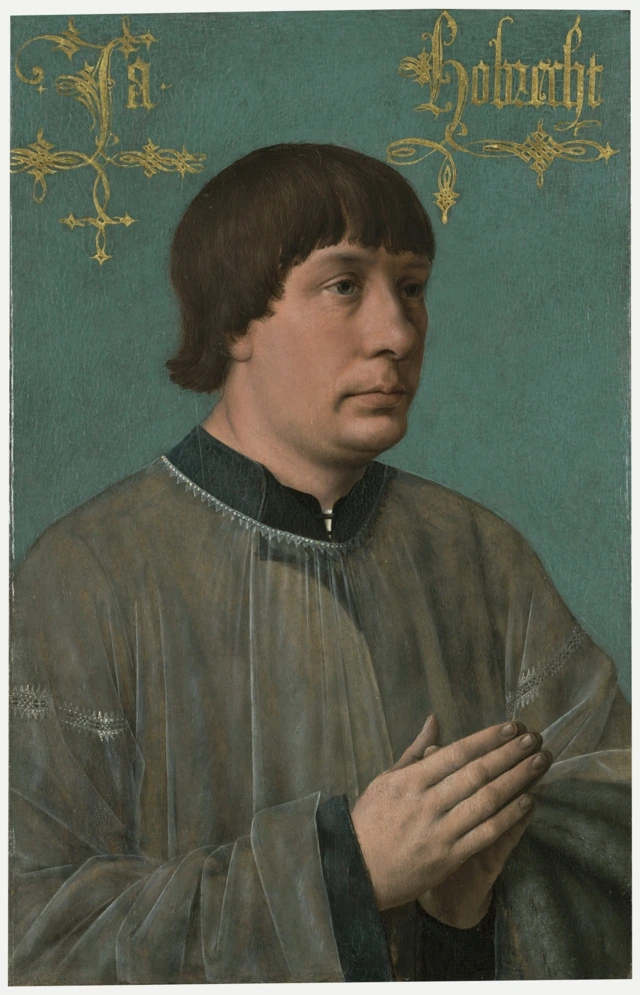
Obrecht, Obreht, Hobrecht, Jacob, *1457 or 1458 Ghent, †VII 1505 Ferrara, Franco-Flemish composer. He was the son of the city trumpeter from Ghent, Willem Obrecht, and his wife, Lysbette Gheeraerts (†1460). Little is known about the composer’s early years; he probably studied music in his hometown. In the late 1460s, he may have met A. Busnois. In the second half of the 1470s, according to Glareanus, he taught singing to the young Erasmus of Rotterdam. Documents from 1480 attest to Obrecht’s university education, although it is not known where he obtained it. In 1480–84, already as a priest, he directed the choir of the Brotherhood of the Blessed Virgin Mary at the church of St. Gertrude in Bergen op Zoom. During this time, he was also active as a composer and copyist, and his masses were known and appreciated in Italy. In 1484, he was employed as magister puerorum at Cambrai Cathedral, and from 1485 to 1491, he served as succentor at the St. Donatian’s Cathedral in Bruges. In August 1487, he was granted a six-month leave of absence by the chapter of that church to travel to Ferrara, where he went at the invitation of Duke Ercole d’Este. He returned from Italy in the summer of 1488 but first went to Bergen op Zoom, and only at the end of the year did he resume his former duties in Bruges. In 1492, he was dismissed for unclear reasons by the chapter of St. Donatian but soon took up the post of choirmaster at the Cathedral of Our Lady in Antwerp, which had been vacant after the death of J. Barbireau.
In 1497, he moved to Bergen op Zoom, where he obtained a very lucrative position as a singer in the Brotherhood of the Blessed Virgin Mary. In 1498, he again became a succentor at the St. Donatian’s Cathedral in Bruges. In 1500, due to a serious illness, he resigned from this position but supported himself thanks to benefices granted to him by the chapter in recognition of his services. In 1501–03, he worked as a singer and copyist at the Church of Our Lady in Antwerp. In 1503, he travelled to Innsbruck to the court of Emperor Maximilian I, for whom he composed the mass Regina caeli (now lost). In September 1504, he was employed in the vacant position after Josquin’s departure as maestro di cappella at the court of Duke Ercoli d’Este in Ferrara. He lost this position after the prince’s death († 25 January 1505), and a few months later, he died from a plague epidemic.
Obrecht is one of the most outstanding composers conventionally classified as belonging to the generation of Josquin des Prez. He gained international fame as a creator in his twenties. His legacy is preserved in numerous manuscripts (mainly Segovia, St. Gallen, Florence), as well as in prints (including Misse Obrecht, Venice 1503 O. Petrucci) published not only during the composer’s lifetime but also for half a century after his death. The most frequently copied of his compositions in the 16th century were the masses Fortuna desperata, Salve diva parens and Si dedero and the motets Parce Domine and Si sumpsero. Fragments of his works were quoted by numerous theorists in their treatises up until 1590, including S. Monetarius in Epithoma utriusque musices practice (1515). J. Tinctoris listed him among the outstanding musicians as the only one of that generation (Complexus effectuum musices, revised version of 1481–83), and H. Glareanus, emphasising Obrecht’s diligence, compared him to Ovid (Dodecachordon, 1547). There is a preserved portrait of the composer at the age of 38, painted in 1496 by Quinten Matsys (Kimber Art Museum).
R. Wegman distinguishes three basic stages of Obrecht’s work. The first, early (until the end of the 1480s), is characterised by references to the compositional methods of the previous generation, primarily A. Busnois and J. Ockeghem, the use of dense contrapuntal texture and the predominance of free development of the cantus firmus. The second, mature (until the mid-1490s), is characterised by greater transparency of the contrapuntal texture, the introduction of homophonic fragments, and the creation of strict cantus firmus patterns. In the recent period (since the mid-1490s), in which motet works predominate, Obrecht used diverse types of texture – from declamatory to intensive imitation and, in masses, elements of parody technique.
The masses are of fundamental importance in Obrecht’s work. All of them use the cantus firmus technique, and in terms of the variety of ways in which it is used, the composer had no competition in his time. In general, the cantus prius factus melody can be easily distinguished in the masses, partly because Obrecht used the long-note cantus firmus more often than other composers of his generation. The early masses are based on chorale material. The cantus firmus melody is treated quite freely in them, and the integration of the cycle is additionally emphasised by polyphonic formulas repeated at the beginning of each part (e.g. in the masses Petrus apostolus, De sancto Donatiano, and Beata viscera), which is a reference to the Burgundian tradition. The Sicut spina rosam mass, in addition to the chorale cantus firmus, contains quotes from the Mi-mi mass by J. Ockeghem and is also maintained in the style of that composer. Obrecht’s most popular mass Salve diva parens, based on a quasi-choral melody with text unknown from other sources, is distinguished by a wealth of compositional techniques (repetitions and intricate transformations of motifs, sequences, various imitations, textural and rhythmic contrasts). Since the late 1480s, the composer used a secular cantus firmus, probably for the first time in the Adieu mes amours mass, where he used either an anonymous single-voice chanson or the tenor of its polyphonic version by Josquin. The Fortuna desperata mass was based on the tenor chanson by A. Busnois, and some of Obrecht’s ideas were later used by Josquin in his analogous composition. In the L’homme armé mass, in turn, Obrecht used a system of cantus firmus transformations (retrograde, inversion, retrograde inversion) modelled on the corresponding mass by Busnois. In the Caput mass, the structure of the cantus firmus (as earlier in Ockeghem’s) is borrowed from an anonymous English mass of the same title, while the cantus firmus of the Ave regina caelorum mass is taken from the tenor of a motet by W. Frye, mostly faithfully quoted but in places paraphrased.
Obrecht shows a particular predilection for the segmented cantus firmus technique, occasionally encountered in other composers and used by him in five masses: Je ne demande, Malheur me bat, Si dedero, Rose playsante and Maria zart. In each part of such a composition, a different fragment of the cantus firmus divided into segments is used in the tenor, and only in Agnus Dei is the melody introduced in its entirety. In the late mass Maria zart, based on a German Marian hymn, the distribution of the segments of this melody is less schematic – the tenor of each part begins with a fragment that appeared at the end of the previous part, and moreover, the motifs of the song also run through other voices. In masses that draw the tenor from a polyphonic composition, fragments of other voices of the original are usually used, and thus elements of the parody technique are introduced, e.g. in the mass Si dedero, based on a motet by A. Agricola. The most advanced form of this technique appears in the late mass Cela sans plus based on a chanson by C. de Lannoy. In a few compositions, Obrecht did not limit himself to a single cantus firmus. In the masses De sancto Martino and De sancto Donatiano, he used several successively appearing melodies of chorale antiphons from services in honour of the respective saints. The latter of these masses was founded by the Bruges burgher Adriane de Vos as a commemoration of her deceased husband Donaes de Moor, and the text of the secular song Gefft den armen quoted in the Kyrie refers to his charity. In both masses Plurimorum carminum, Obrecht used melodies from chansons by different composers (in one – 22, in the other – 5). The Sub tuum praesidium mass is based on seven cantus firmi – in addition to the title antiphon appearing in each part in the highest voice, with an increasing volume of sound (from three to seven voices) the melodies of six other Marian antiphons are gradually introduced: in Agnus Dei, four different cantus firmi are performed simultaneously. The special role of the seven in this piece can be explained by Marian symbolism.
The cantus firmus melody in Obrecht’s works is often subject to transformations. In masses with a segmented cantus firmus, the tenor usually appears in several different types of mensura over the course of one movement (in “Et in Spiritum” of the mass Je ne demande, there are as many as five). Obrecht also used such transformations as retrograde, inversion, and retrograde inversion (e.g. in the Grecorum mass). In the Gloria and Credo of the mass Fortuna desperata, by appropriately combining the parts of the cantus firmus melody in the basic version and in retrograde, the composer achieved a sophisticated equivalent of a palindrome. In the Credo of the mass De tous biens playne, in turn, a structure of an anagram appears: the sounds of the basic version of the cantus firmus are arranged from the longest to the shortest, and then the whole appears in retrograde. Another type of transformation is the addition motif, i.e. one in which each motif is a repetition of the previous one, extended by one note (e.g. the Sanctus from the Fortuna desperata mass). Some transformations are signalled by verbal instructions added to the musical score.
The structure of Obrecht’s mass is generally carefully planned and often determined by the arrangement of the cantus firmus or subordinated to certain numerical combinations. Such a case is represented by the Sub tuum praesidium mass, where the melody of the titular antiphon appears once in each part, which makes them almost the same length. The entire mass has 888 breves, of which 333 fall in the Kyrie and Gloria and 555 – in the remaining parts. In many works, the form is determined by the arrangement of fragments with full and reduced cast. Obrecht most often reduced the volume of sound (and with it – the cantus firmus) in the segments “Christe” and “Pleni sunt caeli,” less often in others (different in individual works). An interesting, symmetrical arrangement of 4-, 3- and 2-voice parts occurs in the Maria zart mass (Kyrie: 4–3–4, Gloria: 4–2–2–4, Credo: 4–3–3–4, Sanctus: 4–3–4–3–4, Agnus: 4–3–4).
Obrecht’s motet output remains somewhat in the shadow of the mass, but even here, there is no shortage of works worthy of attention. R. Strohm recreated a hypothetical repertoire from the composer’s time in Bruges. Some of the motets (Alma Redemptoris mater, Ave maris stella, Ave regina caelorum, Beata es Maria, Regina caeli, the 3-voice Salve regina) were probably composed for the needs of the Marian concerts regularly performed in that city. The motet O preciosissime sanguis was composed for the Basilica of the Holy Blood in Bruges. The creation of the motet O beate Basili/O beate pater should be associated with the cult of Saint Basil characteristic of that city. Salve crux arbor vitae (for the feast of the Exaltation of the Holy Cross) and Salve sancta facies/Homo quidam (intended for Corpus Christi, written for the textile merchants’ foundation) were probably also written for Bruges. Motets for special occasions include Mille quingentis (cantus firmus: Requiem aeternam; quotes from Virgil’s Eclogues) – a lament for the death of the composer’s father († 22 November 1488) and Quis numerare queat, a thanksgiving composition, probably related to the suspension of hostilities between Henry VII and Charles VIII in 1492. In turn, Inter preclarissimas virtutes/Estote fortes in bello is, according to R.C. Wegman, a kind of musical request for a position, probably at the court of Pope Alexander VI. In many motets, Obrecht used the cantus firmus technique and the melodies were mostly taken from Gregorian chant, sometimes together with the text; hence, some motets have two texts; in some, he quoted several different melodies (e.g. in Factor orbis/Canite tuba). In Inter praeclarissimas virtutes, he used a type of segmented cantus firmus. The motet Regina caeli (two-voice) is a specific experiment in which he used 13 different types of proportions. Obrecht used different types of texture in motets: from dense counterpoint modelled on old masters (Salve regina for six voices) through intensive imitation (Laudes Christo redemptori) to declamation (Laudemus nunc Dominum/Nun est hic aliud).
In secular compositions, Obrecht mainly used Flemish texts (or their incipits) – partly with a light, urban folklore-inspired character, e.g. Ic hoerde de clocskins luden. Several compositions are adaptations of French chansons, e.g. J’ay pris amours. A few pieces without text have also survived. In secular compositions, homophonic texture and simple harmony predominate. An exception is the artfully shaped Fugue, which is a 3-voice canon accompanied by a fourth voice consisting of successive augmented semibreves of the main melody.
Obrecht most often used the Dorian mode but almost exclusively in a transposed version. He usually made the key of the mass dependent on the key of the cantus firmus. Characteristically, he took care to maintain tonal unity throughout the entire multi-movement works, among other things, by consistently using one finalis. The tonality is also reinforced by extended cadences (e.g. the Ave regina caelorum mass). By applying the rules of musica ficta, Obrecht preferred – contrary to the recommendations of theoreticians – melodic correctness over harmonic correctness. He showed an exceptional predilection for building longer melodic lines from conventional melodic formulas – he particularly preferred clausal motifs. He was fond of using a means typical of his time – sequences, often based on common motifs (Credo of the Rose playsante mass). He used ostinato to a lesser extent than Josquin and never built longer wholes from them. In masses, he used melismas on a large scale, also in the Gloria and Credo sections, which was less common in other composers. The Maria zart mass is the most saturated with melismas – the longest mass composition of that time (it lasts over an hour). Compared to Josquin, the imitative technique plays a slightly smaller role in Obrecht’s work. Imitations of relatively short motifs predominate, often placed in the middle of a phrase. Canons also appear less frequently in his compositions than in other composers of that period; they are usually two-voice, accompanied by a third, free voice. In several pieces, Obrecht used a canonical setting of the long-note cantus firmus (e.g. in Haec Deum caeli). He willingly used progressions of parallel imperfect consonances (tenths throughout the entire second Agnus Dei in the Je ne demande mass). He often referred to techniques and structural solutions used by older composers, e.g. J. Ockeghem, W. Frye, A. Busnois, A. Agricola, and Josquin. In Obrecht’s work, one can find manifestations of musical rhetoric, e.g. in Magnificat, the phrase “in saecula” repeated several times emphasises the notion of multiplicity connoted by this expression, and in Laudes Christo redemptori, on the words “in ara crucis,” there appears a figure that is an early equivalent of the Baroque imaginatio crucis.
Literature: O. Gombosi Jacob Obrecht. Eine stilkritische Studie, «Sammlung musikwissenschaftlicher Einzeldarstellungen» IV, Leipzig 1925, reprint Wiesbaden 1972; B. Meier Zyklische Gesamtstruktur und Tonalität in den Messen Jacob Obrechts, “Archiv für Musikwissenschaft” X, 1953; M. Antonowycz Renaissance-Tendenzen in den „Fortuna desperata” – Messen von Josquin und Obrecht, “Die Musikforschung” IX, 1956; L. Lockwood A Note on Obrecht`s Mass „Sub tuum praesidium”, “Revue Belge de Musicologie” XIV, 1960; A. Salop Jacob Obrecht and the Early Development of Harmonic Polyphony, “Journal of the American Musicological Society” XVII, 1964; M. Staehelin Obrechtiana, “Tijdschrift van de Vereniging voor Nederlandse Muziekgschiedenis” XXV, 1975; R.L. Todd Retrograde, Inversion, Retrograde-Inversion and Related Techniques in the Masses of Obrecht, “The Musical Quarterly” LXIV, 1978; R.D. Ross Toward a Theory of Tonal Coherence. The Motets of Jacob Obrecht, “The Musical Quarterly” LXVII, 1981; T. Noblitt Chromatic Cross-Relations and Editorial „Musica Ficta” in Masses of Obrecht, “Tijdschrift van de Vereniging voor Nederlandse Muziekgschiedenis” XXXII, 1982; B. Hudson Two Ferrarese Masses by Jacob Obrecht, “Journal of Musicology” IV, 1986; B. Hudson Obrecht’s Tribute to Ockeghem, “Tijdschrift van de Vereniging voor Nederlandse Muziekgschiedenis” XXXVII, 1987; B. Hudson On the Texting of Obrecht’s Masses, “Musica Disciplina” XLII, 1988; A. Leszczyńska Kadencja w fakturze motetów Jacoba Obrechta, “Muzyka” 1988 No. 2; R. Strohm Music in Late Medieval Bruges, Oxford 1990; M.J. Bloxam Sacred Polyphony and Local Traditions of Liturgy and Plainsong. Reflections on Music by Jacob Obrecht, in: Plainsong in the Age of Polyphony, ed. T.F. Kelly, Cambridge 1992; M.J. Bloxam Plainsong and Polyphony for the Blessed Virgin. Notes on Two Masses by Jacob Obrecht, “Journal of Musicology” XII, 1994; R.C. Wegman Born for the Muses. The Life and Masses of Jacob Obrecht, Oxford 1994; B.J. Blackburn Obrecht’s „Missa Je ne demande” and Busnois`s Chanson. An Essay in Reconstructing Lost Canons, “Tijdschrift van de Vereniging voor Nederlandse Muziekgschiedenis” XLV, 1995; R. Sherr A Biographical Miscellany. Josquin, Tinctoris, Obrecht, Brumel, in: Musicología humana, commemorative book of W. and U. Kirkendale, ed. S. Gmeinweiser, D. Hiley, J. Riedlbauer, Florence 1995; R.C. Wegman From Maker to Composer Improvisation and Musical Authorship in the Low Countries, 1450–1500, “Journal of the American Musicological Society” XLIX, 1996; A. Leszczyńska Melodyka niderlandzka w polifonii Josquina, Obrechta i La Rue, Warsaw 1997; R.C. Wegman Agricola, Bordon and Obrecht at Ghent: Discoveries and revisions, “Revue belge de musicologie/Belgisch tijdschrift voor muziekwetenschap” LI, 1997; J. Heidrich Die Missa „Beata progenies” im Chorbuch „Jena 32”. Eine bisher unerkannte Komposition Jacob Obrechts?, “Archiv für Musikwissenschaft” LVII, 2000; S. Gallahager Pater optime: Vergilian allusion in Obrecht’s „Mille quingentis”, “The Journal of Musicology”, XVIII, 2001; R. Staines Obrecht at 500: Style and structure in the Missa „Fortuna desperata”, “The Musical Times” CXLVI, 2005; J. Bali Looking at the sphinx: Obrecht’s Missa Maria zart, “Journal of the Alamire Foundation” II, 2010; B.J. Blackburn Obrecht, Busnoys, and the sign of „3” before 1500, “Journal of the Alamire Foundation” II, 2010; F. Fitch „Two fellows from Ghent”: For the Obrecht and Agricola quincentenaries, “Journal of the Alamire Foundation” II, 2010; L. Holford-Strevens The Latinity of Jacob Obrecht, “Journal of the Alamire Foundation” II, 2010; M.A. Anderson „His name will be called John”: Reception and symbolism in Obrecht’s Missa de Sancto Johanne Baptista, “Early Music” XXXIX, 2011; M.J. Bloxam Text and context: Obrecht’s Missa de Sancto Donatiano in its social and ritual landscape, “Journal of the Alamire Foundation” III, 2011; W. Edwards Word setting in a perfect musical world: The case of Obrecht’s motets, “Journal of the Alamire Foundation” III, 2011; R.C. Wegman Obrecht and Erasmus “Journal of the Alamire Foundation, III, 2011; Ph. Weller Sighting the Obrechtian motet, “Journal of the Alamire Foundation” III, 2011; B.J. Blackburn The corruption of one is the generation of the other: Interpreting canonic riddles, “Journal of the Alamire Foundation” IV, 2012; A. Zayaruznaya What Fortune can do to a minim, “Journal of the American Musicological Society” LXV, 2012; M.J. Bloxam, Ockeghem’s presence in Obrecht’s Masses, “Tijdschrift van de Koninklijke Vereniging voor Nederlandse Muziekgeschiedenis”, LXVII, 2017; W. Fuhrmann Segovia’s repertoire: Attributions and datings (with special reference to Jacob Obrecht) in: The Segovia manuscript: A European musical repertory in Spain, c. 1500, ed. W. Fuhrmann, C. Urchueguía, Woodbridge 2019; J. Rifkin Obrecht, Double Counterpoint, and Musical Memory, “Musical Quarterly” CIV, 202.
Compositions:
religious:
masses for 4 voices:
Adieu mes amours
Ave regina caelorum
Beata viscera
Caput
Cela sans plus
De sancto Donatiano
De sancto Martino
Fortuna desperata, Grecorum
Je ne demande
L’homme armé
Libenter gloriabor
Malheur me bat
Maria zart
O lumen ecclesie
Petrus apostolus
Pfauenschwanz
Plurimorum carminum I
Plurimorum carminum II
Rose playsante
Salve diva parens
Scaramella
Sicut spina rosam
Si dedero
Veci la danse Barbari
masses for 3 voices:
De tous biens playne
Fors seulement
***
Sub tuum praesidium, mass for 3–7 voices
Regina caeli (lost)
masses of uncertain authorship:
De Sancto Johanne Baptista for 4 voices
Gracioulx et biaulx,
N’arayje jamais for 4 voices
Sine nomine for 4 voices
Je ne seray plus for 3 voices
motets for 6 voices:
Salve regina
motets for 5 voices:
Factor orbis/Canite tuba
Haec Deum caeli
Laudemus nunc Dominum/Nun est hic aliud
Mater patris/Sancta Dei genitrix
O preciosissime sanguis/Guberna tuos famulos
Salve crux arbor vitae/O crux lignum triumphale
motets for 4 voices:
Ave regina caelorum
Beata es Maria
Benedicamus in laude
Cuius sacrata viscera
Discubuit Jesus
Inter praeclarissimas virtutes/Estote fortes in bello
Laudes Christo
Magnificat
Mille quingentis/Requiem aeternam
O beate Basili/O beate Pater
Parce Domine
Quis numerare queat
Salve regina
Salve sancta facies/Homo quidam
motets for 3 voices:
Alma Redemptoris mater
Ave maris stella
Cuius sacrata viscera
Salve regina
Si sumpsero
***
Omnis spiritus for 2–4 voices
Regina caeli for 2 voices
over 30 secular works:
songs, including:
Als al de weerelt in vruechden leeft for 4 voices
Fors seulement for 4 voices
Helas mon bien for 3 voices
Ic draghe de mutse for 4 voices
Ic hoerde de clocskins luden for 4 voices
J’ay pris amours for 4 voices
Marion la doulce for 3 voices
Meiskin es u for 4 voices
Se bien fait for 4 voices
instrumental:
Fugue for 4 voices
Tandernaken for 3 voices
a few works for 3 voices
Editions:
Werken van Jacob Obrecht, ed. J. Wolf, Amsterdam and Leipzig 1908–21, reprint Farnborough 1968
Jacob Obrecht Opera omnia, editio altera, ed. A. Smijers, M. v. Crevel, Amsterdam 1953–64
New Obrecht Edition, ed. Ch. Maas et al., Utrecht 1983–99