
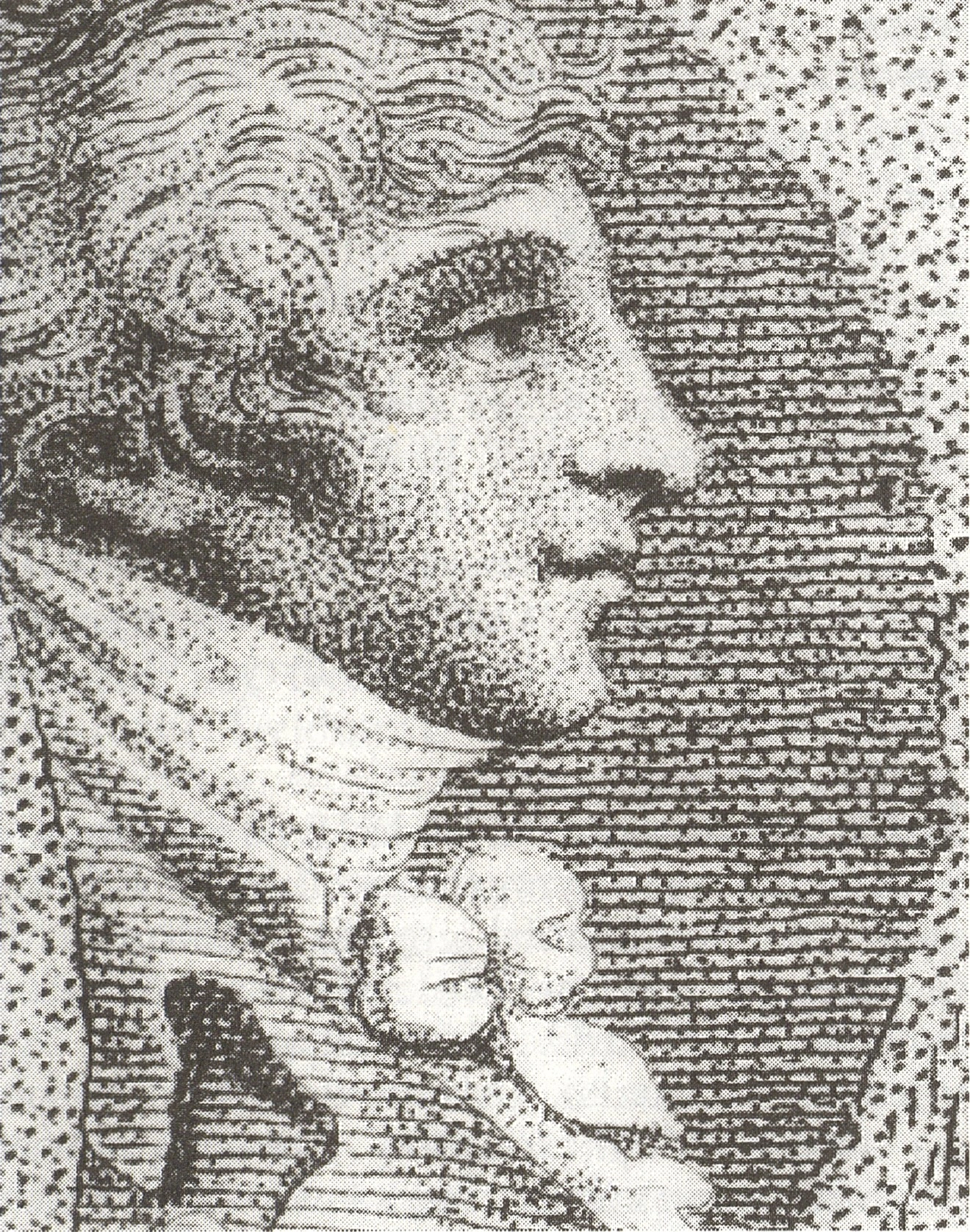
Wariacje [partytura]

Janiewicz, Yaniewicz, Feliks, *1762 Vilnius, †21 May 1848 Edinburgh, Polish violinist, conductor, composer, music teacher, organiser of musical life. He achieved a high level of proficiency on the violin at an early age. Around 1778 he moved to Warsaw, and around 1785 he stayed in Vienna, where he gave concerts and is said to have briefly taken composition lessons with Haydn. As a protégé of Count Jerzy Wielhorski, he stayed in Italy between 1785 and 1787, accompanying Princess Izabela Lubomirska, née Czartoryska, and performing at court and public concerts in Naples and Rome (1786). From the end of 1787, he stayed in Paris. He performed there at the Concerts Spirituel on 25 December 1787 and on 9, 18, 21, 24, and 28 March 1788, receiving the patronage of the Duchess of Orléans. In 1790 he performed again in several Italian cities. In 1792 Janiewicz arrived in Great Britain at the invitation of J.P. Salomon. He made his first public appearance in London on 9 February 1792 at a benefit concert for V. Jírovec conducted by Salomon. In the 1792 season, he was the principal violin soloist at Salomon’s subscription concerts in the Hanover Square Rooms. In the following season, after his position was taken over by G.B. Viotti, Janiewicz performed at the oratorio concerts at the King’s Theatre, Haymarket; he returned to Salomon’s concerts in 1796. In addition to performing at regular concerts, he took part in numerous benefit concerts for leading musicians, including J. Haydn (3 May 1792). From the beginning of his stay in England, Janiewicz travelled extensively as a concert violinist and orchestra conductor, performing in Bath in 1792–93, in Ireland in 1796, 1797, and 1799, regularly performing in Manchester and Liverpool from around 1788, and making his first appearance in Edinburgh in 1803. On 12 October 1799, he married Eliza Breeze (†27 May 1862) and settled in Liverpool, where around 1800 he established a shop selling sheet music and musical instruments, also engaging in small-scale publishing activities. Between around 1810 and 1813, his business partner was J. Green, and from around 1816, W.D.G. Weiss, who took over the business after Janiewicz’s withdrawal around 1829. Janiewicz was actively involved in Liverpool’s musical life: in 1799, 1808, and 1813 he conducted the festival orchestra; for many seasons up to around 1814 he directed the orchestra of subscription concerts; and in 1819, 1820, and 1822 he organised his own series of instrumental music concerts. Between 1810 and 1813, he ran a music shop and a small publishing house at Leicester Square, London. In 1813, he was one of the thirty co-founders of the Philharmonic Society in London, with which he collaborated until 1815. In 1815 he moved to Edinburgh, where he developed his concert career, taking part in festivals (1815, 1819, and 1824), directing subscription concert orchestras, and organising his own concert series from 1816. During this period, he also performed in other Scottish cities, including Glasgow, Aberdeen, and Dundee, as well as in Ireland. In 1831, Janiewicz retired from public performance. Little is known about the final years of his life. He was buried at Warriston Cemetery in Edinburgh. Janiewicz had five children, three of whom survived infancy: two daughters – the elder, Felicia, became a pianist and singer, while the younger, Paulina, a harpist – and a son, Felix, who became a renowned dental surgeon.
As a composer Janiewicz was essentially self-taught, yet he achieved a high degree of professionalism; he primarily composed with himself in mind as the performer. Consequently, the core of his oeuvre consists of violin concertos, string trios, and Divertimenti for two violins, works that lean more towards the concertante style than towards chamber music. The primary performing role in the divertimenti falls to the first violin, treated in a virtuosic manner; it is the first violin that determines both the choice of motifs and the formal design of these compositions. Janiewicz’s finest works, his concertos and trios, follow Classical models. All are in three movements, with a sonata-allegro as the first movement and a rondo as the third. His sonata-allegro movements are never schematic, rather, they display a clear and thoughtfully conceived structure. The first theme has a periodic structure, often featuring triadic and ornamented melodic figures; it sometimes reappears in the exposition in the dominant (Trio No. 1) or in the minor dominant (Trio No. 3). The second theme, less developed in his earlier compositions than in his later ones, is built on the principle of contrast. A third theme is sometimes introduced in the concertos. Transitional passages play a very important role in the musical discourse, most often taking the form of extended passagework and scale figurations. Elements of motivic development can also be observed already within the expositions. The development section, not yet clearly delineated in the Trio No. 1, becomes an important structural component in Janiewicz’s later works, typically beginning with a motive from the concluding phrase of the exposition or with the principal motive of the first theme. In the recapitulation, one of the themes is often omitted. In the slow movements of the sonata cycle, Janiewicz occasionally employs pre-existing material, for example an aria from Handel’s Sosarme in the Trio No. 3 and the Sonata in F major and at other times introduces dance forms such as the siciliana or the polonaise. The rondo, as the third movement of the cycle, reflects in Janiewicz’s output an early Classical model with a relatively schematic design, enriched by elements of the galant style, including melodic emphasis, sequential organization of sections, and their varied repetitions. The rondo, as the third part of the cycle, represents in Janiewicz’s work an early classical type with a fairly schematic structure, with elements of the galant style – i.e. melodic writing, sectional arrangement, and varied repetition. Janiewicz’s compositions display notable violinistic qualities, including effective exploitation of registers (with a range extending to E4), parallel thirds and sixths, double stops, wide leaps exceeding an octave, and broken-octave figures. His piano works belong to the sentimental, salon-music tradition. He often drew on Polish folk music, writing mazurkas, sometimes incorporating elements of the oberek, as well as the kujawiak, and polonaises, of rather conventional character, formally elaborate, featuring the characteristic polonaise rhythm in the melody rather than in the accompaniment. Janiewicz also occasionally and somewhat stereotypically drew on European folk music: Scottish (Rondo in the Scottish Style), Italian (Divertimento Nos. 1 and 2), Swiss (Swiss Air as Rondo), and Jewish (the second movement of the Trio No. 5 – Jewish Chant). Janiewicz was one of the founders of the Polish violin school and a representative of Classicism, who incorporated elements of the stile brillante into his work, evident in the elaboration of virtuosic violin parts and the development of advanced violin techniques. Janiewicz’s compositions have been the subject of numerous arrangements by J.L. Dusík, J.B. Cramer, A. Moffat, R. Padlewski, K. Sikorski, T. Ochlewski, A. Panufnik, A. Malawski, M. Dziewulska and T. Machl.
Janiewicz’s playing style was rooted in the Viotti school, and his interpretation was characterised by melodiousness and emotional richness. His contemporaries emphasised the extraordinary precision, purity of intonation and full, even tone in Janiewicz’s playing, as well as his technical proficiency, particularly in the execution of octaves.
Literature: E.L. Gerber Neues historisch-biographisches Lexicon der Tonkünstler, Lepizig 1812–14; G.F. Graham An Account of the First Edinburgh Musical Festival, Edinburgh 1816; A Dictionary of Musicians, ed. J.S. Sainsbury, vol. 2, 2nd edition 1827, 1966; K. Lach-Szyrma Anglia i Szkocja. Przypomnienie z podróży roku 1820–1824 odbytej, Warsaw 1829, new edition with footnotes and afterword by P. Hertz, Warsaw 1981; W.T. Parke Musical Mémoires, London 1830; T. Strumiłło Szkice z polskiego życia muzycznego XIX wieku, Krakow 1954; J. Reiss Skrzypce i skrzypkowie, Krakow 1955; A. Porębowiczowa Feliks Janiewicz, “Ruch Muzyczny” 1960 no. 22; J. Berwaldt Życie Feliksa Janiewicza (1762–1848), „Muzyka” 1966 nos. 3–4; J. Berwaldt Twórczość Feliksa Janiewicza, “Muzyka” 1967 no. 1; A. Chodkowski Feliks Janiewicz i londyńskie koncerty Salomona w latach 1792–1795, in: Studia musicologica aesthetica,theoretica, historica, commemorative book for Zofia Lissa, Krakow 1979; A. Sitarz Faktura fortepianowa utworów Feliksa Janiewicz na przykładzie “Mazurka A-dur” i wariacji “Hope told a flattering tale”, in: Donum natalicum. Studia Thaddaeo Przybylski octogenario dedicata, ed. Z. Fabiańska, A. Jarzębska, A. Sitarz, Krakow 2007; A. Sitarz Feliks Janiewicz’s violin concertos against the background of the works of his contemporary composers, “Musica Iagellonica” 12 (2021).
Compositions
Instrumental:
orchestral:
Violin Concerto No. 1 in F major, Paris ca. 1788 Imbault, London 1791 or 1792 Longman & Broderip, Offenbach am Mein 1792 J. André, as Concerto in F Major for piano and orchestra in an arrangement by J.L. Dusik, Paris ca. 1790 Imbault and an arrangement for piano and violin, London ca. 1794 T. Skillern, London ca. 1797 Levis, Houston & Hyde, Liverpool ca. 1799 H. Hime
Violin Concerto No. 2 in E major, Paris ca. 1788 Imbault
Violin Concerto No. 3 in A major, Paris ca. 1791 Imbault
Violin Concerto No. 4 in A major, Paris ca. 1797 Imbault
Violin Concerto No. 5 in E minor, Paris 1803–07 Pleyel
Violin Concerto in G major in a piano arrangement by J.B. Cramer, London ca. 1794 T. Skillern
Piano concerto in B-flat major, Dublin ca. 1800 Hime, Liverpool ca. 1805 published by the composer
chamber:
6 Trios for 2 violins and cello, Paris ca. 1800 Imbault, London ca. 1802 Clementi & Co.
6 divertimenti for 2 violins, London ca. 1805 Clementi & Co.
Sonata in A major for piano with violin and cello accompaniment (transcription of Trio No. 2), London ca. 1800 Longman, Clementi & Co. (only the violin part remains)
Sonata in F major for piano with violin accompaniment (transcription of Trio No. 3), London ca. 1805 Clementi & Co. (only the piano part remains)
piano:
Sonata in B-flat major, Liverpool ca. 1801 published by the composer (an arrangement of the Piano Concerto in B-flat major)
Rondo à la militaire for piano, London ca. 1805 Clementi & Co.
Peggy’s Love for piano (transcription of part three of Divertimento), London ca. 1805 Clementi & Co.
Favorite Polacca for piano, London ca. 1805 published by the composer
A Polish Rondo for piano (separate edition of part three of Sonata in B-flat major), Liverpool ca. 1810, published by the composer
Mazurek for piano, London ca. 1810 Clementi & Co.
Indian War Hoop, rondo for piano, Liverpool ca. 1815, published by the composer
Swiss Air as a Rondo for piano, ca. 1820
Rondo in the Scottish Style for piano, London ca. 1830 Chappel & Co.
Additionally, The Ladies’ Collection of Piano-Forte Music Consisting of Songs, Lessons, Rondos, Variations, Overtures, Marches etc. Composed and Selected from the Works of the most Eminent Authors by F. Yaniewicz, including as No. 1 the variations Hope told a flattering tale, Liverpool 1803–04, published by the composer and Sonata in B-flat major as No. 3, Liverpool ca. 1805, published by the composer
Vocal-instrumental:
songs:
Go youth beloved, words by A. Opie, Liverpool ca. 1803 published by the composer
song for group singing, published in two textual versions and under three titles: Song of Battle, words by M. Haughton, Liverpool ca. 1805; The Battle of Derne; and The Birthday of Freedom, words by C. Harford, Philadelphia 1805, G. E. Blake
arrangements for voice and piano:
Mighty God of Flamens and Darts (arrangement of W.A. Mozart’s song Oiseaux, si tous les ans KV 307), London ca. 1805 Clementi & Co.
Love Resistless (arrangement of W.A. Mozart’s song Abend ist’s KV 523), London ca. 1805 Clementi & Co
Editions:
Trio No. 1 in C major, arrangement by K. Biegański and A. Chodkowski, in: Muzyka staropolska, ed. Z. Szweykowski, Krakow 1966
Violin Concerto No. 5 in E minor in the version for violin and piano, arrangement by Z. Jeżewski, K. Sikorski, Z. Hodor, T. Ochlewski, «Florilegium Musicae Antique» iss. 27, Krakow 1969
Trios for 2 violins and cello, arrangement by J. Berwaldt, «Źródła do Historii Muzyki Polskiej» iss. 18, ed. Z.M. Szweykowski, Krakow 1969.
Feliks Janiewicz: Opera omnia, «Monumenta Musicae in Polonia», vol. 1: Koncerty skrzypcowe 1, Krakow 1996 (includes a monographic introduction and a thematic catalogue)
Feliks Janiewicz: Opera omnia, «Monumenta Musicae in Polonia», vol. 2: Koncerty skrzypcowe 2, Krakow 1998