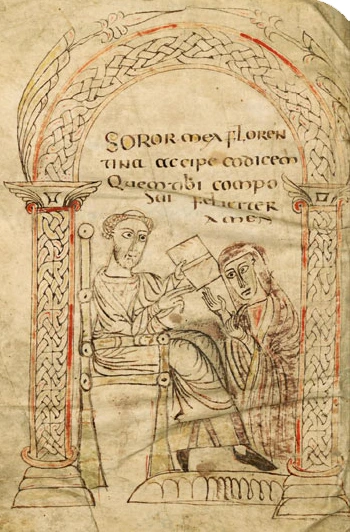
Isidore of Seville, Isidorus Hispalensis, *ca. 560 Cartagena (?), †4 April 636 Seville, Spanish theologian and Church Father, saint. He was probably born in Cartagena, the son of Severianus and Theodora; his family soon moved to Seville. He received a thorough education under the guidance of his elder brother, who was then Bishop of Seville. He was well versed in Latin and Greek, and also knew Hebrew. Around the year 600, he became Archbishop of Seville, where he opened a school for clerics and assembled a rich library. As archbishop, he presided over the Fourth Council of Toledo, which aimed to achieve doctrinal and liturgical unity in Spain and Southern France. His most important works include: De ordine creaturarum, De natura rerum ad Sisebutum regem liber unus, and above all Etymologiae (Originum sive etymologiarum libri viginti) – an encyclopaedic work which, in 20 books, conveys the entirety of knowledge available at the time. Book 3 of Etymologiae is devoted to the quadrivial disciplines – arithmetic, geometry, astronomy and music. The section on music (Sententiae de musica), comprising nine chapters, presents the definition and etymology of music, the ‘inventors’ of music, the concept of a world modelled on the harmony of sounds, the influence of music on humans, a classification of music, definitions of basic musical terms (vox, harmonica, symphonia, diaphonia, euphonia, diastema, diesis, tonus, cantus, arsis, thesis), a brief description of certain wind instruments (tuba, tibia, calamus, fistula, sambuca) and percussion instruments (tympanum, cythara, psalterium, lyra, barbita, sistrum, tintinabulum) and the numerical ratios of basic intervals (diatessaron, diapente, diapason, diapason cum diapente, bisdiapason, tonus, semitonium). Isidore of Seville’s arguments, influenced by the views of St Augustine and Cassiodorus, among others, had a significant impact on later musical literature. His definition of music (musica est peritia modulationis sono cantuque consistera), his remarks on the etymology of the term musica and the ‘inventors’ of music, as well as his division of music into harmonica (vocal music), organica (music for wind instruments) and rhythmica (music for percussion instruments), formed the basis of musical treatises up to and including the 16th century.
Literature: G. Pietzsch Die Klassifikation der Musik von Boethius bis Ugolino von Orvieto, Halle 1929; W. Gurlitt Zur Bedeutungsgeschichte von musicus und cantor bei Isidor von Sevilla, «Abhandlungen der Mainzer Akademie der Wissenschaften und der Literatur, geistes-und sozialwissenschaftliche Klasse» No. 7, 1950; H. Hüschen Der Einfluss Isidor von Sevilla auf der Musikanschauung des Mittelalters, in Festschrift for H. Anglés, vol. 1, Barcelona 1958; J. Fontaine Isidore de Séville et la culture classique de l’Espagne wisigothique, 2 vols., Paris 1959; Isidoriana. Colección de estudios sobre Isidoro de Sevilla, ed. M.C. Diaz y Diaz, Léon 1961; G. Wille Musica romana, Amsterdam 1967; H. Avenary Musikalische analecta aus Isidors Etymologiae. Campana, tubae ductiles, puncti, “Die Musikforschung” XXI, 1968; J. Legowicz Historia filozofii średniowiecznej Europy zachodniej, Warsaw 1980.
Sententiae de musica. Originum sive etymologiarum libri III. cap. 15–23, in: Scriptores ecclesiastici de musica sacra potissimum I, 19–25, ed. M. Gerbert, 3 vols., St. Blasien 1784, also in: Patrologiae cursus completus, series latina LXXXII, 163–169, ed. J.P. Migne, 1844–55