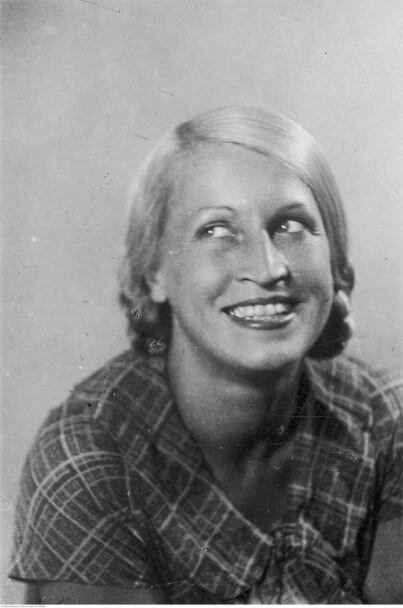
Hryniewicka (Hryniewiecka) Jadwiga, *20 June 1903 Nizhny Novgorod, †19 June 1988 Warsaw, Polish dancer, choreographer, teacher. Between 1920 and 1924, she trained at the S. and T. Wysocki School of Music in Warsaw, later at M. Wigman’s academy in Dresden and in Paris with Saunier (acrobatics). She made her debut as a dancer in 1921 with a recital at the Reduta Theatre in Warsaw. Until 1939, she performed dance recitals in Warsaw and other Polish cities. In 1933, she took part in the International Dance Competition in Warsaw and received an honorary certificate. Between 1934 and 1936, she was a soloist, choreographer and ballet teacher at the Grand Theatre. She created the choreography for the operas Iris (music by P. Mascagni), The Dybbuk (music by L. Rocca), The Pearl Fishers (music by G. Bizet) and Eros i Psyche (music by L. Różycki). She performed many solo dances, such as the dance of death (The Dybbuk) and the dance of Lilith (Walpurgis Night from Faust, music by Ch. Gounod). Between 1930 and 1939, she worked as a choreographer with operetta theatres in Kraków and Warsaw (e.g. The Vagabond King, music by R. Friml) and drama theatres (e.g. Widowisko rybałtowskie, music by R. Palester), and created dances for herself and for the pupils of her own school, which she ran from 1933 to 1939. She was one of Poland’s most outstanding representatives of free dance. She was known for her excellent body control, great expressiveness, her ability to convey a wide range of emotions, and her mastery of various dance styles. After the Second World War, she took up teaching and choreography in professional and amateur dance companies. As a dancer and choreographer, she specialised in Polish dances. Between 1945 and 1948, she was the ballet mistress of the Central Artistic Ensemble of the Polish Army (including Oberek, music by G. Bacewicz; Obertas, music by H. Wieniawski). In 1947, she founded and successfully led (until 1965) the Folk Dance Ensemble of the S. Harnam Cotton Industry Works in Łódź. For a time, she directed the amateur ensemble Starówka; between 1949 and 1951, she collaborated on the creation of the Mazowsze ensemble, and from 1952 to 1956 with the Skolimów ensemble (including the mazur from The Haunted Manor, music by S. Moniuszko; Suita tańców z XVI w. after Tabulatury Jana z Lublina). She was awarded the Knight’s Cross of the Order of Polonia Restituta and the Honorary Badge of the City of Łódź.
Literature: B. Mamontowicz-Łojek Terpsychora i lekkie muzy, Krakow 1972; I. Turska Almanach baletu polskiego 1945–74, Krakow 1984; T. Wysocka Dzieje baletu, Warsaw 1970.