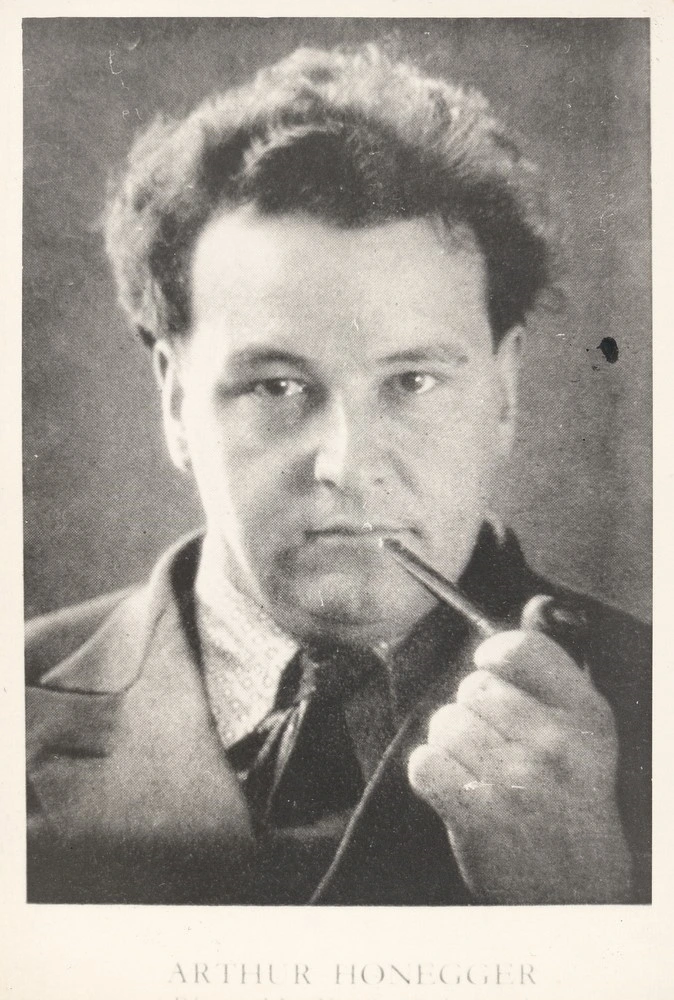
Honegger Arthur, *10 March 1892, Le Havre, †27 November 1955, Paris, Swiss composer. He came from a Protestant Swiss family living in France due to his father’s professional duties (representative of a coffee import company). Honegger did not receive a thorough musical education in his childhood, but he did attempt to compose on his own; his three trios for two violins and piano, written between 1903 and 1905, were performed among his family. It was not until 1905 that he began to study harmony with R.Ch. Martin, organist at St-Michel Church in Le Havre. From 1909 to 1911, he stayed in Zurich and studied at the local conservatory under F. Hegar; from 1911 to 1913 he continued his studies at the conservatory in Paris (commuting from Le Havre) under L. Capet (violin) and A. Gédalge (harmony, counterpoint, and fugue). From 1914 to 1915, he did his military service in Switzerland. In 1916, he returned to Paris to study with Ch. Widor (composition) and V. d’Indy (conducting). It was then that he encountered the aesthetic views of J. Cocteau and E. Satie. Together with D. Milhaud, F. Poulenc, G. Auric, L. Durey, and G. Tailleferre he formed the so called Les Six group. On 10 May 1926, he married pianist Andrée Vaurabourg; Honegger’s wife was the main performer of his piano works. In 1928, Honegger traveled to the USSR and the United States. In 1930, he and his wife embarked on a tour of Europe and both Americas, where he worked as a lecturer, conductor, and accompanist. During World War II, he taught composition at the Ecole Normale de Musique and worked as a music critic, publishing mainly in “Comoedia”. In 1947, he left for America on a concert tour; in New York, he fell ill with angina pectoris. In 1948, he returned to Europe. He stayed in German and Swiss health resorts. He composed until 1953 (Une cantate de Noël).
He was a member of the Institut de France (from 1938) and the Académie des Beaux-Arts, president of the Confédération Internationale des Sociétés d’Auteurs, Compositeurs et Editeurs de Musique, and vice-president of the Music Section of UNESCO. He was awarded the Legion of Honor. He received an honorary doctorate from the University of Zurich (1948).
Honegger drew inspiration and technical means from the European musical heritage and absorbed the ideas of contemporary artistic trends. His music combines stylistic features characteristic of contrasting creative poetics. During the same period, Honegger composed works with different aesthetic concepts, e.g. Pastorale d’été (1920), similar in style to Debussy, the oratorio Le roi David (1921), referring to Handel’s models, and the ballet-revue Les mariés de la Tour Eiffel (1921), typical for the Les Six group’s program. Honegger abandoned Debussy’s sound concept quite early on (it is represented only in some of his early works, including Six poèmes de G. Apollinaire for voice and piano), but he constantly returned to the models of the great classics and the program of the “Six”. Although by 1922 Honegger no longer felt he belonged to the Les Six (he expressed this view in “Courrier Musical” in 1922), we find in his later work a reflection of some of the ideas contained in J. Cocteau’s article Le coq et arlequin, widely regarded as the artistic manifesto of the group. “The role of art is to capture the spirit of the age,” said Cocteau in Le coq. Among the composers of the “Six” and their ideological leaders, there was a lively idea of reflecting contemporary events in art; they also postulated bringing art closer to the average audience by simplifying the means and demanded the abolition of the boundary between elite artistic music and entertainment. Honegger remained constantly open to the new phenomena of the civilization and culture of his time. Honegger’s legacy includes compositions that reflect the composer’s fascination with technological achievements (Pacific 231 from 1923, a piece containing the name of a locomotive in its title) and his interest in sports (Rugby, 1928), as well as works that appealed to the tastes of the average listener, whether because of their use of popular melodies (La construction d’une cité, 1937), their references to jazz (Prélude et blues, 1925), or their combination of music with visual effects (the outdoor performance Les mille et une nuits, 1937). Radio music written in the 1930s and film music from the 1920s–40s (including for documentaries) testify to Honegger’s desire to co-create works related to technically modern media and, at the same time, intended for a mass audience. The idea of accessibility in music never left Honegger, even when he was composing works in a genre considered to be so-called serious music. “My efforts – says the composer – have always been directed towards the ideal of writing music that is understandable by the great mass of listeners but sufficiently free of banality to interest music lovers” (I Am a Composer).
In Honegger’s opinion, the appeal of music should lie in its expressive melodic rhythm, in emphasizing the meaning contained in the lyrics, and in the plasticity of the work’s structure. Indeed, these assumptions of the composer are fully reflected in his work. A return to expressive melody was one of the demands of the Les Six group, which raised this issue in opposition to the post-impressionist tendency to elevate tone color above other structural elements. Melody appears in Honegger’s works in a wide variety of forms and textural arrangements. The composer often introduces quotations from original folk melodies, popular songs, and Gregorian chant (e.g., Trimazo – a children’s song from the Lorraine region in scenes 9 and 10 of Jeanne d’Arc, old Swiss songs L’Basel an mim Rhy and Basler Morgenstern in parts II and III of Symphony No. 4, French, English and German Christmas carols in the Christmas Cantata, the antiphon Aspiciens a longe in scene 8 of Jeanne d’Arc). Imitations of specific models also play a significant role in his music, such as the shepherd’s song (Cantique du berger David – No. 2 Le roi David) or the Baroque instrumental technique of sequencing melodic figures (e.g. Psalm – No. 3 in Le roi David). Honegger presents a great variety of melodic types in his music, among which two main modes of shaping can be distinguished: 1. in instrumental parts – melodic themes are not very elaborate, rather short, based on a distinctive, uncomplicated rhythmic model, most often containing a characteristic distribution of accents, 2. in the vocal parts – there is a melodious recitative and a syllabic treatment of the text, which is related to Honegger’s desire to convey the meaning of the literary layer of the work in an expressive manner.
Honegger uses the recitative type of melody most consistently in the musical tragedy Antigone; recitative permeates all the vocal parts here. In the introduction to the score, the composer explains that he introduced a type of melodic line for the voice in this work, the shape of which was determined by the word itself, and proposed a method of accentuation of words that was in opposition to consistent prosody and consisted of attacking the initial consonant of the word. Guided by the principle of textual comprehensibility, Honegger – in his great vocal-orchestral works – introduces spoken parts in addition to recitatives (e.g. the testo part in Le roi David, the part of Jeanne in Jeanne d’Arc); he also sometimes illustrates the content using such means as shouting, laughter, and imitation of animal voices (the oratorio Jeanne d’Arc contains such a great variety of vocal parts).
A characteristic feature of almost every work by Honegger is the multiplicity of themes or leitmotifs. The introduction of ever new melodic ideas replaces, as it were, the technique of transformation. The evolution of form takes place through the repetition of these ideas in different rhythmic variants, in different instrumental settings and in various textural arrangements. Rhythmic metamorphoses often consist of augmenting and diminishing the original sound structure. A two-, four-, or even eightfold reduction in the rhythmic values of a theme that is a melodic or melodic-harmonic structure (such as the leitmotifs in Antigone) changes its expression, dramatic and structural function (melodic structures are transformed into figurative and dynamic ones).
The instrumentation that contributes to the transformation of the sound of melodic themes is generally not characterized by the modernity of the means used. Older patterns dominate – romantic or classicizing instrumentation. Only occasionally – especially in vocal-instrumental works – is the performing ensemble enriched with newer instruments (e.g., Martenot waves in Jeanne d’Arc). The instrumentation has a significant impact on the plasticity of the form; by transforming the timbre of the melody, it marks successive sections of the course, as well as contributing to the polygenesis of the sound arrangement in the case of a simultaneous juxtaposition of instrumentally diverse sound planes.
A characteristic feature of Honegger’s compositional technique is the horizontal shaping of the sound structure. It contains clearly marked layers, differentiated in terms of melody, instrumentation, and tonality. It is common for two melodic lines to be conducted simultaneously, in the form of a system of equivalent themes (e.g. two different Christmas carols sung simultaneously in the Christmas Cantata, the simultaneous appearance of two themes in the third movement of Symphony No. 4), or a main theme and ostinato (e.g., a melodic-harmonic leitmotif against an ostinato background in scene 9 of Antigone). There is also a layering of many horizontal arrangements, whether modeled on typical polyphonic ones, taken from the Baroque (compare, for example, Symphonies Nos. 1, 2, and 4, the oratorio Le roi David, especially the Alleluia passages), or according to newer concepts assuming independence between the layers of the structure (e.g. the superimposition of four planes in scene 7 of Jeanne d’Arc: Jeanne’s spoken part, melodic motifs in Marguerite’s part separated by pauses, Catherine’s singing with the words: “De profundis clamavi” and the repetition of the words “Comburatur igne” performed by bass voices on a single note). Assigning each melodic layer to different vocal voices, instruments, or groups of instruments affects the plasticity of the sound arrangement.
The tonal plan also sometimes contributes to the stratification of the structure. Honegger juxtaposes tonal melodies (often quotations) with a harmonically distinct sound plane, which can be the diverse and ubiquitous ostinato structures (repeated notes, chords, or melorhythmic figures) found in the composer’s music. Honegger’s harmony is not homogeneous even within a single piece. The composer uses elements of the major-minor system (tertiary chord structure, distinct tonal centers), but also introduces modal scales and chords with varied interval content. Antigone is a composition that is exceptionally uniform in terms of the harmonic and melodic means used. Throughout the work, seconds, tritones, sevenths, and ninths predominate in vertical arrangements, and each scene is dominated by a specific melodic-harmonic model. Interval structuralism (consisting in the preference for selected intervals in horizontal and vertical terms), which dominates the entire form of Antigone, also occurs in other works, although fragmentarily and in combination with tonal means of shaping the sound.
The form of Honegger’s works, whose plasticity is achieved through the stratification of structures and the sequencing of successive, distinct components, shows similarities to traditional architectural models. However, the composer does not simply reproduce familiar patterns from the past, but creates hybrid forms that bear the characteristics of many old and new models. He composes works whose form cannot be defined by a single term, as it is a synthesis of means and techniques. For example, in Antigone, Honegger refers to Greek tragedy (the commentary role of the choir, the introduction of the chorus coryphaei) and musical drama (leitmotifs, types of solo parts), in Le roi David to oratorio and psalmic works, and in Judith to both opera and oratorio. In his symphonies, the composer combines newer harmonic sounds and “coloristic thematic work” with the concertante and polyphonic techniques known in the past, and uses a fast-slow-fast movement pattern.
The old and the new in Honegger’s work coexist and intertwine, and all the genetically diverse compositional techniques he uses most often serve the non-musical ideas contained in the lyrics or titles of his works. The expressive aspect of Honegger’s music, the pathos of many of his works, associated with the great themes taken up by the composer (historical and patriotic content), brings his work closer to the aesthetics of late Romanticism, while the harmony and melody, together with old compositional techniques, relate the composer’s works to the neoclassical trend. Honegger’s stylistically heterogeneous legacy is a testament to the composer’s artistic attitude, also expressed in many of his writings; it manifests a cult of musical past and vividly reflects the intellectual trends of the present day.
Literature: C. Gérard Arthur Honegger. Catalogue succinct des oeuvres, Brussels 1945; G.K. Spratt, M. Schumann Catalogue de oeuvres de Arthur Honegger, Geneva 1986; M.-F.-G. Delannoy Arthur Honneger, Paris 1947, revised ed. Paris 1953, 2nd ed., 1956, reprinted with M. Schumann’s introduction and a catalogue of G.K. Spratt’s works Geneva 1986; Arthur Honegger. Nachklang Schriften, Photos, Dokumente, ed. W. Reich, Zurich 1957; Arthur Honegger. Beruf und Handwerk des Komponisten. Ilusionslose Gespräche, Kritiken, Aufsätze, introduction E. Klemm, Leipzig 1980; Arthur Honegger. Lettres à ses parents: 1914–1922, introduction and comments H. Halbreich, Geneva 2005; Arthur Honegger. Lettres à Suzanne Charlotte Agassiz (1942–1954), introduction and comments L. Näf and P. Müller, Geneva 2010;
D. Milhaud The Evolution of Modern Music in Paris and in Vienna, “The North American Review” CCXVII no. 809 (April 1923), pp. 544–554; A. George Arthur Honegger, Paris 1925; A. G. Browne A Study of Arthur Honegger,“Music & Letters” X no. 4 (1929), pp. 372–399; W. Tappolet Arthur Honegger, Zurich 1933, revised ed. 1954; A. Hoérée Arthur Honegger. La vie, l’oeuvre, l’homme, Paris 1942; J. Bruyr Honegger et son oeuvre, Paris 1947; A. Gauthier Arthur Honegger, London 1957; M. Landowski Honegger, Paris 1957; V. Rašín ‘Les Six’ and Jean Cocteau, “Music & Letters” XXXVIII no. 2 (1957), pp. 164–169; Y. Guilbert Honneger, Paris 1959; J. Feschotte Arthur Honegger, l’homme et son oeuvre, Paris 1966; P. Meylan René Morax et Arthur Honegger au Théâtre du Jorat, Lausanne 1966, repr. Geneva 1993; L. Rappoport Arthur Onieggier, Leningrad 1967; A. Helman Legenda „Pacyfiku”, in: Na ścieżce dźwiękowej. O muzyce w filmie, Krakow 1968; P. Meylan Arthur Honegger – Humanitäre Botschaft der Musik, Frauenfeld 1970, 2nd French ed. titled Honegger, Lausanne 1990; S. Pawczinskij Simfoniczeskoje tworczestwo Arthura Onieggiera, Moscow 1972; J.H.O. Maillard, J. Nahoum Les symphonies d’Arthur Honegger, Paris 1974; E. Sysojewa Simfonii Arthura Onieggiera, Moscow 1975; D. Jasińska „Król Dawid” Arthura Honeggera, “Muzyka” 1979 no. 2; S. Jarociński Grupa „Sześciu” a Debussy, “Muzyka” 1979 no. 4; K. von Fischer Arthur Honegger, in: Essays in Musicology, trans. C. Skoggard, New York 1979, repr. 1989; G.K. Spratt The Music of Arthur Honegger, Cork 1987; E. Hurard-Viltard Le Groupe des Six, ou le matin d’un jour de fête, Paris 1988; S. Henry ‘Jeanne d’Arc au Bûcher’: A Collaboration Between Arthur Honegger and Paul Claudel, “The Choral Journal” XXXII, no. 8 (1992), pp. 7–14; J. Roy ‘Le roi David’ d’Arthur Honegger, series «Les dossiers du chant choral», Lyon 1992; H. Halbreich Arthur Honegger, Paris 1992, English ed. trans. R. Nichols, Cleckheaton (Yorkshire), Portland (Oregon) 1999; H. Calmel and P. Lécroart Jeanne d’Arc au bucher de Paul Claudel et Arthur Honegger, Paris 1993, 2nd revised ed. Geneva 2004; J. Roy Le groupe de Six, Paris 1994; H. Halbreich L’œuvre d’Arthur Honegger, Paris 1994, e-book 2010; J.F. Fulcher Musical Style, Meaning, and Politics in France on the Eve of the Second World War, “The Journal of Musicology” XIII no. 4, (1995) pp. 425-453; J. Rosteck ‘Évocation dramatique’ oder ‘Théâtre corrompu’? Das experimentelle Musiktheater der “Groupe des Six” als Versuch einer Orientierung zwischen Nationalismus und Avantgarde, “International Journal of Musicology” V (1996), pp. 147–205; H.E. HeadleyThe Choral Works of Arthur Honegger, Newport 1998; K. Waters Rhythmic and Contrapuntal Structures in the Music of Arthur Honegger, Burlington (Ontario) 2002, Abingdon-on-Thames 2019; Honegger, Milhaud: Musique et esthétique: actes du Colloque international Arthur Honegger, Darius Milhaud, Sorbonne 1992, ed. M. Kelkel, Paris 2002; C. Miller Jean Cocteau et les compositeurs du Groupe des Six: Amitiés et collaborations musico-littéraires, “Revue belge de Musicologie / Belgisch Tijdschrift voor Muziekwetenschapˮ LVII (2003), pp. 201–213; P. Lécroart Paul Claudel et la rénovation du drame musical. Étude de ses collaborations avec Darius Milhaud, Arthur Honegger, Paul Collaer, Germaine Tailleferre, Louise Vetch, Sprimont 2004; J. Tchamkerten Arthur Honegger ou l’inquiétude de l’espérance, Geneva 2005; J.F. Fulcher French Identity in Flux: The Triumph of Honegger’s ‘Antigone’, “The Journal of Interdisciplinary History” XXXVI no. 4 titled. “Opera and Society” (2006), pp. 649-674; R. S. Hines Arthur Honegger’s Three Versions of ‘King David’, “The Choral Journal” XLVI no, 8 (2006), pp. 32-39; U. Tadday Arthur Honegger, «Musik-Konzepte» 135, Munich 2007; Z. Kościów Arthur Honegger, Wołomin 2007; D. Ravet Arthur Honegger et Blaise Cendrars: une interprétation musicale des “Pâques à New York”, “Continent Cendrars” XIII (2008), pp. 106-122; Arthur Honegger: Werk und Rezeption = Arthur Honegger: l’œuvre et sa réception, ed. P. Jost, Bern 2009; Les Six: the French composers and their mentors, Jean Cocteau and Erik Satie, ed. R. Shapiro, London 2011, e-book 2023; L.A. Sprout Honegger’s Postwar Rehabilitation, in: Musical Legacy of Wartime France, Oakland (California) 2013, pp. 38–79; M. Melski Arthur Honegger wobec Jeana Cocteau i Grupy Sześciu, “Kwartalnik Młodych Muzykologów UJ” XXXV no. 4, pp. 91–109; P. Lécroart Arthur Honegger: Music Critic for Musique et Théâtre (1925–1926), in: Music Criticism in France, 1918–1939: Authority, Advocacy, Legacy, ed. B.L. Kelly, Ch. Moore Woodbridge 2018, pp. 151–168; H. Milewska Arthur Honegger – nieustannie początkujący, “Hi-Fi i muzyka” 2019 no. 2; J. Caps Arthur Honegger: “The Protestant Ethic”, in: Crisis Music: The Life-and-Times of Six Twentieth-Century Composers, Liverpool 2022, pp. 93–133; A. Corbellari Honegger, un architecte de la musique, Gollion (Lausanne) 2025.
Special edition: Bulletin de l’Association Arthur Honegger, 9 volumes, Paris 1994–2003.
Compositions
Instrumental:
orchestral:
Aglavaine et Sélysette, prelude for orchestra after Maeterlinck, 1917
Le chant de Nigamon after G. Aymard for orchestra, 1917
Danse macabre for orchestra, 1919
Horace victorieux, symphonie mimée for orchestra, 1920
Pastorale d’été for chamber orchestra, 1920
Marche funèbre for orchestra, 1921
Chant de joie for orchestra, 1923
La tempête, prelude for orchestra after Shakespeare, 1923
Pacific 231 (Mouvement symphonique no 1), 1923
Impératrice aux rochers, suite for orchestra after music to drama, 1925
La neige sur Rome, symphonic interlude, 1927
Rugby (Mouvement symphonique no 2), 1928
Symphony No. 1, 1930
Les noces d’Amour et de Psyche (based on motifs from Bach’s French and English suites) for orchestra, 1930
Prélude, arioso e fughette sur le nom de Bach for string orchestra, 1932
Mouvement symphonique no 3, 1933
Les misérables, an orchestral suite drawn from film music, 1934
Nocturne for orchestra, 1936
La construction d’une cité for orchestra, with D. Milhaud, 1937
Regain, suite for orchestra, 1937
Symphony No. II for strings and trumpet ad libitum 1941
Jour de fête suisse, suite for orchestra, 1943
La traversée des Andes, suite for orchestra, 1943
Le vol sur l’Atlantique, suite for orchestra, 1943
Sérénade à Angélique for small orchestra, 1945
Symphony No. III „Liturgique” for orchestra, 1946
Symphony No. IV „Deliciae Basilienses” for orchestra, 1946
Prélude, fugue et postlude for orchestra, based on the melodrama Amphion, 1948
Symphony No. V „Di tre re” for orchestra, 1950
Monopartita for orchestra, 1951
Suite archaïque for orchestra, 1951
Toccata for orchestra, 1952
for solo instrument/s and orchestra:
Entrée, nocturne et berceuse for piano and chamber orchestra, 1919
Concertino for piano and orchestra, 1924
Concerto for cello and orchestra, 1929
Concerto da camera for flute, English horn, and string orchestra, 1948
chamber:
String Quartet No. 1, 1917
Rhapsodie for two flutes, clarinet, and piano, 1917
Sonata No. 1 for violin and piano, 1918
Sonata No. 2 for violin and piano, 1919
Cadence for violin and piano after Le boeuf sur le toit, 1920
Hymne for 10 string instruments, 1920
Sonata for viola and piano, 1920
Sonata for cello and piano, 1920
Sonatina for 2 violins, 1920
3 contrepoints for piccolo, oboe or English horn, violin, and cello, 1922
Sonatina for clarinet and piano, 1922
Prélude et blues for 4 harps, 1925
Partita for 2 pianos, 1928
Sonatina for violin and cello, 1932
Petite suite, part I for saxophone and cello, part II for 2 flutes, part III for violin, clarinet, and piano, 1934
String quartet No. 2, 1936
String quartet No. 3, 1937
Partita for 2 pianos, 1940
for solo instrument:
3 pièces for piano, 1910: Scherzo, Humoresque, Adagio espressivo
Hommage à Ravel for piano, 1915
Toccata et variations for piano, 1916
Fugue et choral for organ, 1917
Danse de la chèvre for flute, 1919
Prélude et danse for piano, 1919
7 pièces brèves for piano, 1920
Sarabande for piano, 1920, published in: Album des Six
Le cahier romand for piano, 1923
Hommage à A. Roussel for piano, 1928
Prélude, arioso et fughette sur le nom de BACH for piano, 1932
Scenic Railway for piano, 1937, included in the album Parc d’attraction, together with works by other composers
Sonata for violin, 1940
2 esquisses for piano, 1941
Sortilèges for Ondes Martenot, 1946
Vocal-instrumental:
3 poèmes de P. Fort for voice and piano, 1916: 1. La chasseur en forêt, 2. Cloche du soir, 3. Chanson de fol
4 poèmes for voice and piano, text by A. Fontaines, J. Laforgue, F. Jammes, A. Tchobanian, 1916: 1. Sur le basalte, 2. Petite chapelle, 3. Prière, 4. La mort passe
6 poèmes de G. Apollinaire for voice and piano, 1917 (songs nos. 1, 3–6 also scored for voice and orchestra): 1. A la santé, 2. Clothilde, 3. Automne, 4. Les saltimbanques, 5. L’adieu, 6. Les cloches
Cantique de Pâques for three female voices, female choir, and orchestra, 1918
Pâques à New York for voice and string quartet, text by B. Cendrars, 1920
2 chants d’Ariel for voice and piano, text by W. Shakespeare, 1923
6 poésies de J. Cocteau for voice and piano, 1923: 1. Le nègre, 2. Locutions, 3. Souvenirs d’enfance, 4. Ex-voto, 5. Une danseuse, 6. Madame
Chanson de Fagus for voice and orchestra, 1923
Chansons de la „Petite sirène” d’Andersen for voice, flute and string quartet, text by R. Morax, 1924
Chansons de Ronsard for voice, flute and string quartet, 1924
3 chansons populaires for voice and orchestra, 1926
Cantique des cantiques for voice and orchestra, 1926
Vocalise-étude for voice and piano, text by W. Shakespeare, 1929
La danse des morts for voice, choir and orchestra, text by P. Claudel, 1938
3 poèmes de P. Claudel for voice and piano, 1940: 1. La sieste, 2. Le delphinium, 3. Le rendez-vous
3 psalms for voice and piano, 1941: XXXIV, CXI, CXXXVIII
6 mélodies-minute for voice and piano, 1941
Petit cours de morale for voice and piano, text by J. Giraudoux, 1941
Chant de libération for baritone, choir, and orchestra, text by B. Zimmer, 1942
6 villanelles. Saluste du Bartas for voice and piano, 1943
O Salutaris for voice and piano or organ, 1943
4 chansons pour voix grave for alto or bass and piano, text by A. Tchobanian, P. Verlaine, P. Ronsard, W. Aguet, 1945: 1. La douceur de tes yeux, 2. Un grand sommeil noir, 3. La terre, l’eau, l’air et le vent, 4. Chanson de marin
Mimaamaquim (Psalm CXXX) for contralto and piano, text in Hebrew, 1946
Une cantate de Noël for baritone, mixed choir, children’s choir, and orchestra, liturgical texts and carols, 1953
Stage:
Le roi David, dramatic psalm, libretto R. Morax, 1921, staged in Mézières 11 June 1921 (usually performed in a concert version)
Judith, biblical opera-oratorio, libretto R. Morax, 1925, staged in Monte Carlo 13 February 1926
Antigone, tragédie musicale, libretto J. Cocteau after Sophocles, 1927, staged in Brussels 28 December 1927
Amphion, ballet-melodrama, libretto P. Valéry, 1929, staged in Paris 23 June 1931
Les aventures du roi Pausole, operetta, libretto A. Willemetz after P. Louÿs, 1930, staged in Paris 19 December 1930
Cris du monde, oratorio, libretto R. Bizet, 1931, staged in Solothurn 3 May 1931
La belle de Moudon, operetta, libretto R. Morax, 1931, staged in Mézières 30 May 1931
Jeanne d’Arc au bûcher, stage oratorio, libretto P. Claudel, 1935, staged in Basel 12 May 1938
L’Aiglon, opera, with J. Ibert, libretto H. Cain after E. Rostand, 1935, staged in Monte Carlo 11 March 1937
Les mille et une nuits, outdoor performance, 1935, staged in Paris 9 July 1937
Les petites Cardinal, operetta, with J. Ibert, libretto A. Willemetz, 1937, staged in Paris 12 February 1938
Nicolas de Flue, scored for narrator, mixed choir, children’s choir, and orchestra as a dramatic legend, libretto D. de Rougemont, 1939, concert performance in Solothurn 26 October 1940, stage performance in Neuchâtel 31 May 1941
Charles le téméraire, opera, libretto R. Morax, 1944, staged in Mézières May 1944
radio music, music for 26 feature films, 4 documentaries, and 2 animated films
ballets:
Horace victorieux, libretto G. Fauconnet after Titus Livius, staged in Paris 1920, concert performances in Lausanne 30 October 1920
Vérité-mensonge, puppet ballet, libretto A. Hellé, staged in Paris 1920
Les mariés de la Tour Eiffel, with G. Aurik, D. Milhaud, F. Poulenk, G. Tailleferre, libretto J. Cocteau, 1921, staged in Paris 18 June 1921
Skating Rink, ballet, libretto R. Canudo, 1921, staged in Paris 20 January 1922
Sous-marine, libretto C. Ari, 1924, staged in Paris June 1925
Les roses de métal, libretto E. de Grammont, 1928, staged in Paris 1928
Semiramis, ballet-pantomime, libretto P. Valéry, 1931, staged in Paris 11 May 1934
Un oiseau blanc s’est envolé, libretto S. Guitry, 1937, staged in Paris 1937
La naissance de couleurs, libretto E. Klausz, R. Morax, 1940, staged in Paris 1949
Le mangeur de rêves, libretto H. Lenormand, 1941, staged in Paris 1941
L’appel de la montagne, libretto Favre le Bret, 1945, staged in Paris 9 July 1945
Szota Rustaweli/L’homme à la peau de léopard, with A. Czeriepnin and T. Harsányi, 1946, staged in Paris 14 May 1946
De la musique, libretto R. Wild, staged in Paris 1950
incidental music for the theatre:
Le dit des jeux du monde P. Méreal, 1918
La mort de Ste-Alméerne M. Jacob, 1918
La danse macabre C. Larronde, 1919
Antigone Sophocles, 1922
Fantasio A. Musset, 1922
Saul A. Gide, 1922
La tempête W. Shakespeare, 1923
Liluli R. Rolland, 1923
L’impératrice aux rochers S.G. de Bouhélier, 1925
Phoedre G. d’Annunzio, 1926
Marche sur la Bastille R. Rolland, 1936
Liberté M. Rostand, 1937
800 mètres A. Obey, 1941
L’ombre de la ravine J.M. Synge, 1941
La ligne d’horizon S. Roux, 1941
Les suppliantes Aeschylus, 1941
La Mandragora N. Machiavelli, 1942
Le soulier de satin P. Claudel, 1943
Sodome et Gomorrhe J. Giraudoux, 1943
Charles le téméraire R. Morax, 1944
Hamlet W. Shakespeare, 1944
Prométhée Aeschylus, 1946
L’état de siège A. Camus, 1948
Oedipe-roi Sophocles, 1948
Tête d’or P. Claudel, 1949
On ne badine pas avec l’amour A. Musset, 1951
Workings:
Incantation aux fossiles, Lausanne 1948
Je suis compositeur, Paris 1951, Polish ed. Jestem kompozytorem, trans. A. Porębowiczowa, afterword B. Pociej, Krakow 1985