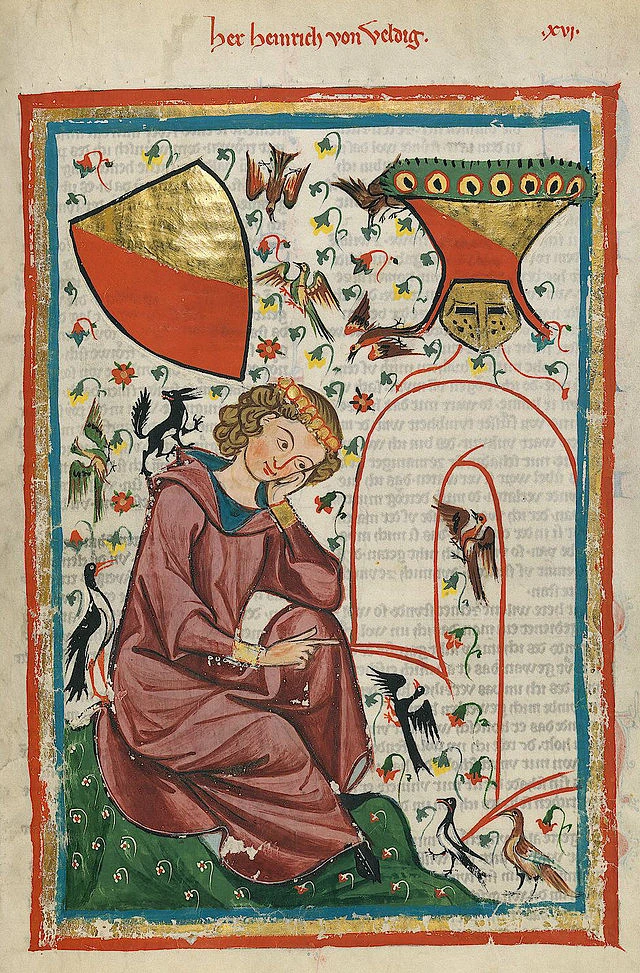
Hendrik van Veldeke, Heinrich, Heynrijck, Henric van Veldeken, *between 1140 and 1150 Maastricht, †before 1210, German poet of Dutch origin. Having received a thorough education, he held high positions in court circles. For a time, he served at the court of Hermann of Thuringia and probably took part in the festivities organised by Frederick Barbarossa at the court in Mainz in 1184. Apart from the epic poem Eneit (ca. 1180), which is essentially a translation of Virgil’s Aeneid into the dialect spoken in the Lower Rhine region (hence Hendrik is now regarded as the oldest Dutch poet), 61 works from his lyric oeuvre have survived (the authorship of some is disputed). Stylistically, these works belong to the early Minnesang tradition and also show Franco-Provençal influences. It is believed that some were performed as contrafacta to older melodies by troubadours such as Richard de Semilli, Pierre de Molins, Gace Brulé and Bertrand de Ventadorn. Hendrik’s poetic work had a significant influence on German literature, particularly lyric and epic poetry.
Literature: J. Smits van Waesberghe De melodieën van Henrik v. Veldekes liederen, Amsterdam 1957; U. Aarburg Melodien zum frühen deutschen Minnesang, in: Der deutsche Minnesang Aufsätze zu seiner Erforschung, ed. H. Fromm, Darmstadt 1961, 5th ed. 1972; G. Schieb Henric van Veldeken, Stuttgart 1965.
Des Minnesangs Frühling, ed. K. Lachmann, Leipzig 1857, 35th edition 1970 (texts)
Singweisen zur Liebeslyrik der deutschen Frühe, ed. U. Aarburg, Düsseldorf 1956