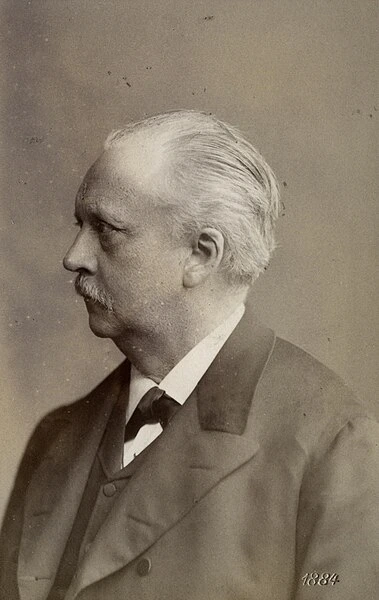
Helmholtz Hermann Ludwig Ferdinand von, *31 August 1821 Potsdam, †8 September 1894 Berlin, German physiologist and physicist. Between 1838 and 1842, he studied medicine (notably under the tutelage of the eminent German physiologist J. Müller) at the Friedrich-Wilhelm Institut in Berlin. During this time, he befriended several medical students, including E. du Bois-Reymond, E. Brück and K. Ludwig, who later, as renowned doctors and scientists, shared his views on physiology and psychology. In 1842, Helmholtz was awarded a doctorate for his thesis De fabrica systematis nervosi evertebratorum, in which he presented his anatomical discovery, namely that nerve fibres originate in the cells of the nerve ganglion. In 1843, as a doctor, he began military service in the Royal Guard regiment in Potsdam. During this time, he became interested in one of the fundamental problems of physics at the time, the principle of conservation of energy, and undertook research into the thermal phenomena arising during muscle activity; he formulated and proved the existence of the principle of conservation of energy. On 23 July 1847, he presented the results of his research to the Berliner Physikalische Gesellschaft and subsequently published them. In doing so, he introduced the extremely important concept of potential (‘Spannkraft’). This work is now regarded as one of the most significant scientific discoveries in the field of physics, but in the mid-19th century it attracted relatively little interest. It was not accepted for publication in scientific journals and was published in Berlin at his own expense.
In 1848, Helmholtz became a lecturer in anatomy at the Kunstakademie in Berlin, and in 1849 he was appointed associate professor of physiology at the University of Königsberg. During his six-year stay in Königsberg, Helmholtz’s scientific interests initially turned towards electrical and optical phenomena; he measured the speed at which electrical impulses travel along nerves. His next discovery was the establishment (1850) of the principle of electric current generation in an induction coil; at the same time, he constructed an ophthalmoscope, enabling ophthalmologists to view the interior of the eye by directing light reflected by a reflector with an aperture into the pupil. This invention brought Helmholtz fame and may have intensified his interest in sensory perception.
Between 1855 and 1858, Helmholtz was a full professor of anatomy and physiology at the University of Bonn. In this post, he faced criticism from medical students who complained that his lectures were too difficult. However, the stay in Bonn proved to be extremely fruitful for Helmholtz in scientific terms, particularly in the field of acoustics. He had first become interested in this field whilst still in Königsberg; at that time, however, his main focus was on the physics and principles governing the sense of hearing; Helmholtz viewed acoustics primarily as a sub-discipline of hydrodynamics. In Bonn, his interest in acoustics began to focus directly on problems that soon proved to be of vital importance for explaining fundamental musical phenomena. In 1856 and 1857, Helmholtz published works on combination tones, in which he demonstrated that, in addition to the previously discovered difference tones (‘Tartini tones’) the non-linear characteristics of a vibration transducer, such as the human ear, cause the formation of sum tones with frequencies equal to the sum of the frequencies of the component tones. He also proved the significant influence of higher harmonic tones on timbre. In 1857, Helmholtz also published a work of fundamental importance to music. Drawing on the harmonic structure of sound, the 36-year-old author explained in it the physical foundations of tonal harmony.
In 1858, Helmholtz took up the post of professor of physiology at the University of Heidelberg, where he remained until 1871. It was here that further fundamental works on musical acoustics began to appear; in 1859, as many as two: one on the physical determinants of the timbre of vowels and the other on air vibrations in pipes. Parallel to this, Helmholtz developed his interest in optics, resulting in the Handbuch der physiologischen Optik (3 vols., 1856–67). Furthermore, he published works on musical temperament, on Arabic-Persian scales and on the mode of vibration of violin strings, and in 1863 the book Die Lehre von den Tonempfindungen… was published summarising his work in the field of auditory physiology and musical acoustics, which remains to this day the most fundamental reading material at the intersection of music, physics and psychophysiology. In 1859, Helmholtz lost first his father and then his wife, who left behind two young children; his health deteriorated significantly. It was not until 1861 that he resumed his intensive scholarly activity; he published papers on hydro- and electrodynamics, and even geometry. In 1862, he took up the post of vice-chancellor at the University of Heidelberg, delivering an inaugural lecture on the relationship between the natural sciences and the entirety of human knowledge.
In 1870, he took up the post of professor of physics at the University of Berlin. A new phase began in Helmholtz’s life, one marked by great scientific achievements, though less closely linked to music; electrodynamics and thermodynamics once again became the main focus of his research. In 1877, he became rector of the University of Berlin; he delivered an inaugural lecture entitled On the Academic Freedom of German Universities, which is an extremely interesting record of his views. From 1888, he headed the newly established Physikalisch-Technische Reichsanstalt, conducting research into air movements, the detailed nature of electrical vibrations, the causes of electricity generation in the atmosphere, and the energy of ocean waves and winds. At that time, he devoted less time to issues of sensory physiology and acoustics, but later in life he wrote important works in this field: Telephonie und Klangfarbe (1878) and on the correct interpretation of sensory impressions (1894). On 12 July 1894, he suffered a stroke and, after two months in a semi-conscious state, died on 8 September of that year.
Scientific geniuses such as Helmholtz belong to a bygone era, when it was possible for a single individual to acquire comprehensive knowledge of a vast area of the natural world and contribute to the advancement of science. But in Helmholtz’s case, it was even more than that. We owe him not only fundamental scientific achievements in the fields of medicine, physiology and physics, but also for demonstrating how these fields influence the shaping of the world of art. Helmholtz was characterised by phenomenal scientific intuition and immense diligence.
Almost the entirety of Helmholtz’s work in the fields of auditory physiology, musical acoustics and musicology is set out in his seminal, comprehensive treatise entitled Die Lehre von den Tonempfindungen als physiologische Grundlage für die Theorie der Musik. The fourth edition (1877), the last published during the author’s lifetime, contained quite significant changes to certain chapters; in 1885, a second edition in English was published, featuring an excellent translation and numerous footnotes by A.J. Ellis.
Helmholtz’s most valuable contribution to our understanding of auditory perception is his hypothesis regarding the resonance analysis of sound in the inner ear. This hypothesis, which is now a well-documented theory, was presented in two slightly different versions in subsequent editions of Helmholtz’s book. In his initial version, the author attributed resonance properties to the pillar cells that form part of the structure known as the ‘tunnel of Corti’. In the final version, he presented the so-called ‘harp in the ear’ hypothesis, i.e. a set of resonantly tuned transverse hair cells in the basilar membrane of the cochlea. These hair cells vary in length by a ratio of 1:12 and, to some extent, resemble a stringed instrument. This hypothesis was harshly criticised, among other reasons, because the assumption of selective stimulation of hair cells would require the conclusion that each stimulated hair cell responds with a long resonant decay, which would contradict observation. The ‘harp in the ear’ hypothesis was superseded by Békésy’s theory of travelling waves, but Helmholtz’s general idea that tones of different frequencies stimulate the endings of different auditory nerves has been fully confirmed. Furthermore, recent studies show that the remarkably high selectivity of pitch perception is made possible by additional resonant stimulation of the stereocilia of the organ of Corti. This represents, to some extent, a return to the specifics of Helmholtz’s original concept.
Helmholtz’s next, immensely important discovery was the identification of the physical and physiological causes of the phenomenon of sensory dissonance. He demonstrated that the key factor here is the sensation of harshness caused by rapid beats between the component tones of consonant sounds. Using resonators in the form of hard spherical containers of various sizes, Helmholtz also demonstrated how the spectral structure of sound determines its timbre, and identified the spectral features that define the characteristic timbres of vowels. We owe to Helmholtz an explanation of how vibrations arise in the strings and pipes of musical instruments and — crucially — the demonstration that the foundations of tonal harmony are deeply rooted in the harmonic structure of sounds. The ordering of the frequencies of harmonic tones (overtones) into the ratios of the natural number series 1:2:3:4:5, etc., produces a series of inter-overtone intervals: the octave, fifth, fourth, major third, and so on. The first eight tones (with the exception of the seventh) form a spread-out major triad. This creates a situation in which triadic combinations are characterised by relatively low sensory dissonance; moreover, the initial intervals of the overtone series of individual sounds can, under certain conditions, be more easily detected by the ear than other intervals and more readily retained in human memory. As a result of these findings, Helmholtz was a strong advocate of a natural tuning system and regarded the tempering of scales as a ‘necessary evil’.
Despite the relatively long time that has elapsed since the publication of Helmholtz’s works, the vast majority of his discoveries remain fully relevant to this day and form the basis for current research at the intersection of science and musical art.
Literature: Popular Scientific Lectures by Hermann von Helmholtz, ed. and English translation by E. Atkinson, London 1903 (includes an autobiography); L. Koenigsberger Hermann von Helmholtz, 3 vols., Brunswick 1902/1903; E. du Bois-Reymond Gedächtnisrede auf Hermann von Helmholtz, in: Reden, vol. 2, Leipzig 2nd ed. 1912; A. v. Helmholtz Ein Lebensbild in Briefen, compiled by. E. von Siemens-Helmholtz, 2 vols., Berlin 1929; H. Ebert Hermann von Helmholtz, Stuttgart 1949; R.M. and R.R. Warren Helmholtz – On perception, Its Physiology and Development, New York 1968; C. Dahlhaus Hermann von Helmholtz und der Wissenschafischarakter der Musiktheorie, in: Über Musiktheorie, ed. F. Zaminer, Cologne 1970; R.M. Warren Helmholtz and His Continuing Influence, “Music Perception” 1984 No. 3.
Die Lehre von den Tonempfindungen als physiologische Grundlage für die Theorie der Musik, Brunswick 1863, 4th ed. 1877, revised 6th ed. 1913, reprinted in Darmstadt 1968, French edition titled Théorie physiologique de la musique fondée sur l’étude des sensations auditives, translated by G. Guéroult, Paris 1868, 2nd ed. 1874, English edition titled On the Sensations of Tone as a Physiological Basis for the Theory of Music, translated by A.J. Ellis, New York 1875, expanded 2nd ed. 1885, with foreword by H. Margenau 1954, 2nd ed. 1961
Über die Fortpflanzungegeschwindigkeit der Nervenreizung, “Berliner Monatsbericht” 21 January 1850
Über die Natur der menschlichen Sinnesempfindungen, habilitation lecture 28 June 1852
Über die Combinationstöne oder Tartinischen Töne, “Niederrheinische Sitzungsberichte” May 1856
Über die Combinationstöne, “Berliner Monatsbericht” 22 May 1857
Über die physikalische Ursache der Harmonie und Disharmonie, “Naturforscher-Versammlung” Karlsruhe August 1857
Über musikalische Temperatur, “Naturhistorischer Medizinischer Verein” Heidelberg 23 November 1860
On the Motion of the Strings of a Violin, “Proceedings of the Glasgow Philosophical Society” 19 December 1860
Die Mechanik der Gehörknöchelchen und des Trommelfells, “Pflügers Archiv für Physiologie” 1869
Telephonie und Klangfarbe, “Wiedemanns Annalen” May, 1878.