
Czardas aus der Oper: „Der Geist der Wojewoden” [partytura]

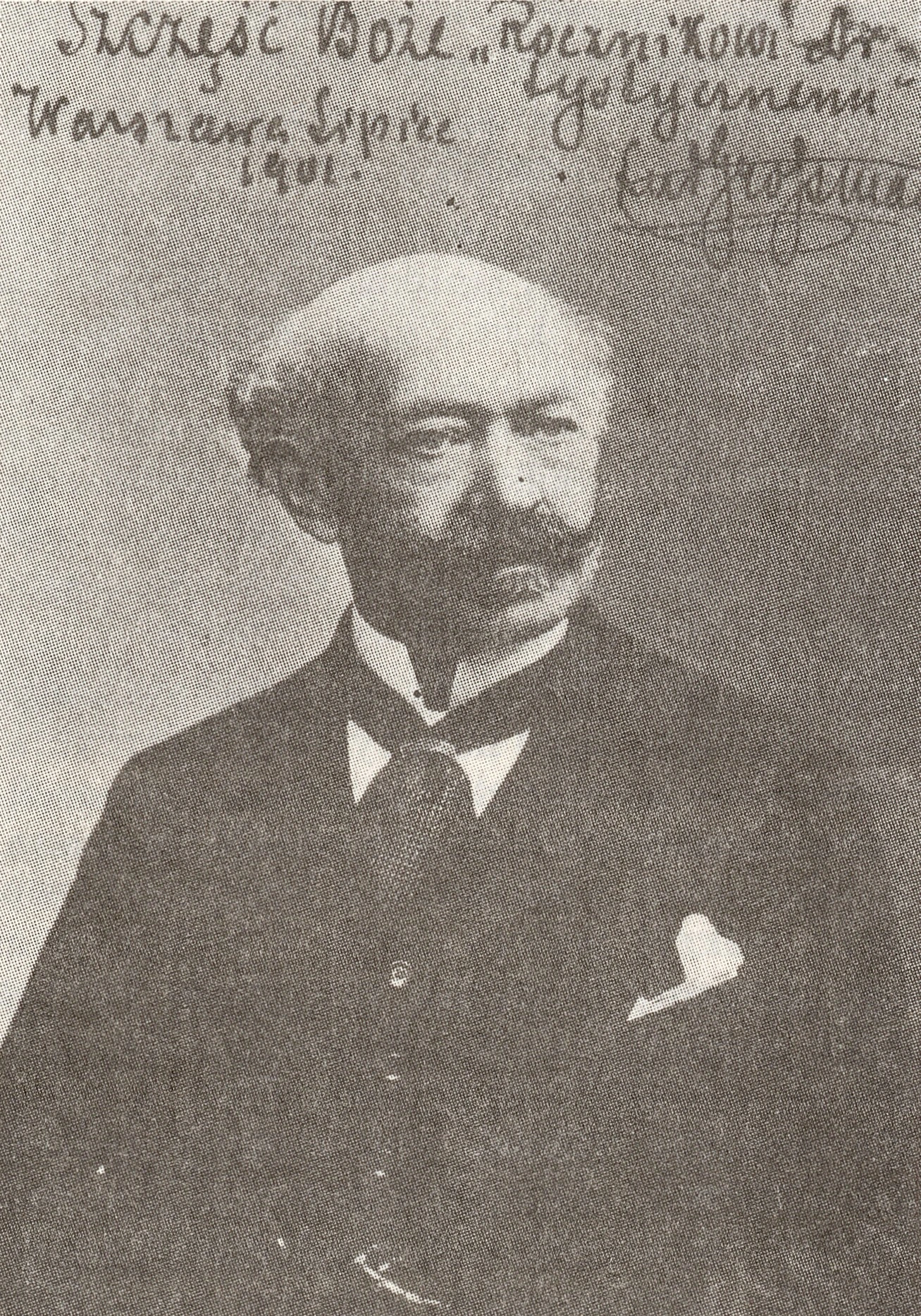
Grossman, Grossmann, Grosman, Ludwik, pseud. W. Horejszo, *6 March 1835 Turek (near Kalisz), †15 July 1915 Wiesbaden, Polish composer, organizer of musical life, conductor, pianist and organist.
He completed secondary school in Kalisz, where he also studied piano with J. Drobniewski and violin with W. Kopiński. He continued his musical studies in Warsaw with A. Freyer, and from 1854 spent three years in Berlin, where he studied composition under C. F. Rungenhagen and attended the university. After returning to Warsaw he appeared as pianist, organist and choral conductor, and also taught music at the Institute for Noblemen and privately. In 1857 he entered into partnership with Herman, owner of a warehouse for grand pianos, upright pianos, harmoniums and melodeons, dealing mainly with the artistic side of the enterprise. In 1866 he stayed in Paris, where he sought a performance of his opera Rybak z Palermo, which was positively assessed by G. Rossini. He returned to France again in 1895.
Grossman distinguished himself chiefly as an organizer of musical life in Warsaw, although his contemporaries regarded him primarily as a composer (particularly emphasizing his skillful and original instrumentation as well as the simplicity of his melodic invention). He was co-owner of the country’s largest commercial-musical enterprise, co-founder and in 1871–74 member of the committee of WTM, member of the first board of the Warsaw Philharmonic, and member of the Directorate of the Imperial Theatres; he collaborated with “Echo Muzyczne, Teatralne i Artystyczne”, financially supported the Warsaw Choral Society «Lutnia», for many years ran together with his wife an interesting musical salon, and maintained contacts with the musical world of Europe and the USA. He was also active as a conductor. He treated composition as secondary, despite the fact that his works were frequently performed and published abroad. The opera Duch wojewody was successfully staged in Vienna (1877), where it received a favorable review from E. Hanslick, as well as in Krakow (1877), Budapest, St. Petersburg (1877), Lviv (1878), Graz, Cieplice, Bern and Berlin (1884). During the ceremonies marking the opening of the Opening of the Suez Canal, a cantata specially commissioned from Grossman was performed, for which the composer received an order from the emir. Uwertura ukraińska “Maria” was included in the repertory of German orchestras. In Poland particular popularity was achieved by the march for male choir Raźno chłopcy and the instrumental czardas from the opera Duch wojewody.
Literature: [?] Uwertura do „Marii” Malczewskiego Ludwika Grossmana, “Ruch Muzyczny” 1859 no. 23; W. Wójcicki [review of Rybak w Palermo] “Kłosy” 1867 no. 88; review of Duch wojewody: J. Kleczyński “Tygodnik Ilustrowany” 1873 no. 307, W. Wiślicki “Kłosy” 1873 no. 436.