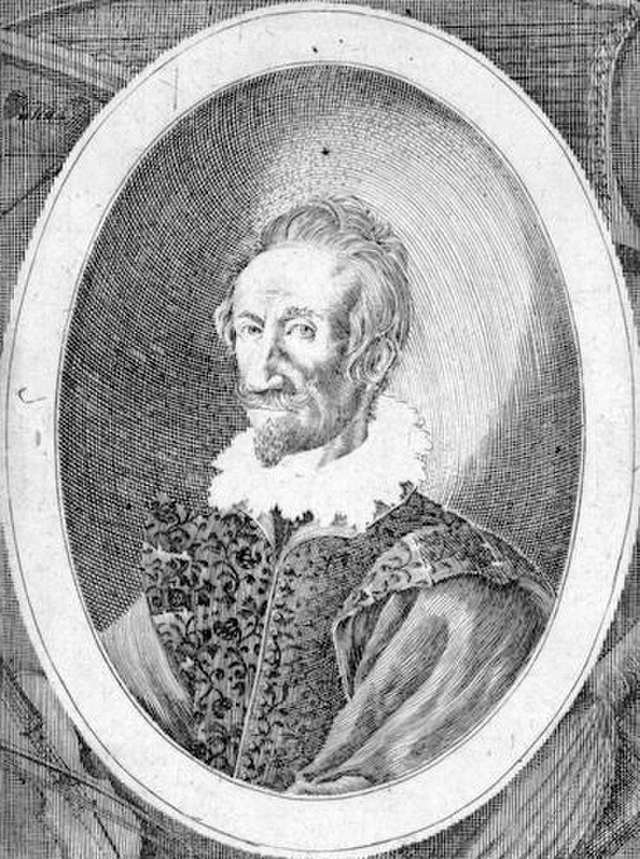
Goudimel, Godimel, Godymel, Jodimel, Jodrymel, Claude; *ca. 1514 Besançon, †between 28 and 31 August 1572 Lyon, French composer. From 1549 to 1551 he studied at the University of Paris; from 1551 to 1552 he worked as a proofreader for the publisher Nicolas du Chemin, and from 1552 to 1555 he was the publisher’s business partner. After 1557 he resided in Metz, which he left in 1567. In 1572 he was in Lyon, where he was murdered during the St. Bartholomew’s Day massacre. Goudimel maintained close contacts with numerous poets and writers, including Pierre de Ronsard, Louis de Masures, and S. Schede. He prepared for publication a collection of motets and a collection of chansons by various composers.
Goudimel belonged to that group of sixteenth-century composers who cultivated solid polyphonic craftsmanship while avoiding innovation, placing practical usefulness at the forefront of their works. He owed his popularity in France and elsewhere in sixteenth-century Europe chiefly to his psalm settings; his other compositions did not achieve comparable success. Goudimel produced three settings of the Psalms in the form of polyphonic songs and motets, based on melodies drawn from the Huguenot Psalter. The first version (67 psalms, the Ten Commandments, and the Canticle of Simeon) is written in a motet style. These are large-scale compositions divided, in accordance with the structure of the text, into several (five or six) sections. In them the composer employed all the polyphonic devices known at the time. The second version (150 psalms and other prayers), technically somewhat simpler, consists of ornate contrapuntal settings of melodies placed either in the tenor or the highest voice. The third version (also complete), the best known, is written predominantly in note-against-note texture, with the melody in the tenor (only very rarely in the highest voice). This final and simplest version, intended for domestic use, became widely adopted throughout Europe as the standard repertory of the Reformed Church.
The number of works in the latter two versions does not correspond exactly to the number of psalms. On the one hand, the Huguenot Psalter prescribed the same melodies for different texts; on the other, the composer set some melodies more than once using the same technique. Precise study of the issue is hindered by the fact that, of the 83 psalms published in 1562, only the bass partbook survives. Goudimel’s psalms were frequently reprinted (not only with French texts) and paraphrased by other composers. They are written mainly in three- and four-part textures, though scorings for larger ensembles also occur. A characteristic feature of Goudimel’s masses is their technical simplicity and strict observance of the rules of counterpoint. They possess a clear texture, usually in four voices, though many passages are written in three voices. The style of these compositions does not differ markedly from that of contemporary French composers. Goudimel’s chansons are likewise ascetic in character; here, however, the composer paid greater attention than in his sacred works to the meaning of the text, attempting to express it through musical means.
Literature: G. Becker Goduimel et son oeuvre, notice biographique et critique, “Bulletin de la Société d’histoire du protestantisme français” XXXIV, 1885; M. Brenet Claude Goudimel, “Annales Franc-Comtoises” 1898 no. 3; F. Lesure Claude Goudimel, étudiant, correcteur et éditeur parisien, “Musica Disciplina” II, 1948; E. Trillat Claude Goudimel, le Psautier huguenot et la Saint-Barthélémy lyonnaise, Lyon 1949; P.-A. Gaillard Bourgeois et Goudimel, “Schweizerische Musikzeitung” XC, 1950; U. Teuber Claude Goudimel als Psalmkomponist, “Dansk kirkesangs årsskrift”, 1953; P. Gaillard Zum Werkverzeichnis Claude Goudimel, “Jahrbuch für Liturgik und Hymnologie” I, 1955; P. Pidoux Notes sur quelques éditions des pseaumes de Claude Goudimel, “Revue de Musicologie” XLII, 1958; P. Pidoux Le psautier huguenot du XVIe siècle, 2 vols., Basel 1962; R. Häusler Satztechnik und Form in Claude Goudimels lateinischen Werken, Berno 1968; F. Lesure Deux „nouveaux” recueils de psaumes en forme de motets de Claude Goudimel, “Revue de Musicologie” LIV, 1968; D. Gutknecht Vergleichende Betrachtung des Goudimel-Psalters mit dem Lobwasser—Psalter, “Jahrbuch für Liturgik und Hymnologie” XV, 1970; J. Kłobukowska Msze francuskie w repertuarze kapeli roranckiej, “Muzyka” 1971 no. 3; F. Lesure Musique et musiciens français du XVIe siècle, Geneva 1976.
Compositions (published in Paris by Le Roy & Ballard, unless stated otherwise):
psalms:
Premier livre, contenant huyct pseaulmes de David, traduictz par Clement Marot, et mis en musique au long (en forme de mottetz)… plus les commandements de Dieu…, 9 works for 3–5 voices, 1551 N. du Chemin, expanded under the title Premier livre de psalmes de David, avec les commandemens de Dieu, mis en musique au long ( en forme de motetz)… Nouvellement (…) reveu, corrigé, et augmenté du psalme, Quand Israel, 10 works, 1557, 1558 and 1565, Book 2 — 8 works for 4–6 voices, 1559 and 1566, Book 3 — 8 works for 4 and 5 voices, 1557, 1561 and 1566, Book 4 — 9 works for 4 and 5 voices, 1560 and 1565, Book 5 — 10 works for 4 and 5 voices, 1562, Book 6 — 8 works for 4 voices, 1565, Book 7 — 8 works for 4 voices, 1566, Book 8 — 8 works for 4 voices, 1566
Pseaumes de David traduictz par Clement Marot, et Théodore de Besze, nouvellement mis en musique…, 83 psalms, the Ten Commandments, the Canticle of Simeon, prayers before and after meals, for 4 voices, note-against-note (?), 1562
Les cent cinquante pseaumes de David, nouvellement mis en musique…, also containing the Ten Commandments, the Canticle of Simeon, prayers before and after meals, for 4 voices (some note-against-note, differing from the 1562 edition, others florid), 1564 and 1565, under the title Les psaumes mis en rime française, par Clement Marot et Théodore de Beze. Mis en musique…, Lyon–Geneva 1565, the heirs of F. Jaqui, and Delft 1602, B. H. Schinckel
Les cent cinquante pseaumes de David, nouvellement mis en musique…, also containing the Ten Commandments and the Canticle of Simeon, for 4 voices (ornamental counterpoint, 18 works identical with the editions of 1564 and 1565 under the same title), 1568 and Geneva 1580, P. de Saint-André
Les pseaumes de David (…) revus de nouveau sur le texte des derniers exemplaires imprimez à Paris, et acomodez maintenant…, Geneva 1667 and 1668 J. Ant. & Samuel de Tournes and Niort 1669 Ph. Bureau
furthermore, in collective prints:
two from 1555 by S. du Bose & G. Guéroult (one containing 6 psalms later published in Books 2 and 3, the other 2 works for 4 voices), and one from 1597 by J. Commelin (1 work for 6 voices)
5 masses for 4 voices:
Missa (…) ad imitationem cantionis Il ne se treuve en amitié, 1552 N. du Chemin
Missa Le bien que i ay, in: Missae tres a Claudio de Sermisy, Jeanne Mailard, Claude Goudimel …, 1558
Missa Audi filia, Missa Tant plus ie metz and Missa De mes ennuis, in: Missae tres (…) ad imitationem modulorum…, 1558, two of the above-mentioned masses: Missa Audi filia and Missa Tant plus ie metz (titled Missa de Sanctis Martyribus) are also preserved in manuscripts in the Cathedral Chapter Archives at Wawel Cathedral, shelfmark Kk I.7 (formerly in the Municipal and Provincial Archives of Kraków, shelfmark D 32–35)
Magnificat and 12 motets in collective prints, Paris 1551–65
approx. 70 chansons, mainly for 4 voices (also 3 and 5 voices), in collective prints, 1549–83
Editions:
Claude Goudimel. Oeuvres complètes, vol. 1 ed. H. Gagnebin, vol. 2 ed. E. Ławry, vol. 3 ed. H. Gagnebin and L. A. Dittmer, vols. 9 and 10 ed. P. Pidoux, vol. 11, ed. R. Häusler, Brooklyn, vols. 1, 2, 9, — 1967, vols. 3, 10, 11 — 1969; 150 psalms after the 1580 ed., ExpMaîtres II, IV, VI, Paris 1894–97
150 psalms in: Les pseaumes mis en musique à 4 parties par Claude Goudimel (1565), facsimile ed. P. Pidoux and K. Ameln, Kassel 1935
3 masses, ExpMon IX, Paris 1928
1 motet and Salve Regina, «Trésor musical. Musique religieuse» III, ed. R. I. van Maldeghem, Brussels 1867
1 chanson in: Ronsard et la musique de son temps, ed. J. Tiersot, Paris 1901;
2 chansons in: La fleur des musiciens de Pierre de Ronsard, ed. H. Expert, Paris 1923
1 chanson in: 15 chansons françaises du XVIe siècle, ed. M. Gauchie, Paris 1926
2 chansons in: Anthologie de la chanson parisienne au XVIe siècle, eds. F. Lesure and L. Levy, Monaco 1953
4 motets Chw CII, ed. R. Häusler, Wolfenbüttel 1970