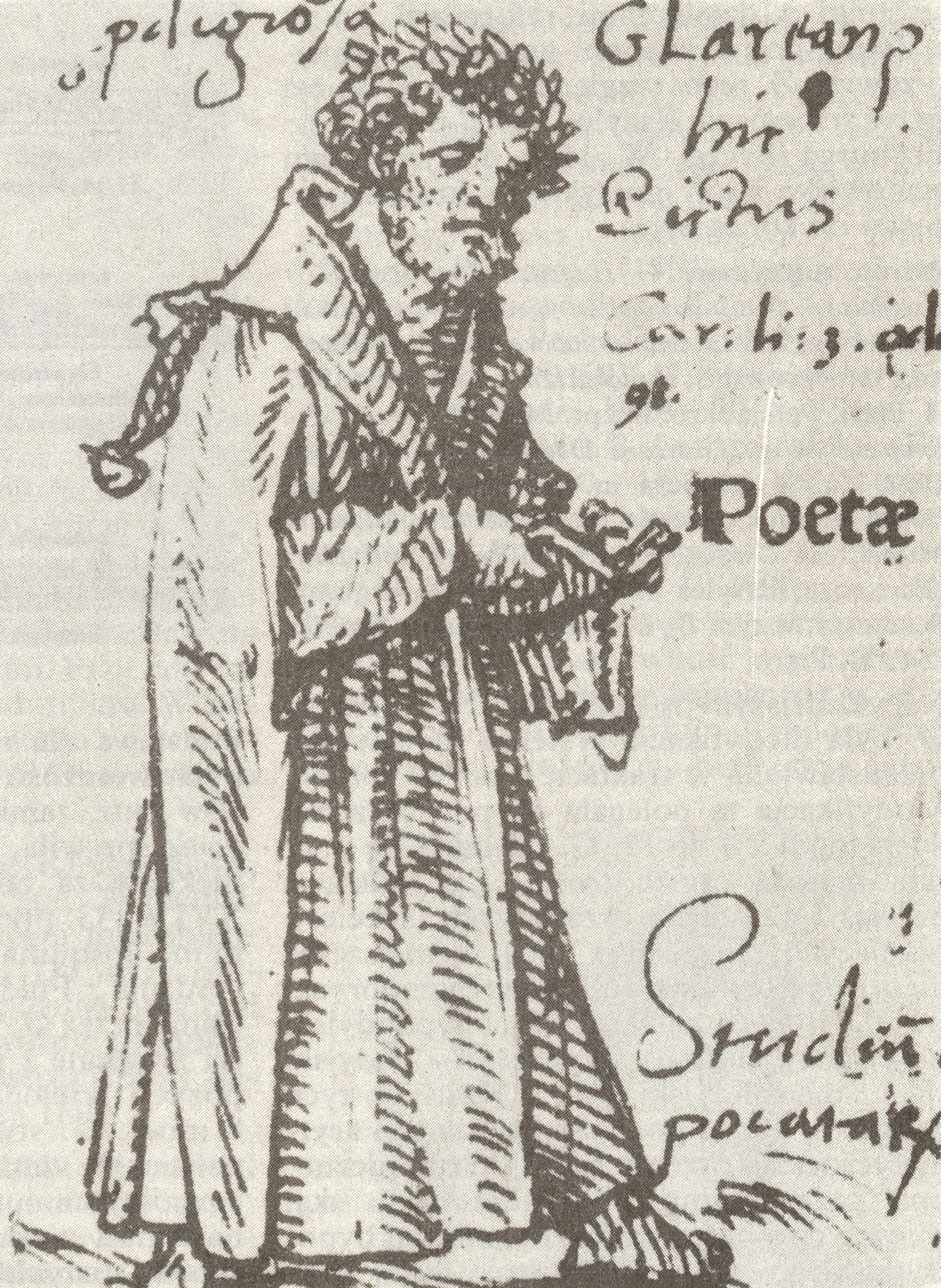
Glarean Heinrich, Glareanus Heinrich, born H. Loriti, *June 1488 in Mellis (in the canton of Glarus, Switzerland), †28 March 1563 in Freiburg im Breisgau, Swiss humanist, poet, philologist, geographer, mathematician, and musician.
He came from a wealthy peasant family. After 1497, he studied in Bern, and from 1501 in Rottweil under Michael Rubellus. On 5 June 1506, he began his studies at the University of Cologne. One of his teachers was the German theorist, Johannes Cochlaeus. In 1510, Glareanu obtained a Master of Arts degree. From 1511, he used the pseudonym Glareanus (from his place of birth). On 25 July 1513, he received the title of poeta laureatus from Emperor Maximilian I and he composed a laudatory song in the emperor’s honor to mark the occasion. In 1514, he began lecturing at the University of Basel, where he also organized a scholarship for students. In Basel, he established personal contact with Erasmus of Rotterdam. In 1515, he received a scholarship from the Duke of Milan and left for Pavia to lecture at the local university; however, he soon returned to Basel. In May 1517, he received a scholarship from King Francis I of France and left for Paris. There, he ran a scholarship for students, but did not lecture at the university; in Paris, he established contact with many scholars, including Jacques Lefèvre d’Etaples. In 1522, he returned to Basel, where he again established a bursary and lectured at the university. In 1524, he was appointed to the council of the faculty of artium, and in 1526 he became dean of that faculty. In Basel, Glarean established personal contact with Jan Łaski, an outstanding activist of the Polish Reformation, to whom he dedicated his geographical work De geographia liber unus (Basel 1527). Between 1528 and 1532, he maintained correspondence with Łaski; in a letter to Łaski dated 6 November 1529, he presented the concept of the Dodecachordon. Around 1526, Glarean broke off his relations with the activists of the Reformation (including Zwingli), with whom he had previously sympathized. For this reason, he left Basel, which had been taken over by the Reformation, and in 1527 went to Freiburg im Breisgau. In 1529, he was appointed professor of poetics there, a position he held until the end of his life.
Glareans’ most important theoretical achievement was the modification of the modal system, presented in his treatise Dodecachordon. This modification consisted in increasing the number of modes from 8 to 12; Glarean used a purely theoretical method to do this. He based his system on seven octave species, differing in the arrangement of whole tones and semitones: hypodorian (A–A), hypophrygian (B–B), hypolydian (C–C), Dorian (D–D), phrygian (E–E), lydian (F–F), and mixolydian (G–G). Each of these species was divided arithmetically (by a fourth) and harmonically (by a fifth). After rejecting the scales resulting from the harmonic division of the hypophrygian mode (B–F–B = hypereolian) and the arithmetic division of the Lydian mode (F–B–F = hyperphrygian) Glarean obtained 12 scales, 8 of which corresponded to the old church scales, while the remaining 4 – Ionian and Aeolian with their plagal forms – formed new scales.
Glareans’ theoretical considerations were based on compositional work. The abundance of musical examples included in Dodecachordon meant that this treatise was sometimes considered an anthology of works from the first half of the 16th century. Glarean quoted fragments of works by Josquin des Prés, Senfl, Isaac, and Adam of Fulda, among others. The impetus for Glarean to formulate his theory of the 12 modes was the difficulty of assigning polyphonic compositions to specific 8 modes. Glarean stated that in his time, the modus ionicus (“omnium modorum usitatissimus”) was the most widely used, while the modus lydius and hypolydius were falling out of use or transitioning into the modus ionicus and hypoionicus. He also noted that modes have the ability to interpenetrate, e.g., Phrygian with Aeolian, Lydian with Ionian, Mixolydian with Hypomixolydian. He also drew attention to the expressive character of individual modes and their use in choral music.
Glarean devoted the last two chapters of Book 2 of Dodecachordon to considerations on the superiority of monophonic music over polyphonic music. There, he introduced, among other things, a distinction between the creator of a melody (phonascus) and the musician who arranges that melody for multiple voices (symphoneta), with the former being rated much higher. At the end of the same book, he included his own compositions to texts by Horace and Prudentius, among others. These are works in the style of the so-called Horatian ode (German Odenkompositionen), which was widespread in the 16th century, especially in Germany. A characteristic feature of the Horatian ode is its rhythmic structure, resulting from the meter of the poetic text. Unlike most compositions of this type, which are usually four-voice, Glarean’s works are monophonic.
Glareans’ earlier treatise, Isagoge in musicen, which is didactic in nature, is based largely on the views of Boethius. In ten chapters, the author discussed, among other things, the definition of music, the problems of musicae fictae, intervals, the theory of consonance and dissonance; he devoted a lot of space to tonal problems, analyzing in detail the Greek scales in the form transmitted by Boethius and Ptolemy, as well as the church scales.
Glareans’ theoretical views gained wide publicity during his lifetime. In Hungary, they were disseminated by Janos Honterus, who studied in Basel and became acquainted with Glarean there. However, the theory of 12 modi did not meet with universal acceptance. Most elementary textbooks from the second half of the 16th century and even the first half of the 17th century were based on the old system of 8 modes.
Literature: L. Geiger Renaissance und Humanismus in Italien und Deutschland, Berlin 1882; O.F. Fritzsche Glarean. Sein Leben und seine Schriften, Frauenfeld 1890; A. Schering Die Notenbeispielen in Glarean’s Dodekachordon (1547), “Sammelbände der Internationalen Musikgesellschaft” XIII, 1911/12; H. Riemann Geschichte der Musiktheorie, Berlin 2nd ed. 1920; W. Kahl Studien zur Musikgeschichte des 16. und 17. Jahrhunderts, «Beiträge zur rheinische Musikgeschichte» III, Cologne 1953; B. Meier Glarean’s Isagoge in musicen (1516), in the congress proceedings Wien Mozartjahr 1956, Vienna 1958; F.B. Turell Modulation. A Study of Its Pre-History from Aristoxenus to H. Glarean, thesis, University of Southern California 1956; Ch. Pietzsch Glarean’s lateinische Textparodie zum „Ach hülft mich leid” des Adam von Fulda, “Die Musikforschung” XI, 1959; F.B. Turell The „Isagoge in musicen” of H. Glarean, “Journal of Music Theory” III, 1959 (includes the English translation of the treatise); B. Meier H. Loriti Glarean als Musiktheoretiker, «Aufsätze zur Freiburger Wissenschaft- und Universitätsgeschichte» XXII, Freiburg im Breisgau 1960; W. Voisé „Dodecachordon” d’H. Glarean d’après sa correspondance avec J. Laski, The Book of the First International Musicological Congress, devoted to the Works of F. Chopin 16th–22nd February, ed. Z. Lissa, Warsaw 1960; C.A. Miller The „Dodecachordon”. Its Origins and Influence on Renaissance Musical Thougt, “Musica Disciplina” XV, 1961; J. M. Chomiński Historia harmonii i kontrapunktu, vol. 2, Krakow 1962; W. Fuchss Musik und Erziehung als Mittler zwischen Ungarn und der Schweiz, “Studia Musicologica” X, 1968; E. Lichtenhahn „Ars perfecta”. Zu Glarean’s Auffassung der Musikgeschichte, celebratory publication for A. Geering, Bern 1972; E. Witkowska-Zaremba Toni i modi w teorii musicae planae I poł. XVI wieku, “Muzyka” 1983 no. 1; F-D. Sauerborn Glarean und sein Schüler Homer Herpol, “Freiburger Universitätsblätter” 28, 1989; S. Gissel Die modi phrygius, hypophrygius und phrygius connexus, “Musica Disciplina” 45, 1991; A. Horz Mehrstimmig oder einstimmig? Heinrich Glarean und der humanistische Odengesang im 16. Jahrhundert, in: Einstimmig – Mehrstimmig, ed. W. Seidel, “Musiktheorie” XXVII/2, 2012; I.M. Groote Aktuelle Forschungsperspektiven zu Heinrich Glarean, “Die Tonkunst: Magazin für klassische Musik und Musikwissenschaft” 7(3), 2013; B. Kölbl Zwischen lectio und recreatio: Das deutsche Lied als Exemplum in Heinrich Glareans Musikunterricht, in: “Senfl-Studien. II. Wiener Forum für ältere Musikgeschichte” 7, Tutzing, 2013; Ch. Berger Heinrich Glarean und der äolische Modus seiner Zeit, “Hamburger Jahrbuch für Musikwissenschaft” 29, 2013; I.M. Groote Musikalische Poetik nach Melanchthon und Glarean: Zur Genese eines Interpretationsmodells, “Archiv für Musikwissenschaft” 70 (3), 2013; D. Mertens Glarean und Erasmus in Freiburg, “Freiburger Universitätsblätter” 53 (203), 2014; Ch. Berger Glareans Bild der Musikgeschichte, “Freiburger Universitätsblätter” 53 (203), 2014; M. Haas Argumentieren mit „Musik”: Farabi und Glarean – Fallbeispiele zum musikbezogenen Kommunizieren, in: Communication music: Festschrift für Ernst Lichtenhahn zum 80. Geburtstag/Festschrift for Ernst Lichtenhahn’s 80th birthday, Bern 2015; A. Horz Heinrich Glarean’s Dodekachordon: The textual references of the music treaty, “Wiener Forum für ältere Musikgeschichte”, Tutzing 2017.
Texts on music:
Isagoge in musicen (…) e quibusque bonis authoribus latinis et graecis ad studiosorum utilitate multo labore elaborata, Basel 1516 Frobenius
Dodekachordon, Basel 1547 H. Petri; shortened version titled Musicae epitome sive compendium ex Glareani Dodecachordo, Basel 1557 and 1559 H. Petri, German translation Uss Glareani Musick ein Usszug, mit Verwilligung und Hilff Glareani…, Basel 1557 H. Petri
Edition of Boethius’ works, including De institutione musica, Basel, 1546, H. Petri
Critical editions and translation:
Glareani Dodecachordon, translation and ed. P. Bohn, «Publikationen älterer praktischer und theoretischer Musikwerke der Gesellschaft für Musikforschung» XVI–XVIII, 1888–90
The Dodecachordon of H. Glarean, 2 vols., Latin text and English translation C.A. Miller, «Musicological Studies and Documents» VI, American Institute of Musicology, 1965
Dodekachordon, facs. ed. from 1547, «Monuments of Music and Music Literature in Facsimile» II, 65, New York 1967, repr. Hildesheim 1969