
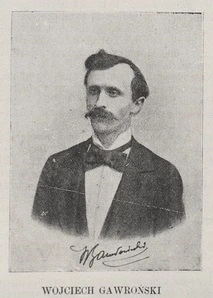
Laureaci Konkursu Muzycznego I. J. Paderewskiego

Gawroński Wojciech, Rola-Gawroński, *28 March (not 27 April) 1868 Sejmany (near Vilnius), †5 August 1910 Kowanówko (near Poznań), Polish pianist and composer. He attended schools in Vilnius, Simferopol, and Warsaw. He began his musical education with his father. He gave his first concert at the age of 11 in Simferopol, performing works by Chopin. He studied at the Music Institute in Warsaw with R. Strobl (piano), G. Roguski (music theory), and Z. Noskowski (composition), receiving his diploma in 1891. He was also a private student of A. Münchheimer, and for some time of M. Moszkowski in Berlin. Having moved to Kaunas, he gave music lessons and then for a year (until June 1894) was conductor of the orchestra and choir of the cathedral in Vilnius. Around 1895 he stayed in Vienna, where he continued his piano studies with T. Leschetizky (?). At the end of 1895 he took over the directorship of a music school he founded in Oryol, where he also led the activities of the Music Society. During this period, he gave many concerts, especially in Poland and Russia; in Warsaw he appeared in composers’ concerts, including at the Warsaw Music Society (1902, 1906) and at the Philharmonic (1903). In 1902 he settled in Warsaw and devoted himself to composition and teaching; at the same time, he commuted to Łódź, where he taught piano at a music school. For his compositions Gawroński received several prizes in national and international competitions: in 1896 first prize in Warsaw for the song Pamiętaj o mnie Op. 1 No. 3; in 1898 first prize for the String Quartet in F major Op. 16 at the Paderewski International Competition in Leipzig and a first distinction at the Prince Lubomirski Competition in Warsaw for Variations Op. 9 No. 2 for piano; in 1903 at the same competition two first distinctions for piano works: Ballade Op. 10 No. 1 and Legend Op. 13 No. 2; also in 1903 his String Quartet in F minor Op. 17 was awarded at a competition in Moscow. Gawroński also took part in a competition (1903) for an opera based on Maria by Malczewski. The composer died in Kowanówko and was buried in Oborniki near Poznań.
Gawroński was regarded as a good performer of Bach and Chopin; he also frequently played Schumann and Liszt. S. Przybyszewski collaborated with him while preparing a series of lectures entitled Chopin and the Nation at the Warsaw Philharmonic (1904). Gawroński’s compositions were generally published by Gebethner i Wolff, partly at the composer’s own expense; a few appeared as supplements to “Echo Muzyczne, Teatralne i Artystyczne” and “Nowości Muzyczne”, while many have been lost or remain in manuscript. During his lifetime, his songs, piano miniatures, and string quartets gained popularity. J. Kleczyński and M. M. Biernacki evaluated Gawroński’s works favorably, while at the same time criticizing his incomplete mastery of musical form. Today, his output is considered to have mainly historical significance.
Literature: I. Chabielski Wojciech Gawroński. Sylwetka artysty, “Scena i Sztuka” 1910 no. 34; S. M. Stoiński Wojciech Rola-Gawroński (w 25-tą rocznicę śmierci), “Śpiewak” 1935 no. 7/8 (contains the list of compositions).
Instrumental:
Symphony Op. 21 (lost)
Serenade Op. 15 No. 2 for violin and piano
String Quartet in F major, Op. 16
String Quartet in F minor, Op. 17
String Quartet in D major Op. 19
Sonata Op. 22 for viola and piano, Krakow 1953
String Quartet in A major Op. 23
Scène de ballet Op. 24 No. 1 for cello and piano
Pieśń miłości, Op. 24 No. 3 for violin and piano
Pieśń poranna Op. 24 No. 4 for violin and piano
Pieśń wieczorna Op. 25 No. 1 for violin and piano
Fantaisie polonaise Op. 25 No. 4 for violin and piano
Sonata Op. 27 for violin and piano
approx. 30 piano works, including:
Berceuse Op. 2 No. 5
Nad morzem, ballade Op. 9 No. 1
Caprice à la Mazourka Op. 10 No. 2
Variations Op. 12
Impromptu Op. 13 No. 1
Quatre préludes Op. 14
Introduction et Polonaise Op. 20
Morceaux fantastiques Op. 29.
Vocal and vocal-instrumental:
approx. 30 solo songs: Op. 1 – 5 songs, Op. 4 – 5 songs, Op. 5 – 5 songs, Op. 6 – 4 songs, Op. 8 – 4 songs, Op. 11 – 4 songs, Op. 15 and 18 – 1 song each
several a cappella choral songs
Stage:
operas:
Maria, libretto after A. Malczewski: A. Miller 1899, S. Przybyszewski 1910
Pojata, libretto A. Miller after F. Bernatowicz, ca. 1900
Samuel Zborowski, ca. 1896, also listed as a poem for choir and orchestra
Antigone, poem for choir and orchestra, ca. 1896