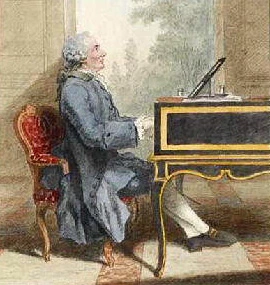
Duni, Duny, Egidio Romoaldo, *9 February 1709 Matera (Basilicata), †11 June 1775 Paris, Italian composer. He came from a musical family; his father Francesco was a bandmaster, and his brother Antonio was a composer and bandmaster. In 1718, he entered the Conservatorio di Santa Maria di Loreto in Naples, but was probably not a student of F. Durante; he later studied at the Conservatorio della Pietà dei Turchini. The years 1730–48 were a period of intense work and numerous travels. Until recently, it was believed that Duni’s first opera experience was the opera seria Nerone, but as early as 1732, the composer’s arias were used in the pastiche Didone abbandonata in Rome. Nerone received mixed reviews; according to some viewers, it was a success, while F. Valesio in his Diario, wrote of the audience’s ‘meager applause’. Nevertheless, in 1736 Duni presented two more operas, Adriano in Siria in Rome, and La tirannide debellata in Milan. Probably in the early 1730s, Duni also stayed at the Viennese court (on a diplomatic mission). Later, the composer left for London, where in 1737 his opera Demofoonte was staged at the King’s Theatre, and a year later Minuetti e Contridanze were published. From London, Duni went to the Netherlands. In October 1738, his name was entered in the register of the University of Leiden. In 1739, he returned to Italy and continued to compose mainly operas, including for theaters in Milan and Florence. In 1743, he became bandmaster at the church of San Nicola in Bari. At the beginning of 1748, he met the Spanish Infante Don Felipe in Genoa, who invited him to the court in Parma. Duni spent nine years there, surrounded by French culture. He also gave music lessons to the infant’s daughter Isabella, later wife of Archduke Joseph. Olimpiade (1755) was Duni’s last opera seria, and La buona figluola, with a libretto by Goldoni, was his last Italian opera. In 1755–56, Duni wrote his first opéras comiques: Ninette à la cour, La chercheuse d’esprit, and Le peintre amoureux de son modèle, which was staged in Paris at the Foire Saint-Laurent in 1757; the opera was met with great enthusiasm and was performed about 30 times. Encouraged by his success, Duni moved permanently to Paris in 1757. In 1761, he became director of the Comédie-Italienne. The opera Les deux chasseurs et la laitière (1763) brought him to the height of fame, along with other works such as Mazet (1761), Le milicien (1762), La fée Urgèle (1765), L’école de la jeunesse (1765), and La Clochette (1766), it was performed on many European stages. After writing the opera Thémire (1770), Duni ceased his compositional work.
Alongside F.A. Philidor and P.A. Monsigny, Duni was one of the main representatives of 18th-century opéra comique. The composer underwent a significant evolution in style – from Italian opera seria (mostly to texts by P. Metastasio) with arias typical of the genre, through Italian opera buffa to texts by C. Goldoni, to French opéra comique, to which he eventually devoted himself exclusively. He owed the success of his French operas largely to excellent librettists such as Ch.S. Favart, M. Sedaine, and L. Anseaume. It is worth remembering that in opéra comique, which combines spoken and sung elements, music did not play a dominant role. Duni paved the way for comic opera, which was followed by his successors; he combined features of the Italian and French styles. In addition to small vocal forms, he introduced extensively developed arias and ensemble finales, usually built on the principle of vaudeville. In the opera Nina et Lindor, he combined elaborate arias with accompanied recitatives, resulting in entire scenes. In many operas, the realism, superbly expressed through musical means, is noteworthy.
Duni’s operatic work was well known to Polish audiences. Many of his operas were staged in Warsaw by French ensembles as early as the 18th century. None of his Italian operas have survived in their entirety (Nerone and Catone in Utica have survived in long fragments). His French operas were published in Paris. Currently, Duni’s work has been attracting increasing interest from researchers since the turn of the century. Research conducted, as well as conferences organized in Matera, the composer’s birthplace, have filled many gaps in his biography and work.
Literature: Ch.S. Favart Théâtre, Paris 1763–1772; Ch.S. Favart Correspondance littéraire dramatique et anecdotique, Paris 1808; F. von Biedenfeld Die komische Oper, Leipzig 1848; G. Cucuel Les créatures de l’opéra-comique français, Paris 1914; H. Bedarida Parme et la France de 1748 à 1789, Paris 1927; M. Perrucci G.M. Trabaci e E.R. Duni nella storia della musica italiana, Matera 1965; Ch.E. Koch jr. The Dramatic Ensemble Finale in the Opéra Comique of the 18th Century, “Acta Musicologica” XXXIX, 1967; K.M. Smith Egidio Duni and the Development of the Opéra-Comique from 1753 to 1770, thesis Cornell University, Ithaca (New York) 1980; A. Żórawska-Witkowska Muzyka na dworze i w teatrze Stanisława Augusta, Warsaw 1995; E. Cook Duet and Ensamble in the Early Opéra-Comique, New York 1995; D. Plasmati Egidio Duni-Duny tra Italia e Francia, Matera-Rome 2003; I due mondi di Duni. Il teatro musicale di un compositore illuminista fra Italia e Francia, ed. P. Russo, Lucca 2014.
Compositions:
Instrumental:
Sei Sonate a tre Op. 1, Rotterdam n.d.
Minuetti e Contridanze, London 1738
Vocal-instrumental:
Athalie, oratorio
Le sacrifice d’Isaac, oratorio
Giuseppe riconosciuto, oratorio
mass for 5 voices
litanies
Te Deum
stage:
opere serie:
Nerone, libretto F. Silvani, staged in Rome 1735
Demofoonte, text by P. Metastasio, staged in London 1737
Didone abbandonata, text by P. Metastasio, staged in Milan 1739
Catone in Utica, text by P. Metastasio, staged in Florence 1740
Artaserse, text by P. Metastasio, staged in Florence 1744
Ciro riconosciuto, text by P. Metastasio, staged in Genoa 1748
L’Olimpiade, text by P. Metastasio, staged in Parma 1755
opere buffe:
La Cascina with G. Scolari, libretto C. Goldoni, staged in Venice 1755
La buona figliuola, libretto C. Goldoni, staged in Parma 1756
ca. 20 opéras comiques, including:
Le caprice amoureux, ou Ninette à la cour, libretto Ch.S. Favart, staged in Parma 1755
La semplice curiosa (trans. Chercheuse d’esprit Ch.S. Favarta), staged in Parma 1756
Le peintre amoureux de son modèle, libretto L. Anseaume, staged in Paris 1757
La fille mal gardée, ou Le pédant amoureux, libretto Ch.S. Favart, Mme Favart and Lourdet de Santerre, staged in Paris 1758
Nina et Lindor, ou Les caprices du coeur, libretto C.-P. Richelet, staged in Paris 1758
La veuve indécise, libretto L. Anseaume after J.J. Vadé, staged in Paris 1759
L’Isle des foux, libretto L. Anseaume, staged in Paris 1760 (parody of L’Arcifanfano by C. Goldoni)
La plaideuse, ou Le procés, libretto Ch.S. Favart, staged in Paris 1762
La nouvelle Italie with A.-J. Rigade, libretto J. Galli di Bibiena, staged in Paris 1762
Le milicien, libretto L. Anseaume, staged in Versailles 1762
Les deux chasseurs et la laitière, libretto L. Anseaume, staged in Paris 1763; title Dwaj strzelcy i mleczarka, trans. J. Baudouin, staged in Warsaw 1779
L’école de la jeunesse, ou Le Barnevelt français, libretto L. Anseaume, staged in Paris 1765
La fée Urgèle, ou Ce qui plaît aux dames, libretto Ch.S. Favart and Voisenon after Voltaire, staged in Fontainebleau 1765; title Wieszczka Urzella, trans. J. Baudouin, staged in Warsaw 1781
La clochette, libretto L. Anseaume, staged in Paris 1766
Les sabots, libretto M.J. Sedaine after J. Cazotte, staged in Paris 1768
Thémire, libretto M. Sedaine, staged in private 1770
Workings:
Lettre à M.D.L.G. pensionnaire adjoint au Mercure pour l’article Spectacles, “Mercure de France” 16 January 1762
Lettre à l’abbé de Voisenon, in: J. Tiersot Lettres de musiciens écrites en français du XVe au XXe siècle, Turin 1924