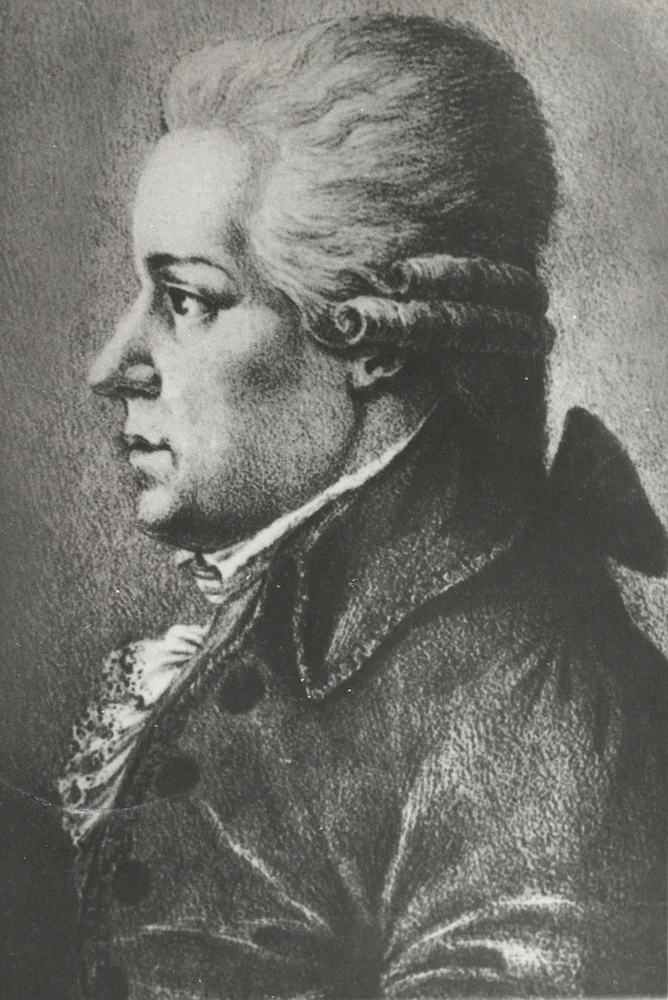
Dittersdorf Carl, Karl, Ditters von, actually Johann Carl Ditters, *2 November 1739 Vienna (Laimgrube), †24 October 1799 Neuhof estate in the village of Stillfriedsdorf (now Deštná, Czech Republic), Austrian composer and violinist. He was the son of Paul Ditters, an embroiderer at the imperial court, who came to Vienna from Lublin. Carl learned to play the violin from the age of 7 with König, and then with J. Ziegler. Later, he played in the orchestra of the Benedictine church (Schottenkirche) in Vienna. At the age of 12, he became a page at the Viennese court of Prince von Sachsen-Hildburghausen, where he received a thorough education – he was taught by the Italian violinist G. Trani and the opera composer G. Bonno. In 1761, after the dissolution of the princely ensemble, Dittersdorf was given a position at the Viennese court opera. In 1763, he set off with Ch.W. Gluck on a trip to Italy, where he enjoyed success as a violinist. In 1765, he became the conductor of Bishop A. von Patachich’s orchestra in Grosswardein (Rom. Oradea), succeeding M. Haydn. There, he reorganized the musical ensemble and founded an opera theater. In 1769, the orchestra was disbanded, and Dittersdorf was given a position with the Prince-Bishop of Wrocław, Ph.G. von Schaffgotsch, and for over two decades he directed the ensemble at his castle (Johannisberg) and performed administrative functions (including supervising the forests of the Duchy of Nysa). Here, he also founded an opera stage and married his student, the singer Nicolina Trink, with whom he had numerous children (only four of whom survived to adulthood). In 1770, thanks to Schaffgotsch’s efforts, he received the papal Order of the Golden Spur, and in 1773, a title of nobility (from then on, Ditters von Dittersdorf). During this period, he traveled to Vienna, among other places, where he staged works such as the oratorio Giob and the singspiel Der Apotheker und der Doktor (1786). In the 1780s and 1790s, Dittersdorf’s stage works enjoyed great popularity in Wrocław. From 1794, he also wrote singspiele for the newly established theater of Prince Frederick Augustus of Brunswick in Oels (Oleśnica), conducting performances of some of them. In 1789, Dittersdorf visited Berlin at the invitation of King Frederick William II, probably looking for a new job there due to the deteriorating situation in Johannisberg. However, these efforts were unsuccessful. After the death of Prince-Bishop Schaffgotsch, he found refuge with Baron von Stillfried at Rothlhotta Castle in southern Bohemia. There, ill and impoverished, he spent the last years of his life, continuing to compose. Before his death, he dictated his autobiography to his son.
Dittersdorf was one of the main representatives of the Viennese school and one of the most important creators of singspiel. Gifted with extraordinary talent and ease of writing, he composed prolifically, thus gaining rapid but fleeting fame. His operatic work is of primary importance. Dittersdorf wrote exclusively comic operas, Italian opera buffa until 1777, and German singspiel from 1786 onwards. His first singspiel, Der Apotheker und der Doktor, was a huge success and is still performed today. This was due to the light and fluid melodies, perfectly suited to the characters and situations, which is particularly evident in the ensemble parts, especially in the finales. In Dittersdorf’s instrumental works, the symphonies come to the fore, initially in three parts with a minuet finale, later in four parts. Some of them have descriptive titles, such as Andromède sauvée par Persée or Actéon changé en cerf from the cycle of 12 symphonies based on Metamorphoses. Sometimes the composer used common illustrative effects (e.g., hunting), and in the melodies of the themes he used folk elements. Dittersdorf’s concertos show a transition from the Baroque to the Classical style; this is expressed primarily in the shaping of the thematic material, the gradual abandonment of sequential figuration in favor of clearly differentiated melodic sections. Contemporary performers are particularly familiar with his two E-flat major concertos for double bass with orchestra. Among Dittersdorf’s chamber works, the Quartet in E-flat major stands out for its dramatic expressiveness.
Literature (a selection): Carl Ditters von Dittersdorf. Lebensbeschreibung, seinem Sohne in die Feder diktiert, Leipzig 1801, Eng. trans. A.D. Coleridge, London 1896, revised ed. 1970, next editions: ed. E. Istel – Leipzig 1909, E. Schmitz – Regensburg 1940, B. Loets – Leipzig 1940, N. Miller – Munich 1967, Czech ed. titled Vzpomínky hudebníka XVIII století, Prague 1958. C. Krebs Dittersdorfiana, Berlin 1900 (includes a list of Dittersdorf’s compositions); H. Istel Dittersdorfiana, “Zeitschrift der Internationalen Musikgesellschaft” IV, 1902/03; L. Riedinger Karl von Dittersdorf als Opernkomponist, “Studien zur Musikwissenschaft” II, 1914; G. Rigler Die Kammermusik Dittersdorfs, “Studien zur Musikwissenschaft” XIV, 1927; F.O. Souper The Music of Dittersdorf, “Music and Letters” XI, 1930; W. Altmann Die Streichquintette Dittersdorfs, in: Studien zur Musikgeschichte, G. Adler’s celebratory publication, Vienna 1930; J. La Rue Dittersdorf Negotiates a Price, in: H. Albrecht in memoriam, Kassel 1962; M. Grave First-Movement Form as a Measure of Dittersdorf’s Symphonic Development, thesis New York University, New York 1977 (it includes a thematic index of Dittersdorf’s symphonies); R. Zuber Příspěvky k životopisu Karla Ditterse z Dittersdorfu, “Kulturní zpravodaj Jesenik”, April 1984; D. Heartz Ditters, Gluck und der Artikel „Von dem wienerischen Geschmack in der Musik (1766)”, «Gluck-Studien» I, 1989; O. Pulkert Karl Ditters z Dittersdorfu, “Hudební rozhledy” XLII, 1989; Carl Ditters von Dittersdorf (1739–99). Sein Wirken in Österreich-Schlesien und seine letzten Jahre in Böhmen, catalogs of documentary exhibitions, ed. H. Unverricht, Würzburg 1989–93; Carl Ditters von Dittersdorf 1739–1799. Der schlesische Opernkomponist, eds. H. Unverricht, O. Landmann, Würzburg 1991; H. Unverricht Dittersdorfs Metamorphosen-Sinfonien, “Musik des Ostens” XII, Kassel 1992; O. Settari Zámek Jánský Vrch a město Javornik v minulostí, “Sbornik prací Filozofické Fakulty Brněnské Univerzity” XXVII–XXVIII, 1992–93; E. Benedikt Carl Ditters von Dittersdorf. Messe in C (Franziskanermesse), “Singende Kirche” XL, 1993; R. Walter Die Missa solemnis Carl Ditters von Dittersdorf für die Breslauer Kathedrale (1797), Bonn 1994; E. Badura-Skoda Zu Carl Ditters von Dittersdorf und seinem Beitrag zum Musikleben Wiens, Vienna 1995; A. Żórawska-Witkowska Muzyka na dworze i w teatrze Stanisława Augusta, Warsaw 1995; Carl Ditters von Dittersdorf. Leben-Umwelt-Werk, ed. H. Unverricht, Tutzing 1997; Beiträge zu Leben und Werk des Carl Ditters von Dittersdorf/Przyczynki do życia i twórczości Carla Dittersa von Dittersdorfa, ed. P. Tarlinski, H. Unverricht, Opole 2000; M. Grave, J. Lane Dittersdorf, Carl Ditters von, in: The New Grove Dictionary of Music and Musicians, London 2001; H. Seifert, O. Pulkert Ditters von Dittersdorf, Carl, in: Die Musik in Geschichte, Kassel 2001; A. Drożdżewska Muzyka w teatrze dworskim księcia Fryderyka Augusta brunszwickiego w Oleśnicy, “Muzyka” 2007, no. 3; H. Unverricht Carl von Dittersdorf. Briefe, ausgewählte Urkunden und Akten, Tutzig 2008; A. Drożdżewska Recent State of Research on the Life and Work of Carl Ditters von Dittersdorf in Poland, “Musicologica Olomucensia” 30, 2019; P. Koukal Dittersdorf jako člověk, “Musicologica Olomucensia” 30, 2019; M. Kula Idiomatyczne cechy języka muzycznego symfonii Carla Dittersa von Dittersdorfa, in: Tradycje śląskiej kultury muzycznej XV, Wrocław 2020; M. Kula Symfonie Carla Dittersa von Dittersdorfa oraz ich recepcja w dawnej Rzeczypospolitej i na Śląsku, doctoral dissertation, University of Wrocław 2021; T. Fatalski Errata do… autobiografii. Mankamenty Lebensbeschreibung Carla Dittersa von Dittersdorfa, “Kwartalnik Młodych Muzykologów UJ” no. 49 (2/2021).
Editions (a selection):
Carl Ditters von Dittersdorf. Ausgewählte Orchesterwerke, ed. J. Liebeskind, Leipzig 1899–1904, revised ed. 1970 (including 6 symphonies after Ovid’s Metamorphoses, Sinfonia in F major and in E-flat major, overture to the La liberatrice oratorio)
Serenata in F major and 3 symphonies, ed. V. Luithlen, «Denkmäler der Tonkunst in Österreich» XLIII, 1936, 2nd ed. 1960
Concerto in G major for oboe, 3 partitas for wind instruments and 3 Italian arias for soprano and orchestra, ed. G. Rhau, Wiesbaden 1948
Concerto for violins in C major, ed. W. Lebermann, Mainz 1961
Concerto for viola in F major, ed. W. Lebermann, Mainz 1966
Doktor und Apotheker and Hieronymus Knicker, singspiel, ed. R. Kleinmichel, Leipzig n.d.
Betrug durch Aberglauben, singspiel, Leipzig n.d.
Cembalo-Konzert in A major, ed. W. Upmeyer, «Nagels Musik-Archiv» XLI, Hanover 1929, new ed. Kassel 1968
Sinfonia in C, ed. W. Gabriel, Graz 1975
Concertos for Double Bass and Orchestra, London 1978
Sinfonia in D, ed. R.A. Murányi, Budapest 1981
Missa pro defunctis in C minor, ed. R. Walter, Bad Schwalbach 1990
Sinfonia in F major, ed. R. Lück, Bad Schwalbach 1990
Divertimento in E, ed. M. Boschini, Vienna 2002
Missa solemnis in C, ed. J. Kirner, Stuttgart 2003
Missa solemnis in C: Credo-Messe, ed. J. Kirner, Stuttgart 2005
Compositions:
Instrumental:
Sinfonia nel gusto di cinque nazioni, 1767
12 programme symphonies based on Ovid’s Metamorphoses, ca. 1785
apart from that over 100 other symphonies
more than 40 solo concertos for various instruments (violin, viola, cello, double bass, flute, oboe, oboe d’amore, horn, and harpsichord), with accompaniment by orchestra or string ensemble
divertimenti, serenades, partitas, cassations, nocturnes, over 20 string trios, 6 string quintets, 6 string quartets (Vienna 1789)
duets for various instruments
sonatas and string solos
sonatas, dances, and other works for piano or harpsichord
Vocal-instrumental:
songs and Italian arias for soprano and instruments
oratorios:
Isacco figura del redentore, 1765
Davide nella Valle di Terebinto, 1768
L’Ester ossia La liberatrice del Popolo Giudaico nella Persia, 1773
Giob, 1786
more than 20 masses and mass movements
ca. 30 offertories
over 10 litanies
settings of vespers psalms
arias and motets on sacred texts
sacred and secular cantatas
Stage:
ca. 40 Italian and German comic operas, including:
L’Amore in musica, 1768
Il viaggiatore americano in Joannesberg, 1771
L’Arcifanfano, rè de’Matti, 1774
Il maniscalco, 1775
La contadina fedele, 1776
Il barone di Rocca antica, 1776
Der Apotheker und der Doktor, 1786
Der Betrug durch Aberglauben, 1786
Democrito corretto, 1787
Die Liebe im Narrenhause, 1787
Das rote Käppchen, 1788
Hieronymus Knicker, 1789
Die Hochzeit des Figaro, 1789
Don Quixotte der Zweyte, 1795
Der Schah von Schiras, 1795
Die lustigen Weiber von Windsor, 1796
Der Mädchenmarkt, 1797