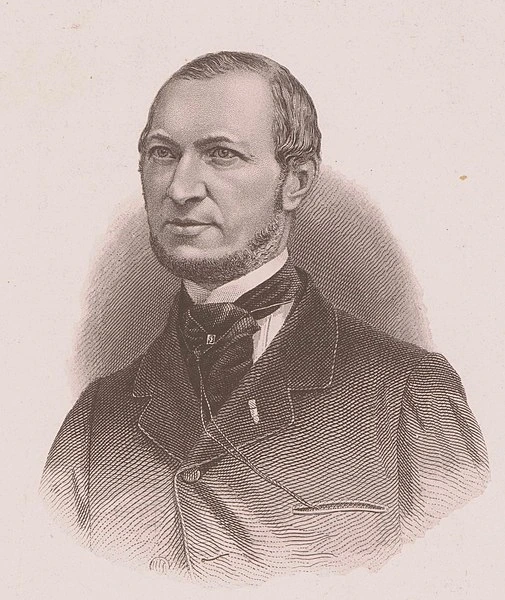
Coussemaker Charles Edmond Henri de, *19 April 1805 Bailleul (Nord), †10 January 1876 Lille, French lawyer and music historian. He completed secondary school in Douai, while simultaneously studying violin under Baudoin at the local Académie de Musique and taking singing lessons from Moreau, the organist at St. Peter’s Church. He then studied law at the University of Paris, earning his law degree in 1830. He also studied singing under F. Pellegrini and harmony with J. Payen and A. Reicha. Upon returning to Douai, he studied counterpoint under V. Lefebvre; Coussemaker’s compositions from this period, most of which are now lost (songs, opera excerpts, masses, and other sacred works, as well as dances), date from this time. He was actively involved in legal work as a lawyer, justice of the peace, and tribunal judge: from around 1831 to 1838 in Douai and Bailleul, from 1839 in Bergues, from 1845 in Hazebrouck and Cambrai, from 1852 in Dunkirk, and from 1858 in Lille. He was a corresponding member of the Institut de France in Paris, the Kaiserliche Österreichische Akademie in Vienna, and the Académie Royale de Belgique in Brussels. He left behind numerous publications in the fields of history, archaeology, and music history.
The wide-ranging subject matter of Coussemaker’s works included the study of the chorale, musical paleography, polyphonic and mensural music, music theory, folk music, and the history of literature. Coussemaker addressed many topics for the first time, thereby laying the foundation for the subsequent development of research on medieval music. Despite numerous errors, mainly of a chronological and terminological nature, his interpretive works, and especially his editorial works (which are primarily of great historical value), remain relevant in many cases and are still reprinted today, serving as an indispensable source base for research on the musical culture of the Middle Ages.
Literature: A. Desplanąue Étude sur les travaux d’histoire et d’archéologie de M.E. de Coussemaker, Lille 1870; C. Dehaisnes Notice sur la vie et les travaux de M.E. de Coussemaker, Bruges 1876; P. Aubry La musicologie médiévale, Paris 1900; J. Handschin Das Fragment Coussemaker, “Acta Musicologica” 1935.
Hucbald, moine de Saint-Amand et ses traités de musique, „Mémoires de la Société des Sciences… de Douai” VII, 1841
Notice sur les collections musicales de la Bibliothèque de Cambrai et des autres villes du département du Nord, Paris 1843
Histoire de l’harmonie au moyen-âge, Paris 1852, reprint Hildesheim 1966
Chants populaires des Flamands de France recueillis et publiés avec les mélodies originales, Ghent 1856
Notice sur un manuscrit musical de la Bibliothéque de Saint-Dié, Paris 1859
Drames liturgiques du moyen-âge, Rennes 1860, New York 1964
Messe du XIIIe siècle traduite en notation modeme et précédée d’une introduction, Paris 1861
Les harmonistes du XIIe et du XIIIe siécle, Lille 1864
Scriptorum de musica medii aevi nova series a Gerbertina altera, 4 vols., Paris 1864, 1867, 1869, 1876, Graz 1908, Milan 1931, Hildesheim 1962
L’art harmonique aux XIIe et XIIIe siécles, Paris 1865, New York 1966
Traités inédits sur la musique du moyen-âge, Lille 1867
Les harmonistes du XIVe siécle, Lille 1869
Oeuvres complétes du trouvère Adam de la Halle, Paris 1872, Ridgewood (New York) 1965
Joannis Tinctoris Tractatus de musica juxta Bruxellensem codicem, necnon Bononiensem ac Gandaoensem, Nova editio, Lille 1875
Traité d’harmonie i Traité de contrepoint et de fugue, 1832, manuscripts lost
a number of minor works and articles in French and Belgian journals