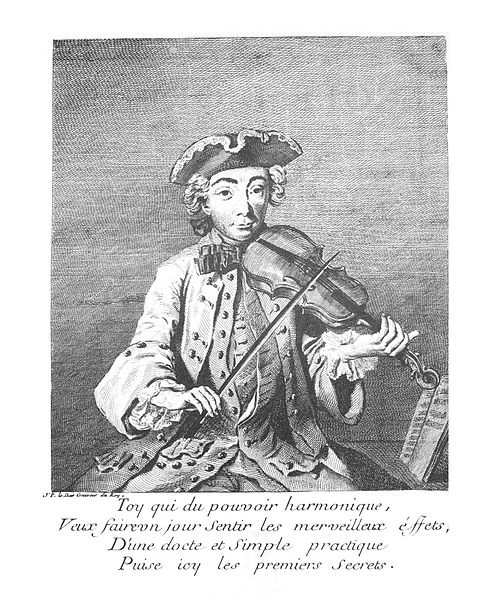
Corrette [korˊet] Michel, *10 April 1707 Rouen, †22 January 1795 Paris, French organist, composer and teacher. He was the son of Gaspard Corrette (†before 1733), a French composer and organist of Dutch origin. Between 1732 and 1739, he was the musical director of the annual Parisian opera performances at the Foire St Germain and Foire St Laurent. Between 1737 and 1790, he was the organist at the Sainte-Marie church in Paris. From around 1738 to 1762, he was organist at the Jesuit college on Rue St-Antoine. He performed at the famous Parisian Concerts Spirituel. He was awarded the titles of Grand maître des Chevaliers du Pivois (1734) and Chevalier de l’Ordre de Christ (1750).
Corrette is known as the author of manuals for playing instruments. They contain a compendium of practical knowledge, which today is a valuable source of information on technique and interpretation in 18th-century performance practice. Not limiting himself to basic instructions, Corrette emphasised fingering (especially in Les amusemens du Parnasse), promoted new performance techniques (adopting the Italian way of holding the bow in L’art de se perfectionner dans le violon…, popularising the chin rest in L’ecole d’Orphée…, the use of thumb position in Méthode théorique et pratique pour… le violoncelle…), addressed issues of ensemble and accompaniment playing (Le maître de clavecin…), compared performance styles using musical examples (comparison of Italian and French styles in L’école d’Orphée…), and in Premier livre d’orgue he set out the principles of registration, articulation, tempo selection, and the adaptation of harpsichord works for the organ. At the same time, he developed a new type of instructional manual, concise and practical, which was later adopted by pedagogical literature.
Corrette’s output is very rich and covers most of the popular genres of secular and sacred music of the time (with the exception of opera). Many of his works were part of his own performing repertoire. He was one of the first French composers to write chamber music with a leading keyboard instrument and ritornello-type concertos. Some of his works are occasional in nature; he wrote, among other things, occasional ariettas in honour of the French Revolution. He also created transcriptions, e.g. of popular opera numbers for the harpsichord. His compositions are correct, although often conventional, with little melodic inventiveness. He was skilled at orchestration and had a broad knowledge of forms and genres. He preferred simple harmonic phrases and avoided chromaticism. He introduced folk instruments (musette, hurdy-gurdy) into his works and often used popular melodies from Paris and the surrounding area. Many of Corette’s compositions have instructional value. He published most of his works in print; a significant number of them are known to us only from mentions in the press.
Literature: D. Higbee M. Corrette on the Piccolo and the Speculations regarding Vivaldi’s “flautino”, “The Galpin Society Journal” XVII, 1964; D. Boyden The History of Violin Playing, London 1965, Polish translation Krakow 1980; F. Lesure, G. Thibault La méthode de mandoline de M. Corrette (1772), “Fontes Artis Musicae” 13/1, 1966; R. Suchecki Wiolonczela od A do Z, Krakow 1982; J.-L. Perrot Catalogue commenté des oeuvres de M. Corrette I, II, III, “Académie Musicologique du Forez” Part 1, 1984, Parts 2 and 3, 1985; C. Farrar M. Corrette and Flute-playing in the Eighteenth Century, «Music Theorists in Translations» IX, New York 1970; W. Kolneder Laudate Dominum, eine Motette von M. Corrette nach dem Frühlings-Konzert op. VIII Nr. 1 von Vivaldi, in: Logos musicae: Festschrift für Albert Palm, ed. R. Görner, Wiesbaden 1982; Y. Jaffrès Du nouveau sur M. Corrette, in: Aspects de la musique baroque et classique à Lyon et en France, ed. D. Paquette, Lyon 1989; Y. Jaffrès M. Corrette et la Révolution Française, in: Le tambour et la harpe. Oeuvres, pratiques et manifestations musicales sous la Révolution, 1788–1800, ed. J.-R. Julien and J.-R. Mongrédien, Paris 1991; S. Mamy “Le Printemps” d’A. Vivaldi revu et corrigé à Paris par N. Chédeville, M. Corrette et J. J. Rousseau, “Informazioni e studi vivaldiani” XIII, 1992; Y. Jaffrès M. Corrette et Porgue (1707–1795), «L’Orgue. Cahiers et Mémoires» LIII, Paris 1995 (contains a catalogue of organ works and bibliography), English edition Artarmon 1998; J. Yves Les III Leçons de ténèbres de Michel Corrette, “Recherches sur la musique française classique” XXIX, 1996–98; F. Lainé La pédagogie de l’alto en France, de la méthode de Michel Corrette aux études de Maurice Vieux (1773–1932), thesis Tours 1998; D. Ponsford, J. Byrt Interpreting the Notes Inégales Evidence, “Early Music” XXVIII, 2000; R. D. Anderson Michel Corrette and the stringing, scaling, and pitch of French harpsichords, “Early Keyboard Journal” XXI, 2003; H. M. Lardin Michel Corrette’s Méthodes pour apprendre à jouer de la contre-basse à 3. à 4. et à 5. cordes, de la quinte ou alto et de la viole d’Orphée : a new translation with commentary, thesis, Ithaca 2006; G. Sadler From Charpentier to Corrette, “Early Music” 37/2, 2009; Regards sur Michel Corrette, ed. Y. Jaffrès, P. Saby, Lion 2011; B. François-Sappey Michel Corrette: sous la direction de Gilles Cantagrel, in: Guide de la musique d’orgue, Paris 2012; M. Cyr Origins and performance of accompanied keyboard music in France, “The Musical Times” 156/1932 (2015); F. Giesa Michel Corrette (1741) – Jean Louis Duport (1806) Zwei historische Celloschulen und die Möglichkeiten, sie im modernen Instrumentalunterricht zu verwenden, Saarbrücken 2021; M. Ch. Cleary The rediscovery of the Nouvelle méthode pour apprendre à jouer de la harpe by Michel Corrette, “Eighteenth-century Music” 19/1, 2022.
Compositions:
Instrumental:
Six symphonies en quatuor contenant les plus beaux noëls français et étrangers for violin or flute, violin, viola and b.c., Paris 1781
concertos:
Concerto No. 6 for 3 flutes or violin or oboe and b.c., Op. 3, Paris 1728
Concerto No. 6 for 3 flutes or violin or oboe and bass instruments, Op. 4, Paris ca. 1729
25 concertos comiques for 3 high-pitched instruments and b.c., Paris 1732–60, Nos. 1–6 also published as Op. 8, 1733, Nos. 22–24 lost
Le berger fortuné Paris ca. 1737
Les récréations du berger fortuné Paris ca. 1737
Les voyages du berger fortuné aux Indes orientales na musette lub vielle, Paris ca. 1737
Le phénix for 4 cellos or bassoons, Paris 1738
5 concertos (probably from the lost collection Six concerto dont les quatre premiers sont sur les plus beaux noëls, le cinquieme sur l’O filii, le sixieme en carillon Paris 1753):
Concerto No. 1 for flute, 2 violins and b.c.
Concerto No. 2 for musettes or hurdy gurdy, or flute or violin and bass instrument
Concerto No. 3 for musette or another instrument and b.c.
Concerto No. 4 for musette or other instrument and b.c. (Swiss carols)
Concerto No. 5 for flute or violin and b.c. (German carol)
VI concerti a sei strumenti for harpsichord or obbligato organ, 3 violins, flute, viola and cello, Op. 26, Paris 1756
chamber:
6 fantaisies for hurdy-gurdy or musette, flute and b.c., Op. 6, Paris ca. 1731
Sonates for 2 flutes, Paris 1727
Sonates for flute or violin and b.c., Op. 13, Paris ca. 1735
Sonates en trio for flute, violin and b.c., Op. 14, Paris ca. 1736
Sonatilles for flute or violin and bass instrument, Op. 19, Paris ca. 1739
Les delices de la solitude, sonatas for cello, double bass, bassoon and b.c., Op. 20, Paris ca. 1739, 2nd edition 1766 (contains guidance on cello performance)
Sonates for harpsichord and violin, Op. 25, Paris 1742
Collections of duets for 2 flutes, Op. 21, 22 and 23, Paris 1739
for organ:
Premier livre d’orgue Op. 16, Paris before 1734, 2nd edition 1737 (contains guidance on cello performance in the introduction), Book 2, Op. 26, 1750, Book 3, 1756
Pièces pour 1’orgue dans un genre nouveau, livre I, Paris 1787
for harpsichord:
Premier livre de pièces de clavecin Op. 12, Paris 1734
Les amusemens du Parnasse, 8 books — Book 1 Mèthode… pour apprendre à toucher le clavecin… Paris 1749, 2nd edition 1779, Book 2, ca. 1750, Book 3 1753, Book 4 1762, Book 5 1769, Book 6 1769, 7th edition 1771 (lost), Book 8 1772
Nouveau livre de noëls avec un carillon for harpsichord or organ, Paris 1753
Divertissements… contenant Les échos de Boston et la Victoire d’un combat naval for harpsichord or organ, Paris 1779
Vocal and vocal-intrumental:
numerous cantatas, arias and ariettas for voice with instrumental accompaniment, including La naissance de la musette, ca. 1745, Jeanne, cantatille avec simphonie, Paris 1743, canons, menuets, rondos and others
motets for choir, including Laudate pueri, Levavi oculos, 1745, Lauda Jerusalem, 1748, Te Deum, 1752
Quatre messes for 2 voices and organ, Paris 1787
Stage:
stage works, including Les âges Op. 10, ballet, Paris 1733, Le lys, ballet Paris 1752
arrangements, including Laudate Dominum de coelis… motet à grand choeur arrangé dans le concerto du printemps de Vivaldi, Paris 1766.
Method books:
L’école d’Orphée. Méthode pour apprendre facilement à jouer du violon dans le goût françois et italien avec des principes de musique et beaucoup de leçons Op. 18, Paris 1738 (reprint 1973), expanded edition 1779, 3rd edition 1790
Méthode theorique et pratique pour apprendre en peu de temps le violoncelle dans sa perfection… Op. 24, Paris 1741 (reprint 1972), 2nd edition 1783
Méthode… à jouer de la flûte traversière…, ca. Paris 1742, expanded to include oboe and clarinet performance 1773, 4th edition 1781 (reprint 1977)
Méthode… à jouer du par-dessus de viole à 5 et à 6 cordes avec des leçons, Paris 1748
Le maître de clavecin pour l’accompagnement. Mèthode theorique et pratique… avec des leçons chantantes où les accords sont notes Paris 1753 (reprint 1976), 2nd edition 1790
Prototipes contenant des leçons d’accompagnement par demandes et réponses, pour servir d’addition au livre intitulé Le maître de clavecin… Paris 1754, expanded edition including ariettas 1775 (reprint 1976; contains sonatas for violin, flute and treble viol)
Le parfait maître à chanter. Méthode pour apprendre facilement la musiąue vocale et instrumentale Paris 1758, expanded edition 1782
Les dons d’Apollon. Méthode pour apprendre facilement à jouer de la guitarre… Book 1, Paris 1762, Book 2, 1763 (lost)
Nouvelle méthode.. à jouer en très peu de temps la mandoline… Paris 1772
Méthode… à jouer de la contre-basse à 3, à 4 et à 5 cordes, de la quinte ou alto et de la viole d’Orphée, nouvel instrument ajusté sur des sonates Paris 1773
L’art de se perfectionner dans le violon où l’on donne à étudier des leçons sur toutes les positions… suitę de L’ecole d’Orphée Paris1782 (reprint 1973 containing 35 works mainly by Italian composers)
La belle vielleuse. Méthode… a jouer du vielle… Paris 1783 (reprint 1977), 2nd edition 1825
Additionally, method books for playing the harp (Paris, 1774), oboe and bassoon (Paris, 1776), and flute (Paris, 1784) – lost
Editions:
Noël: Pour orgue sans pédale ou harmonium, [de Redford, Tallis, Zachow, Corrette et A. Reboulot. Notice de J. Bonfils], «L’Organiste liturgique» vol. 3, Paris 1953
Joseph Bodin de Boismortier, Michel Corrette, Michel de la Barre, Louis Hotteterre, «Altfranzösische Duette für Violinen», Mainz ca. 1960
Concerto in D minor, Op. 26/6, ed. H. Ruf, «Nagels Musik-Archiv» vol. 201, Kassel 1959
Premier livre d’orgue and Nouveau livre de noëls, «Recent Researches in the Music of the Baroque Era» XVIII, ed. G. Beechey, Madison 1974
Französische Duette des frühen 18. Jahrhundert: Für zwei Altblockflöten: De la Barre, Danican-Philidor, Corrette, ed. U. Thieme, Celle 1986
Concertos nos. 1 in G, 3 in D for organ or harpsichord, ed. P. de Lasala, Y. Jaffrès, Artarmon 2002
Bemetzrieder, Corrette, Froestler, Gournay, Langlé, Rodolphe, Roussier et Anonymes, «Basse continue» XV, Courlay 2006
XII [Douze] Offertoires: [pour orgue], ed. P. de Lasala, Y. Jaffrès, Lion 2011
The Complete Organ Works, Volume 2, Premier Livre d’Orgue [1737] et Pièces de clavecin pour l’orgue [1734], ed. P. de Lasala, Y. Jaffrès, Colfax 2012
Symphonie no. 5, contenant les plus beaux noels: for 2 violins, viola and continuo, Arbroath 2013
Guide to early keyboard music: France 2, Budapest 2020