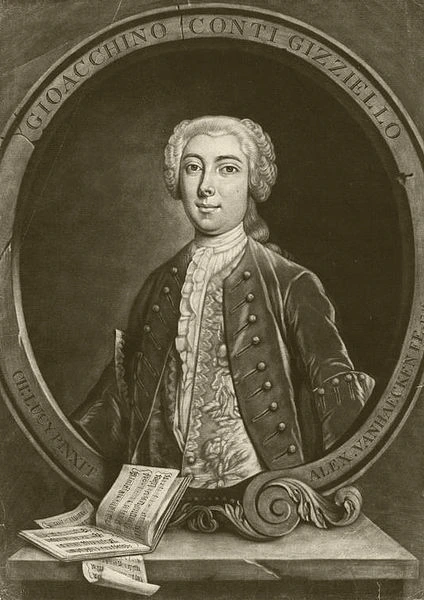
Conti Gioacchino, known as Gizziello or Egizziello, *28 February 1714 Arpino, †25 October 1761 Rome, Italian castrato singer (soprano). Between 1722 and 1729, he was a pupil of D. Gizzi (hence his nickname) in Naples. It is often said that he made his debut in Rome in 1730 at the Teatro delle Dame in the opera Artaserse (libretto by P. Metastasio, music by L. Vinci). Surviving sources (the printed libretto) do not confirm this information. Conti most likely made his debut in Rome during the summer in a restaging of this opera (Saverio Franchi). The only performance confirmed by sources dates back to January 1732, when he sang in Naples in G.B. Pergolesi’s first opera La Salustia (the role of Marziana), which was originally to be performed by N. Grimaldi, known as Nicolino. It is known, however, that Gizzi had previously prepared his talented pupil’s debut in the celebrations in honour of San Gennaro in December 1731 in Naples and in two cantatas (Egeria and Cimotoe). It was not until the following opera season that Gizziello made his debut at the Naples opera house in works by L. Leo, L. Vinci, J.A. Hasse and others. After that, his career took off; he sang at the imperial court in Vienna (1734), in Venice and Genoa. In 1736–37, he performed in London in Handel’s operas (the premieres of Arminio, Giustino, Berenice, as well as Ariodante, Atalanta, Alcina, Poro, Partenope and others). Farinelli was also in London at that time. Having heard him sing at the Opera of the Nobility, which competed with Handel, Gizziello was delighted by the artistry of the magnificent castrato, but suffered an artistic breakdown. According to legend, it was Farinelli who comforted him and encouraged him to continue his career. Gizziello, like no other castrato, was given arias by Handel that demonstrated the high notes of his voice, and he also influenced the composer’s change of style towards the galant style. After returning to Italy, he studied with A.M. Bernacchi and sang in various Italian cities (Rome, Padua, Venice, Naples, Lucca). In 1743, he left for Lisbon, where he performed at the court theatre. In 1746–48, he sang in Naples and Rome (including in compositions by Jommelli). In 1749, he received an invitation from Farinelli to Madrid, where he stayed until 1751. In 1751–52, he performed in Italy (Padua, Milan), and in 1752–55, he returned to the court theatre in Lisbon, where he miraculously survived an earthquake (1755). He returned to Naples, where he was hailed as Caffarelli’s successor.
Gizziello was one of the highest-paid castrati of the 18th century, as well as a typical representative of Italian vocal art in the 18th century, strongly associated with the Neapolitan opera school (J.A. Hasse, N. Jommelli, L. Vinci). He had a well-trained voice spanning over two octaves and was also capable of moving interpretations. This is confirmed by the parts written for him in Handel’s operas – Meleager (Atalanta), Sigismondo (Arminio), Anastasio (Giustino) and Alessandro (Berenice). Among the famous castrati, he was also notable for his extraordinary shyness and modesty.
Literature: G.B.G. Grossi Domenico Gizzi e Gizielli suo allievo, Bibliografia degli Uomini Illustri del Reame di Napoli, Naples 1819; P. Scudo Les sopranistes Gizziello e Guadagni, “Revue des Deux Mondes”, Paris 1862; A. Hariot The castrati in opera, London 1956; F. Cotticelli, P. Maione Onesto divertimento, ed allegria de’popoli. Materiali per una storia dello spettacolo a Napoli nel primo Settecento, Milan 1996; S. Franchi Drammaturgia romana, II, 1701-1750, Rome 1997; S. Gizzi Due celebri musici del XVIII secolo. Domenico Gizzi e il suo allievo Gizziello, Ceccano 2007.