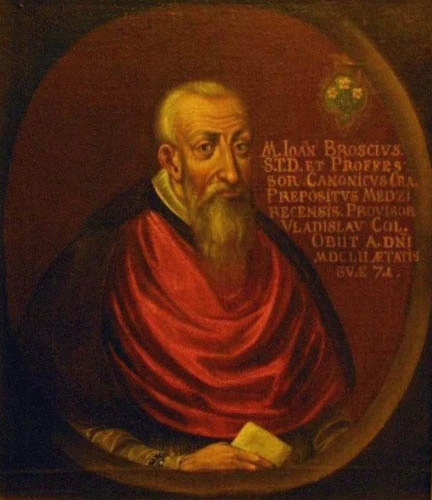
Brożek, Broscius, Jan, *1 November 1585, Kurzelów (Świętokrzyskie Voivodeship), †21 November 1652, Bronowice (near Krakow), Polish mathematician, theologian, astronomer, astrologer, and physician. After graduating from college in Kurzelów, he studied in Krakow. In 1604, he enrolled at the University of Krakow. In 1605, he became a bachelor of liberal arts. Between 1605 and 1607, he lectured at the cathedral school in Włocławek, and in 1607 at the parish school of St. John in Krakow. In 1610 he obtained the degree of Master of Liberal Arts; in 1611 he became rector of the school of the Collegiate Church of All Saints in Kraków; and in 1614 he assumed the chair of astronomy at the Kraków Academy. From 1620 to 1624, he studied in Padua, where he obtained a doctorate in medicine in 1623. After his return, he became involved in a dispute between the University of Krakow and the Jesuit order. From 1626 to 1630, he headed the chair of rhetoric. In 1629, he was ordained a priest. After obtaining a bachelor’s degree in theology, he became a professor of theology at his alma mater. In 1649, he became a canon of the Krakow Cathedral. In 1650, he obtained a doctorate in theology, and in 1652, he became rector of the Krakow Academy.
He was a leading representative of the exact sciences in 17th-century Poland. He published over 30 different works on mathematics, geometry, astronomy, astrology, medicine, and other fields. He also dealt with the mathematical theory of music, which at the time was considered an integral part of arithmetic. In this field, he wrote the treatises An diapason salvo harmonico concentu per aequalia septem intervalla dividi possit vel non (manuscript preserved in the Jagiellonian Library, PL-Kj 2665) and Arithmologia musica; the latter work, mentioned in Brożek’s will and also referred to in his treatise De numeris perfectis disceptatio altera, unfortunately remains unknown to this day. However, Brożek’s extensive handwritten notes on the mathematical foundations of music, entered into Descartes’ Musicae compendium, and his comments entitled Diatonica et choralis musica in manuscript 559 of the Jagiellonian Library have survived.
Literature: Historia nauki polskiej, ed. B. Suchodolski, vols. 2 and 6, Wrocław 1970, 1974; B. Przybyszewska-Jarmińska Historia muzyki polskiej vol. 3, Barok, part 1: 1595–1696, Warsaw 2006.