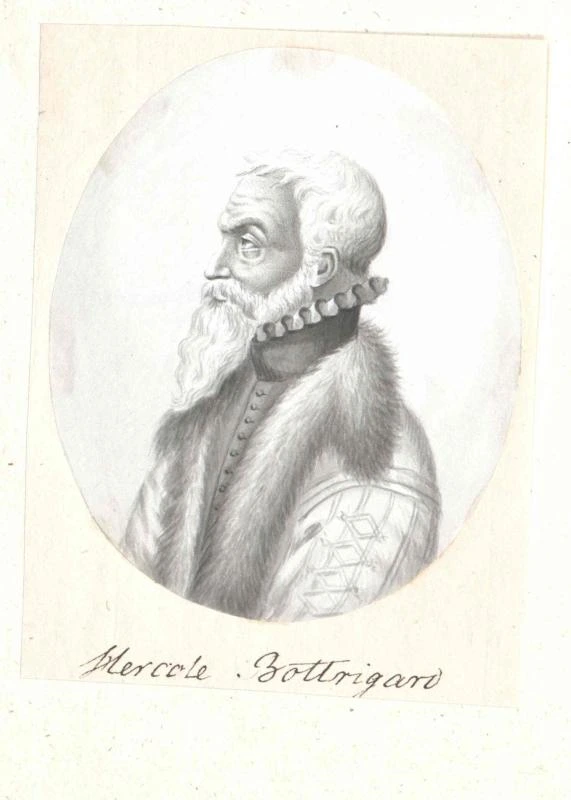
Bottrigari, Bottrigaro, Ercole, baptised 24 August 1531 Bologna, †30 September 1612 San Alberto (near Bologna), Italian music theorist, composer and poet. Born as the illegitimate son of a Bolognese aristocrat, he was soon legitimised and brought into his father’s residence, where he received a solid education in law, mathematics, astronomy, as well as politics, architecture, music and knowledge of antiquity, in the spirit of the Renaissance ideal of a comprehensive education. In 1547, his father placed at his disposal a printing house in Bologna, which had been established especially for him. In 1551, Bottrigari married and became a member of the city council. In 1576, he moved to Ferrara, where he remained at the court of Duke Alfonso II d’Este until 1586. The rich musical life (the activities of L. Luzzaschi, G. de Wert, the concerto delle donne and concerto grande ensembles) increased his interest in music and its history and theory; he began to collect books on the subject, and his library eventually grew to a considerable size (now in Bologna, Civico Museo Bibliografico). Shortly after returning to Bologna (1586), he settled in his family residence in San Alberto. At that time, he befriended A. Melon, a music teacher and supervisor of the musicians of the Bolognese Signoria; their shared interests and exchange of ideas were reflected in Bottrigari’s writings.
In the first part, Il Melone Bottrigari discusses the types of Greek music: diatonic, chromatic and enharmonic. In part 2, he defends the views of N. Vicentino and the concept of ‘seconda pratica’ formulated by C. Monteverdi against critics (G.M. Artusi et al.). Il desiderio is a very important testimony to musical life at the court of Alfonso II; the author also discusses the problems of tuning various instruments and, in connection with their diversity, the possibility of combining these instruments in an ensemble. Il Patricio contains a critique of F. Patrizi’s statements on the acoustic views of Aristoxenus. According to Enrico Bottrigari, [Ercole] Bottrigari was himself an accomplished singer and instrumentalist, as well as a composer of madrigals. Of these, only one survives, included in Il Melone as an example of chromatic writing; another served as the basis for a composition by Ph. de Monte.
Literature: Enrico Bottrigari Notizie biografiche intorno agli studi ed alla vita del Cavaliere Ercole Bottrigari, Bologna 1842; U. Sesini Studi sull’umanesimo musicale. Ercole Bottrigari, “Convivium” XIII, 1941, reprint in: La musica a Bologna, red. G. Vecchi, Bologna 1966; R. Giazotto “Il Patricio” di Hercole Bottrigari dimostrato praticamente da un anonimo cinquecentesco, „«Collectanea Historiae Musicae» I, 1953; G. Vecchi Primi accenni ad una storia delle semeiografia musicale nel “Trimerone” di Ercole Bottrigari, in: Memorie e contributi alla musica del medioevo all’eta moderna, offerti a Federico Ghisi nel settantesimo compleanno (1901–1971), Bologna 1971; P. Reghini A difesa del “Patrizio” (nel labirinto della musica greca), Padua 1974; G. Vecchi Music, Liturgy, Hebrew Psalmody, and the Bolognese Historians (Ercole Bottrigari, Giovanni Battista Martini), in: Report of the Twelfth International Musicological Society Congress, Berkeley 1977, ed. D. Heartz, B. Wade, Berkeley 1981; C. V. Palisca Humanism in Italian Renaissance Musical Thought, New Haven 1985; C. V. Palisca Boethius in the Renaissance, in: Music Theory and Its Sources, ed. A. Barbera, Notre Dame 1990; C. V. Palisca Two Sixteenth-Century Italian Translations of Boethius’ “De institutione musica,” in: Atti del XIV congresso della Società Internazionale di Musicologia, Turin 1990; M. Ilari Ercole Bottrigari traduttore de “De musica” di Boezio, in: Studi in onore di Giulio Cattin, ed. F. Luisi, Rome 1990; M. Moretti Gli strumenti musicali negli scritti di Ercole Bottrigari, dissertation, Università degli Studi di Padova, 1990; M. R. Maniates Bottrigari versus Sigonio. On Vicentino and His Ancient Music Adapted to Modern Practice, in: Musical Humanism and its Legacy. Essays in Honor of Claude V. Palisca, ed. N. Baker and B. R. Hanning, Stuyvesant 1992; M. R. Maniates The Cavalier Ercole Bottrigari and His Brickbats: Prolegomena to the Defense of Don Nicola Vicentino against Messer Gandolfo Sigonio, in: Music Theory and the Exploration of the Past, ed. Ch. Hatch and D.W. Bernstein, Chicago 1993; E. Müller Ercole Bottrigari: “Il Trimerone.” Edition und Kommentar, dissertation, Universität Karlsruhe, 1994; G. L. Betti Cardano a Bologna e la sua polemica con il tartaglia nel ricordo di un contemporaneo, “Bruniana & Campanelliana” XV, 2009; G. L. Betti Il “vero numero degli anni” e il “giorno della passione et morte” di Cristo in un “Discorso” di Ercole Bottrigari del 1595, “Bruniana & Campanelliana” XVI, 2010; L. Bruno “Il cantar novo” di Ercole Bottrigari, ovvero dell’antica musica cromatica ridotta alla moderna pratica polifonica tra Cinque e Seicento, “Studi Musicali” V, 2014; K. Soares Il Desiderio de Ercole Bottrigari: uma discussão teórica sobre o uso dos genera gregos na polifonia do final do séc. XVI, dissertation, Universidade Estadual Paulista, 2021.
Works:
Il Patricio, overo de’ tetracordi armonici di Aristosseno…, Bologna 1593
Il desiderio, overo de’ concerti di varij strumenti musicali…, Venice 1594 (published under the pseudonym Alemanno Benelli – an anagram of Annibale Mellone), 2nd edition Bologna 1599 (under his own name), 3rd edition Milan 1601 (under the name A. Melloni)
Il Melone, discorso armonico (…) et il Melone secondo…, Ferrara 1602
Trimerone de fondamenti armonici, 1599 and Italian translation De musica Boethius, manuscript Bologna, Civico Museo Bibliografico
Editions:
Il Patricio…, facsimile edition G. Vecchi, «Biblioteca Musica Bononiensis» 11/27, Bologna 1969
Il desiderio…, facsimile edition with introduction by K. Meyer, «Veröffentlichungen der Musik-Bibliothek Paul Hirsch» V, Berlin 1924, facsimile edition G. Vecchi, «Biblioteca Musica Bononiensis» 11/28, Bologna 1969, English translation C. MacClintock, «Musicological Studies and Documents» IX, 1962
Il Melone…, facsimile edition G. Vecchi, «Biblioteca Musica Bononiensis» II, Bologna 1969