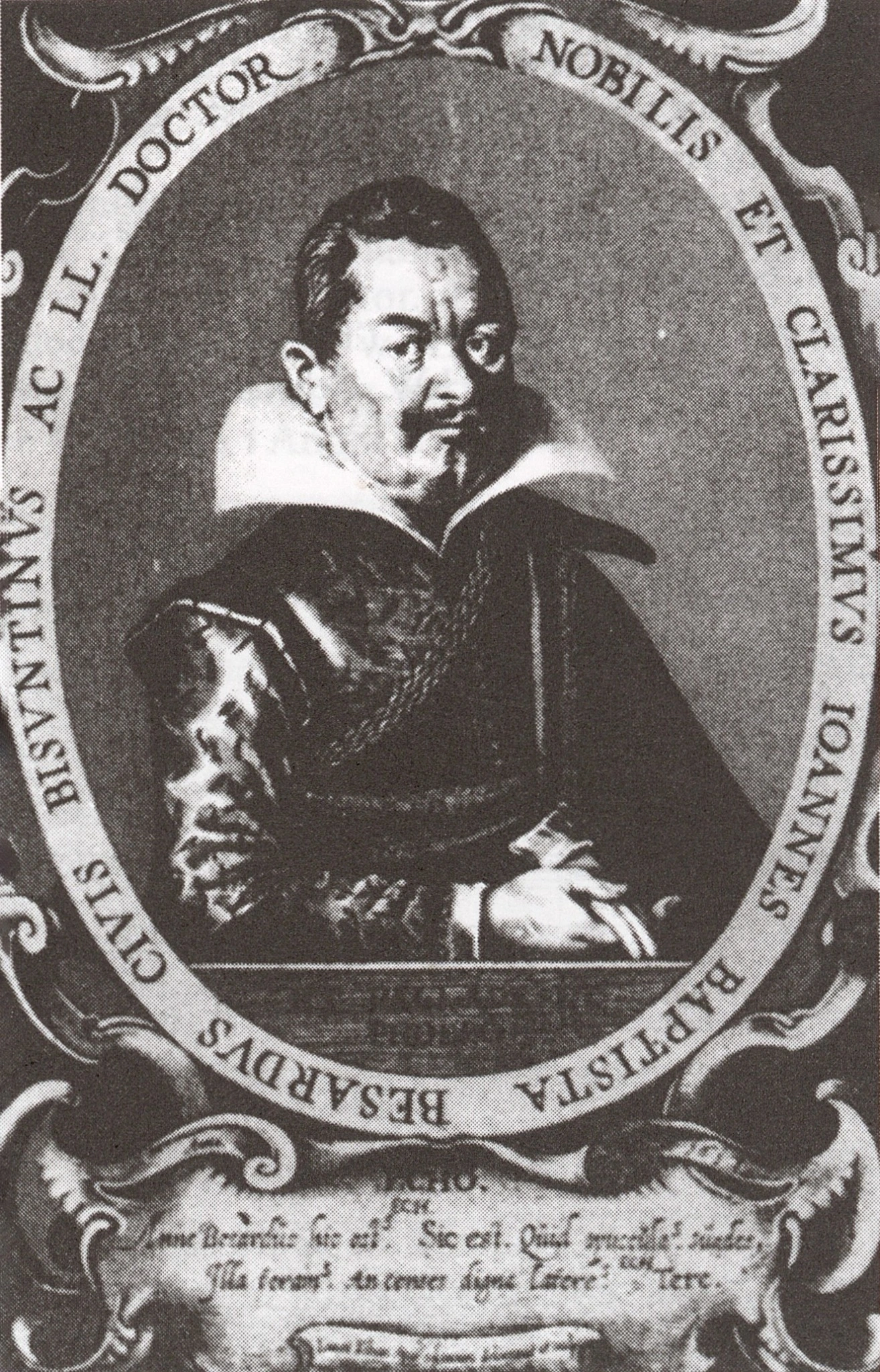
Besard Jean-Baptiste, *ca. 1567 Jussey (near Besançon) or Besançon, †after 1617, French lutenist, composer, and editor. He came from a bourgeois family that had lived in Besançon since his childhood; in 1587, he obtained a doctorate in civil and canon law at the University of Dôle, thereby acquiring a noble title. He learned to play the lute from an early age, and after 1587 he perfected his craft under the guidance of the Italian lutenist Laurencin, probably in Rome. In 1597, he stayed in Hesse. He returned to Besançon and married in 1602; however, a year later he abandoned both his wife and his homeland, returning only briefly to resolve necessary financial matters. He spent the rest of his life (probably until his death) in Germany, living in Cologne and Augsburg, among other places. There, in addition to two lute anthologies, he published a collection of treaties concluded in the 16th century, a work that remains a valuable document in the fields of international law and political history: Mercurius Gallo-Belgicus… (only vol. 5 has been preserved, Cologne 1604) and a work on medicine and physics, Antrum philosophicum (Augsburg 1617), dedicated to Philip II, Duke of Pomerania, and his three brothers: Francis, Bishop of Cammin, Bogislaw, and Ulrich.
Most of the works are included within two anthologies published by Besard: Thesaurus harmonicus (Cologne 1603) and Novus partus sive concertationes musicae (Augsburg 1617); the remainder survive in manuscripts. The historical importance of Thesaurus lies in its being the first publication to provide an overview of almost the entire lute repertoire from the second half of the 16th century. Earlier tablature collections usually contained works by one or, at most, a few composers, while Thesaurus covers 21 names, mainly French and Italian lutenists, but also Bakfark, Długoraj, Jakub Polak, and Diomedes Cato (his choreae polonicae are preserved there). Novus partus names 13 composers, again including Jakub Polak. Both works contain Latin instructions for lute playing, also issued separately in German under the title Isagoge in artem testudinariam (Augsburg 1617). An English translation of the instructions from the Thesaurus was published by R. Dowland as the introduction to his anthology Varietie of Lute-Lessons (London 1610).
Besard’s works are characterized by the predominance of vertical thinking over linear thinking, which is expressed, for example, in the octave shifts of individual components of the melodic line. In terms of harmony, there are phenomena typical of a period in which the modal system had already been abandoned, but the laws of tonal harmony had not yet been developed; this is particularly true for the treatment of dissonances. In many of Besard’s works, all elements are subordinated to sophisticated sounds, which places him among the outstanding composers of the Mannerism period.
Literature: O. Chilesotti Jean-Baptiste Bésard et les luthistes du XVIe siècle, in: Congrès international d’histoire de la musique tenu à Paris du 23 au 29 juillet 1900, Solesmes 1901; O. Chilesotti Airs de cour del Thesaurus harmonicus de Jean Baptiste Bésard, in: Atti del Congresso Internazionale di Scienze Storiche, Roma 1-9 Aprile 1903, Rome 1905; L. de la Laurencie Les luthistes Charles Bocquet, Antoine Francisque et Jean-Baptiste Besard, “Revue de musicologie” VII, 1926; J Garton Jean-Baptiste Besard’s Thesaurus harmonicus, dissertation, University of Indiana, 1952; J. Sutton Jean-Baptiste Besard’s “Novus partus” of 1617, dissertation, University of Rochester, 1962; J. Sutton The Lute Instructions of Jean-Baptiste Besard, “The Musical Quarterly” LI, 1965; J. Sutton The Music of Jean-Baptiste Besard’s Novus partus, 1617, “Journal of the American Musicological Society” XIX, 1966; J. Sutton Jean-Baptiste Besard, Renaissance Gentleman, “Journal of the Lute Society of America” I, 1968; J.M. Vaccaro, La musique de luth en France au XVIe siècle, Paris 1981; C. Knispel Das Lautenbuch der Elisabeth von Hessen, Frankfurt am Main 1994; P. Király Jean-Baptiste Besard: New and Neglected Biographical Information, “The Lute” XXXV, 1995; P. Király Einige Beobachtungen und Anmerkungen über Lautenmusikquellen, Lautenisten und Amateure im 16. und frühen 17. Jahrhundert, “Die Laute” I, 1998; J. Lüdtke Die Lautenbücher Philipp Hainhofers (1578–1647), Göttingen 1999; M. Carlone The Knights of the Lute, “Journal of the Lute Society of America” 27, 2004; M. Hottmar Diela poľských lutnistov v lutnovej zbierke Jean-Baptiste Besard: Thesaurus harmonicus (Köln 1603), in: Na pograniczach. Z odległej i bliskiej przeszłości. Studia o stosunkach kulturowych, ed. R. Lipelt, Sanok 2019.
Compositions:
for one lute:
8 preludes
3 fantasias
toccata
symphony
5 psalm settings
chanson setting
14 passamezzi
2 pavans
2 bergamascas
14 galliards
14 allemandes
6 courantes
ballet
3 voltas
5 branles
danse française
deutscher Tanz
for 2 lutes:
5 courantes
Volta
4 branles
for 3 lutes:
2 symphonies
3 psalm settings
2 settings of chansons
passamezzo
Ballo del gran Duca
folia
saltus germanicus
Editions:
Oeuores pour luth seul de Jean-Baptiste Besard, pub. A. Souris, introduction M. Rollin, A. Souris, Paris 1969, 2nd edition 1981
Thesaurus harmonicus…, facsimile, Geneva 1975
Novus partus…, facsimile, Geneva 1983
Isagoge…, facsimile, Geneva 1983