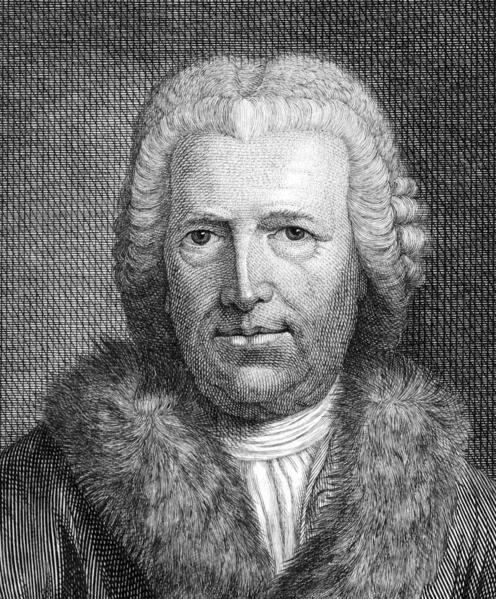
Bernhard Christoph*1 January 1628 Kołobrzeg, †14 November 1692 Dresden, German singer, composer and theorist. He was a student of P. Siefert and Ch. Werner in Gdańsk, and then of H. Schütz in Dresden. There, he was also a member of the court ensemble led by Schütz, initially as an alto, later as a tenor. To further his studies, he made two trips to Italy (1649, 1657). In Rome, he studied with G. Carissimi. After returning to his homeland, he took up the position of court kapellmeister in Dresden, but due to intrigues, he moved to Hamburg in 1644, where he became cantor at St James’s Church. In 1674, he was called back to Dresden to the position of deputy court kapellmeister, which he held until his death.
Bernhard was highly regarded by his contemporaries as a composer. He was considered a master of counterpoint. He composed mainly sacred music. As a theorist, he dealt with issues of compositional technique and singing practice; in his treatises, he discussed, among other things, the problems of using dissonances, figured bass, and the role of rhetoric in music.
Literature: J.M. Müller-Blattau Die Kompositionslehre H. Schützens in der Fassung seines Schülers Ch. Bernhard, Leipzig 1926, Kassel 2nd edition 1962 (contains Bernhard’s treatises); C. Dahlhaus Ch. Bernhard und die Theorie der modalen Imitation, “Archiv für Musikwissenschaft” XXI, 1964; H. Federhofer M. Scacchis “Cribrum Musicum” (1643) und die Kompositionslehre von Ch. Bernhard, in Festschrift for H. Engel, ed. H. Heussner, Kassel 1964; W. Braun Zwei Quellen für Ch. Bernhards und J. Theiles Satzlehren, “Die Musikforschung” XXI, 1968; F. Fiebig Ch. Bernhard und der “stile moderno”. Untersuchungen zu Leben und Werk, «Hamburger Beiträge zur Musikwissenschaft» XXII, Hamburg 1980; M. Ruhnke Gattungsbedingte Unterschiede bei der Anwendung musikalisch-rhetorischer Figuren, in: Gattung und Werk in der Musikgeschichte Norddeutschlands und Skandinaviens, ed. F. Krummacher and H.W. Schwab, «Kieler Schriften zur Musikwissenschaft» XXVI, Kassel 1982; D. Sheldon The Ninth Chord in German Theory, “Journal of Music Theory” XXVI, 1982; J. Markowsky Zwei für die Schütz-Analyse relevante musiktheoretische Quellen des 17. Jahrhunderts: J. Burmeisters “Musica poetica” und Ch. Bernhards “Tractatus compositionis augmentais”, in: Quellenkunde in Thüringen, ed. E. Lange, Bad Köstritz 1988; H. Federhofer Ch. Bernhards Figurenlehre und die Dissonanz, “Die Musikforschung” XLII, 1989; J. Lester A 17th-Century Publication Including Ch. Bernhards “Figurenlehre”, «Israel Studies in Musicology» V, 1990; B. Heyder Edel, sinnreich, hochgelehrt. Zum 300. Todestag von Ch. Bernhard, “Concerto” IX, 1992.
Compositions:
Geistlicher Harmonien erster Theil… for 2–5 voices and b.c., Op. 1, Dresden 1665
Letzter Schwanen-Gesang… for 4 voices, 2 violins, 3 violas and b.c., Hamburg 1667
Traur-Music… for 5 voices and b.c., Hamburg 1667
Letzter Ehren-Nachklang… for 4 voices, 2 violins, 3 violas and b.c., Hamburg 1669
Prudentia Prudentiana (Trauermusik), hymn, Hamburg 1669, lost
Geist- und Lehr-reiches Kirchen- und Hauss-Buch voller… Katechismus…, Dresden 1694
Hundert ahnmutig- und sonderbahr geistlichen Arien…, Dresden 1694
manuscripts:
masses
motets
cantatas
8 sonatas for transverse flute, violin, viola, and cello
Treatises:
Von der Singe-Kunst oder Manier, MS
Tractatus compositionis augmentatus, MS
Ausfuhrlicher Bericht vom Gebrauche der Con- und Dissonantien, MS
Editions:
Kantaty, ed. M. Seifert, «Denkmäler Deutscher Tonkunst» VI, 1901
mass Christ unser Herr zum Jordan kam, «Das Chorwerk» XVI, ed. R. Gerber, Wolfenbüttel 1932
concertos Fürchtet euch nicht, Jauchzet dem Herren alle Welt, ed. B. Grusnick, Kassel 1933, 1934
concertos Aus dem Tiefen ruf’ ich, Was betrübst du dich, ed. B. Grusnick, Kassel 1957
The Treatises of Ch. Bernhard, ed. and English transl. W. Hilse, “Music Forum” III, 1973